
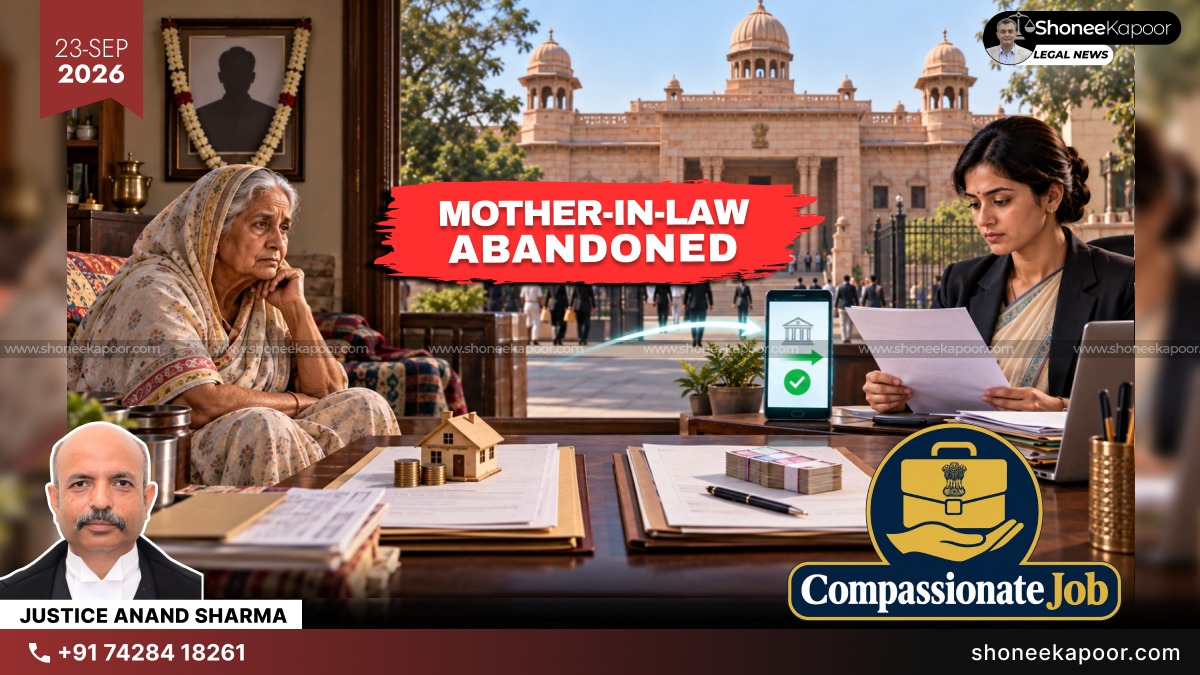
Wife Taking Compassionate Job After Husband’s Death, Can't Abandon His Dependent Parents: Rajasthan HC Orders 25% Salary To Mother-In-Law

Curated by NEWS DESK
Editorial DeskCan a widow take a compassionate job obtained after her husband’s death and then completely walk away from the responsibility of maintaining his dependent parents? The Rajasthan High Court said the benefit cannot be enjoyed while the family whose hardship formed its basis is left behind.
RAJASTHAN: The Rajasthan High Court has directed that 25% of a widow’s monthly salary from a compassionate appointment be deducted and paid directly to her mother-in-law after finding that she had stopped maintaining her deceased husband’s parents despite giving an undertaking to support the family.
Justice Anand Sharma was hearing a writ petition filed by Shri Choth Mal Verma and his wife, Smt. Kamli Devi. Their son, Subhash Chand Verma, was working as a Technical Helper with Ajmer Vidyut Vitran Nigam Limited (AVVNL) and died on 24 March 2017.
After his death, his widow applied for a compassionate appointment. Her parents-in-law gave their no objection, and she was appointed as an LDC on 30 August 2017. Importantly, she had also submitted an affidavit undertaking that she would maintain the other members of her deceased husband’s family.
However, the parents alleged that after securing the government job, their daughter-in-law stopped maintaining them, left the matrimonial home and later remarried. They told the Court that their deceased son had been the family’s sole breadwinner and that their other two sons were unemployed and unable to financially support them.
During the case, the father-in-law died, leaving the mother-in-law as the surviving petitioner. The widow argued that her in-laws had not treated her properly and that she had to leave their house. She also argued that her mother-in-law could be maintained by her two surviving sons and that she should not be forced to share her salary or the deceased employee’s terminal benefits. Her remarriage after obtaining the compassionate appointment was also admitted before the Court.
The Rajasthan High Court noted that a compassionate appointment is meant to provide financial support to the family after the sudden death of its breadwinner. The Court stressed that, in such circumstances, the family does not mean only the widow; it can also include the deceased employee’s parents and other family members recognised under the applicable rules.
The High Court relied upon its earlier decision in Bhagwan Singh Vs. Suptd Engineer Pawas, Ajmer Vidhut Vitran Nigam Limited, 2025 LiveLaw (Raj) 364, where a Coordinate Bench had discussed the responsibilities attached to a compassionate appointment.
Agreeing with those observations, the High Court allowed the writ petition and directed AVVNL to deduct 25% of Mamta Rani’s regular monthly salary and deposit it directly into her mother-in-law’s bank account. The arrangement will continue for the mother-in-law’s lifetime.
The Court further ordered AVVNL to release the deceased husband’s pending terminal benefits within 30 days. The Court directed that those benefits be divided equally between the widow and mother-in-law, giving the mother-in-law a 50% share.
EXPLANATORY TABLE OF LAWS AND SECTIONS
| Law / Provision | What It Means | Relevance To The Case |
|---|---|---|
| Rajasthan Compassionate Appointment of Dependents of Deceased Government Servants Rules, 1996 | Provides the framework for compassionate employment to eligible dependants of a deceased government employee to help the family overcome financial hardship. | The Court relied on the principle that compassionate employment is meant for the welfare of the deceased employee’s dependent family and is not merely an individual employment benefit. |
| Compassionate Appointment Scheme | A welfare mechanism intended to provide immediate financial assistance to a family affected by the death of its breadwinner. | Mamta Rani received employment following her husband’s death and after giving an undertaking to maintain other family members. |
| Undertaking/Affidavit to Maintain Dependants | An assurance given by the person seeking compassionate appointment that other dependent family members will be maintained. | The widow’s undertaking was central to the Court’s finding that she could not take the benefit and later completely disassociate herself from the corresponding obligation. |
| Bhagwan Singh Vs. Suptd Engineer Pawas, AVVNL, 2025 LiveLaw (Raj) 364 | Earlier Rajasthan High Court decision holding that compassionate employment carries responsibilities towards other surviving dependants. | The Court expressly agreed with and relied upon this precedent while granting relief to the mother-in-law. |
CASE DETAILS
| Particular | Details |
|---|---|
| Case Title | Shri Choth Mal Verma and Anr. v. Ajmer Vidyut Vitran Nigam Limited and Ors. |
| Court | High Court of Judicature for Rajasthan, Bench at Jaipur |
| Case No. | S.B. Civil Writ Petition No. 1203/2018 |
| Neutral Citation | 2026:RJ-JP:37767 |
| CNR | RJHC020254802018 |
| Bench | Hon’ble Mr Justice Anand Sharma |
| Judgment Date | 17 September 2026 |
| Petitioners’ Counsel | Mr Ramit Pareek, Advocate, with Ms Ujala Pareek, Advocate and Mr Kartik Sharma, Advocate |
| Respondent No. 3 Counsel | Mr Vidhut Kumar Gupta, Advocate |
| AVVNL Counsel | Mr Abhishek Sharma, Advocate, with Mr Rohit Thakar, Advocate |
| Result | Writ petition allowed; 25% of monthly salary to be paid to mother-in-law and 50% of terminal benefits awarded to her |
KEY TAKEAWAYS
- Husband’s death got her the job
The compassionate job came because her husband died and his family faced a financial crisis. His death created the benefit she received. - She took the job after promising to support his family
She gave an affidavit undertaking to maintain his family. The job came with responsibility, not just a salary. - Job secured, husband’s parents left behind
After getting the appointment, she moved out, remarried and stopped maintaining her deceased husband’s parents. - The court made her salary answer for that responsibility
The Rajasthan High Court ordered that 25% of her monthly salary be paid directly to her mother-in-law for her lifetime. - Husband’s mother also gets half his terminal benefits
The Court ordered 50% of the deceased husband’s terminal benefits to his mother, instead of leaving the entire benefit with the widow.
Share Your Thoughts
Comments are moderated before publication.