
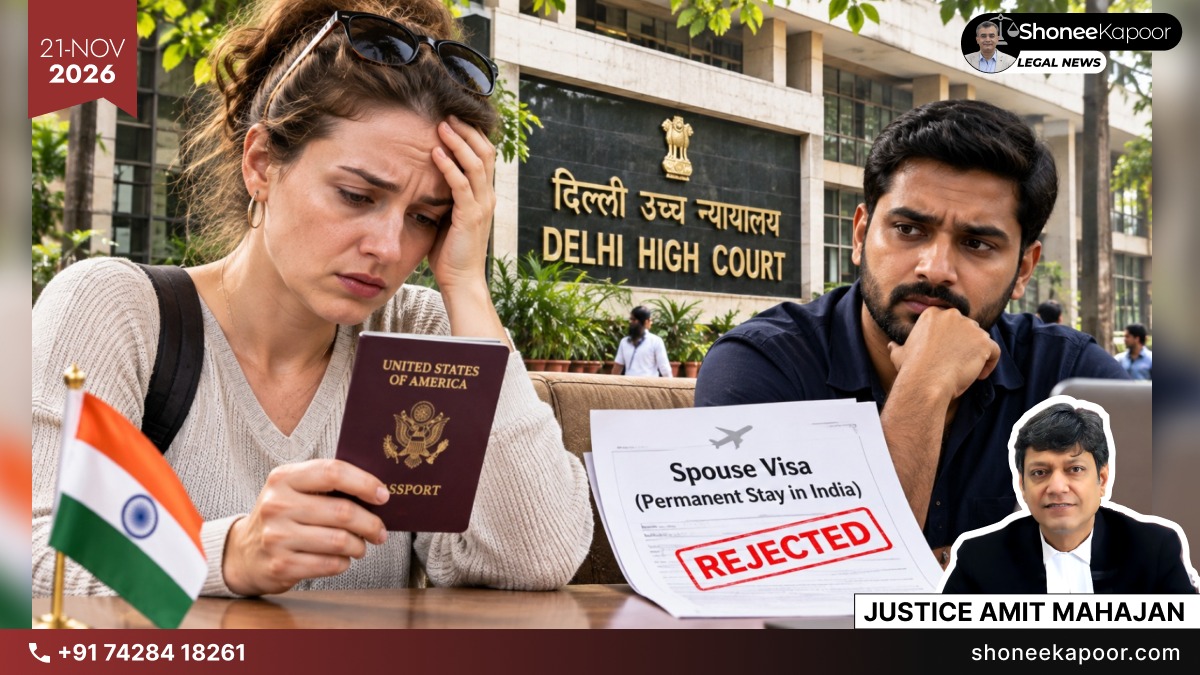
Marriage To Indian Does Not Guarantee Foreign Spouse Visa: Delhi High Court

Curated by NEWS DESK
Editorial DeskNEW DELHI: The Delhi High Court held that marrying an Indian citizen does not automatically give a foreign national the right to obtain a spouse visa or permanently reside in India, and dismissed a US woman's petition seeking conversion of her tourist visa.
Justice Amit Mahajan, in a judgment dated November 17, 2026, upheld the immigration authorities' scrutiny of the woman's matrimonial history and their suspicion that her latest marriage could have been entered into for immigration benefits.
Read Also:- Grounds for Divorce for NRI in Foreign Land
The petitioner, Lisa Hall Srivastava, claimed that she married Indian citizen Mohd. Wasim Akram on December 7, 2025, according to Muslim customs. Their marriage was subsequently solemnised under the Special Marriage Act, 1954, on March 18, 2026.
She applied to the Foreigners Regional Registration Office (FRRO) on March 27, 2026, seeking conversion of her e-Tourist Visa, valid until September 14, 2027, into an Entry (X-1) Spouse Visa.
However, she alleged that the authorities repeatedly questioned her and her husband over their age difference instead of granting the requested visa.
The Central Government opposed her petition, explaining that the investigation was based not merely on the couple's age difference but on her previous marriages, immigration history, and financial circumstances.
Read Also:- Validity of Foreign Decree of Divorce in India
According to the authorities, the woman had earlier married George Daniel Williamson, an Overseas Citizen of India (OCI) cardholder, through whom she obtained OCI status.
After their marriage ended in July 2021, her OCI status was cancelled in November 2023.
She subsequently married Deepak Srivastava in December 2022 and again sought immigration benefits based on that relationship. However, her applications were unsuccessful due to deficiencies in supporting documents, and the second marriage ended in November 2025.
The authorities pointed out that her marriage to Mohd. Wasim Akram was her third matrimonial relationship.
Read Also:- Validity of Foreign Decree of Divorce in India
They also informed the Court that she had been living as a tenant in property owned by her present husband even before their marriage.
Significantly, the records indicated that Akram had accompanied her while she was seeking immigration benefits through her previous marriage.
Considering these circumstances, the immigration authorities suspected that the latest marriage could be a marriage of convenience, potentially involving financial or contractual arrangements to obtain immigration benefits.
Accepting the Government's explanation, the High Court observed:
“This Court finds that the explanation furnished by the Respondents in the Counter Affidavit is satisfactory and the suspicion is well-founded.”
The Court clarified that a foreign national cannot demand an automatic right to enter or continue living in India merely because of marriage to an Indian citizen.
Justice Mahajan observed:
“The mere fact that the Petitioner has entered into a marriage with an Indian citizen does not, by itself, confer an automatic or indefeasible right to conversion of her existing visa into an Entry (X-1) Visa.”
Referring to the Immigration and Foreigners Act, 2025, the Court held that visa approvals, extensions and conversions fall within the powers of the competent immigration authorities.
The High Court also relied on the Supreme Court's judgment in Louis De Raedt v. Union of India (1991), which recognised that foreigners enjoy constitutional protection of life and liberty under Article 21, but cannot claim the right to settle in India under Article 19(1)(e).
The Court further referred to Randa Chehab v. Union of India (2023), reiterating that a foreign national's entry and stay in India are matters of sovereign discretion.
Importantly, the High Court noted that the woman's Indian husband had not filed an affidavit supporting her claims regarding their marriage, cohabitation and surrounding circumstances.
However, the Court clarified that the absence of his affidavit alone could not establish whether the marriage was genuine.
The High Court also refused to replace the immigration authorities' assessment with its own findings, observing:
“Even otherwise, it is not the function of this Court, in exercise of judicial review, to substitute its own assessment for that of the competent authority in a matter concerning admission of a foreign national.”
The woman had also sought protection against deportation, a personal hearing and ₹5 lakh compensation for alleged harassment and financial losses.
Ultimately, the Delhi High Court dismissed her petition, holding that a valid marriage certificate does not automatically establish eligibility for a spouse visa.
However, the Court specifically clarified that it had not declared the marriage fake or invalid. Its findings were limited to the woman's immigration claim and the authorities' examination of her application.
The Court also directed that any pending or future representation submitted by the woman must be considered by the competent authorities in accordance with law.
EXPLANATORY TABLE OF LAWS AND SECTIONS
| Law / Section | What It Means | Application In This Case |
|---|---|---|
| Article 226, Constitution | Gives High Courts writ jurisdiction. | Woman challenged the immigration authorities' actions. |
| Article 14, Constitution | Guarantees equality before the law and equal protection of the laws. | Petitioner alleged arbitrary treatment. |
| Article 21, Constitution | Protects life and personal liberty. | The woman relied on her rights concerning marriage, dignity, and residence. |
| Article 19(1)(e), Constitution | Gives Indian citizens the right to reside and settle anywhere in India. | Court held that foreigners cannot claim this right. |
| Special Marriage Act, 1954 | Provides for civil solemnisation of marriages. | Marriage certificate did not guarantee spouse visa approval. |
| Immigration and Foreigners Act, 2025 | Regulates entry, stay and departure of foreigners. | Authorities could examine visa eligibility and surrounding circumstances. |
| Entry (X-1) Visa | Visa category applicable to eligible foreign spouses of Indian citizens. | Woman sought conversion from her e-Tourist Visa. |
CASE DETAILS
| Particular | Details |
|---|---|
| Case Title | Lisa Hall Srivastava v. Union of India & Anr. |
| Court | Delhi High Court, New Delhi |
| Bench | Justice Amit Mahajan |
| Judgment Date | November 17, 2026 |
| Neutral Citation | 2026:DHC:10234 |
| Case Number | W.P.(C) 7554/2026 |
| CNR Number | DLHC010248312026 |
| Connected Applications | CM APPL. 36558/2026 and CM APPL. 38483/2026 |
| Petitioner's Counsel | Mr. Zahied F. Chouhan, Ms. Iqura Khan, Ms. Nida Parveen and Mr. Kunwar Sultan Ali |
| Respondents' Counsel | Ms. Avshreya Pratap Singh Rudy, CGSC, with Ms. Usha Jamnal, Ms. Nyasa Sharama, Mr. Abhinav Mall, Ms. Nishtha Dhall and Ms. Harshita Chaturvedi |
| Visa Application Date | March 27, 2026 |
| Authority Concerned | FRRO, Delhi |
| Final Decision | Petition dismissed; spouse visa conversion not ordered |
KEY TAKEAWAYS
- Marriage Is Not A Visa Guarantee: Marrying an Indian citizen does not automatically entitle a foreign spouse to reside in India.
- Husband's Marriage Under Scrutiny: Immigration authorities questioned the genuineness of the woman's third marriage after examining her previous relationships and visa history.
- Husband's Affidavit Matters: The Indian husband's failure to submit an affidavit supporting the marriage was noted, though it did not prove the marriage was fake.
- Marriage Certificate Is Not Enough: Even a legally registered marriage cannot prevent immigration authorities from examining possible misuse of visa provisions.
- Marriage Must Not Become An Immigration Shortcut: Genuine marriages deserve protection, but matrimonial relationships should not be used merely to obtain immigration benefits.
Share Your Thoughts
Comments are moderated before publication.