
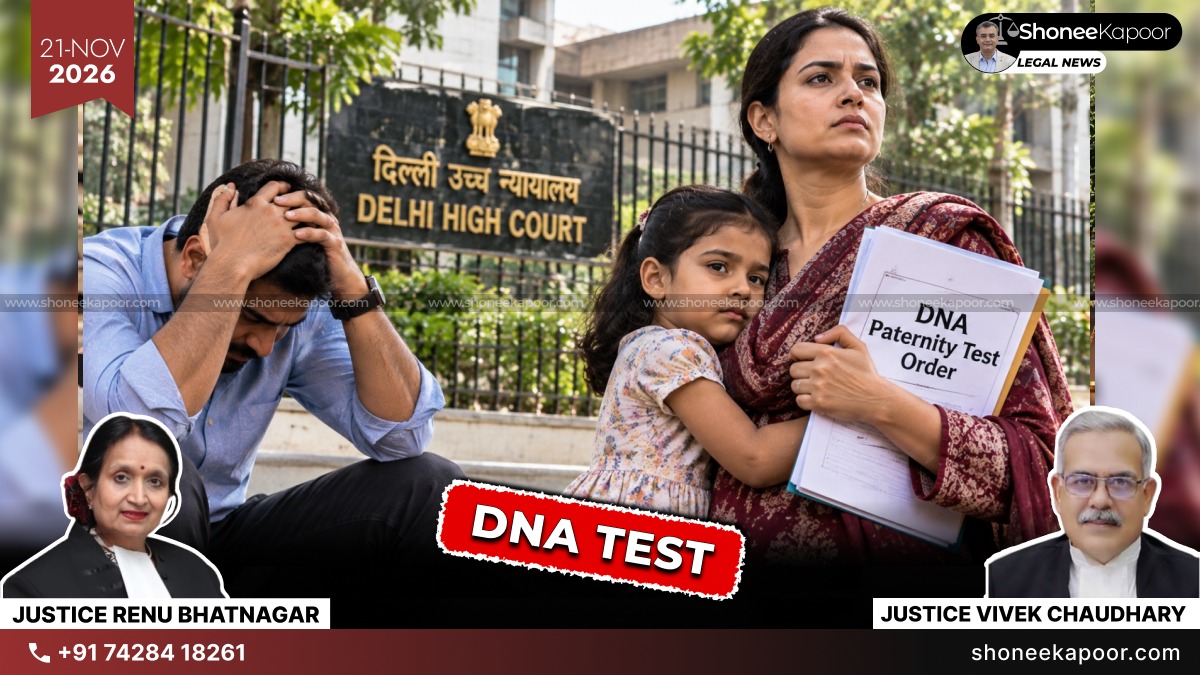
Father Can Refuse DNA Paternity Test Citing Right To Privacy? Delhi High Court Answers

Curated by NEWS DESK
Editorial DeskNEW DELHI: The Delhi High Court has upheld a Family Court order directing a man to undergo a DNA paternity test, holding that a child's right to know her biological father can outweigh the alleged father's right to privacy in appropriate circumstances.
A Division Bench of Justice Vivek Chaudhary and Justice Renu Bhatnagar dismissed an appeal filed by Men, who challenged the DNA test sought by Women and her daughter.
The woman claimed that she married Vinod Kumar on 5 June 1997 and lived with him in Delhi and Gujarat. She alleged that they lived together again between November 2009 and July 2010, during which she conceived a daughter born on 10 March 2011.
However, the man denied the marriage, any relationship with the woman and the child's paternity. He maintained that he had been married to another woman since 1999 and had two children from that marriage.
In 2010, the woman filed proceedings seeking restitution of conjugal rights and maintenance. Both petitions were dismissed in April 2012 because she failed to prove the alleged marriage. The High Court upheld those findings in August 2012.
During those proceedings, the man had initially agreed to undergo DNA testing and even filed an application seeking the test. However, the application was never decided.
The woman and her daughter subsequently filed a separate suit seeking a declaration of biological paternity. On 31 August 2024, the Rohini Family Court directed DNA testing, holding that failure to prove marriage did not automatically defeat the child's independent right to establish parentage.
The man challenged the direction, arguing that the previous judgments had become final, insufficient evidence supported the woman's claims, and compulsory testing would violate his privacy.
The High Court rejected these arguments, observing that the earlier cases concerned the woman's marital status, not the daughter's paternity. The child was not a party to those proceedings.
The Bench also noted that the woman's testimony regarding cohabitation during the period of conception remained unchallenged in cross-examination. The man had not entered the witness box to rebut that evidence.
Importantly, the Court distinguished cases where husbands seek DNA tests to establish their wives' alleged adultery from cases where identifying the biological father is the main issue.
Referring to the Supreme Court's decision in Aparna Ajinkya Firodia v. Ajinkya Arun Firodia, the Bench explained that DNA testing cannot be ordered routinely to investigate adultery during divorce proceedings. However, testing may be justified where biological paternity itself must be determined and other evidence is insufficient.
The Court further held that merely drawing an adverse inference against a person refusing DNA testing cannot replace reliable scientific evidence where testing is necessary.
On the privacy objection, the Bench relied on constitutional principles recognising that privacy is a fundamental but not absolute right. It found that the child's interest in establishing her biological identity carried greater weight in the particular circumstances.
The Court also observed that DNA testing could establish the man's non-paternity if his denial was correct, thereby resolving the dispute through scientific evidence rather than allegations.
The High Court accordingly dismissed the man's appeal and directed the Family Court to arrange DNA sample collection at BSA Hospital at the earliest.
The Bench ordered confidential collection of samples and directed that the DNA report be submitted to the Family Court in a sealed cover. It also permitted the Family Court to take lawful steps to secure compliance if the man failed to appear.
EXPLANATORY TABLE OF LAWS AND SECTIONS
| Law / Section | What It Means | Application In This Case |
|---|---|---|
| Section 9, Hindu Marriage Act, 1955 | Restitution of conjugal rights. | Woman's earlier petition was dismissed because marriage was not proved. |
| Section 125 CrPC | Maintenance for eligible wives, children and parents. | Woman's personal maintenance petition was dismissed. |
| Section 112, Indian Evidence Act, 1872 | Presumption of legitimacy for children born during a valid marriage. | Court held this presumption did not arise because marriage was not established. |
| Section 116, Bharatiya Sakshya Adhiniyam, 2023 | Corresponding provision concerning legitimacy of children. | Referred to as the successor to Section 112. |
| Section 114, Indian Evidence Act, 1872 | Permits certain factual presumptions, including adverse inferences. | Court held adverse inference could not adequately replace necessary DNA evidence. |
| Article 21, Constitution of India | Protects life, personal liberty and privacy. | Man's privacy objection was balanced against the child's interest in establishing parentage. |
CASE DETAILS
| Particular | Details |
|---|---|
| Case Title | V v. S & Anr. |
| Court | Delhi High Court |
| Bench | Justice Vivek Chaudhary and Justice Renu Bhatnagar |
| Judgment Date | 20 November 2026 |
| Reserved On | 17 August 2026 |
| Neutral Citation | 2026:DHC:10283-DB |
| Case Number | MAT.APP.(F.C.) 133/2025 |
| Application | CM APPL. 19386/2025 |
| CNR Number | DLHC010183952025 |
| Family Court Case | CS No. 55923/2016 |
| Appellant's Counsel | Ms. Archana Gaur (DHCLSC), Ms. Ridhima Gaur and Mr. Deepu Kumar |
| Respondents' Counsel | Ms. Kamlakshi Singh (DHCLSC) |
| Family Court Order | 31 August 2024 |
| Final Decision | Appeal dismissed; DNA test direction upheld |
KEY TAKEAWAYS
- Man's Privacy Overruled: Delhi High Court upheld compulsory DNA testing, prioritising the child's right to know her biological father.
- Different Standards For Fathers? Courts impose strict safeguards when husbands seek DNA tests to question paternity, but allowed testing against an alleged father in this case.
- Marriage Not Proved, DNA Test Still Ordered: Despite the woman's earlier failure to establish marriage, the child's independent paternity claim remained valid.
- DNA Test Can Also Prove Innocence: Scientific evidence may establish that the accused man is not the biological father, protecting him against an incorrect paternity claim.
- Men's Privacy Deserves Equal Protection: A child's welfare matters, but a man's bodily autonomy and privacy must receive the same serious consideration as those of women and children.
Share Your Thoughts
Comments are moderated before publication.