
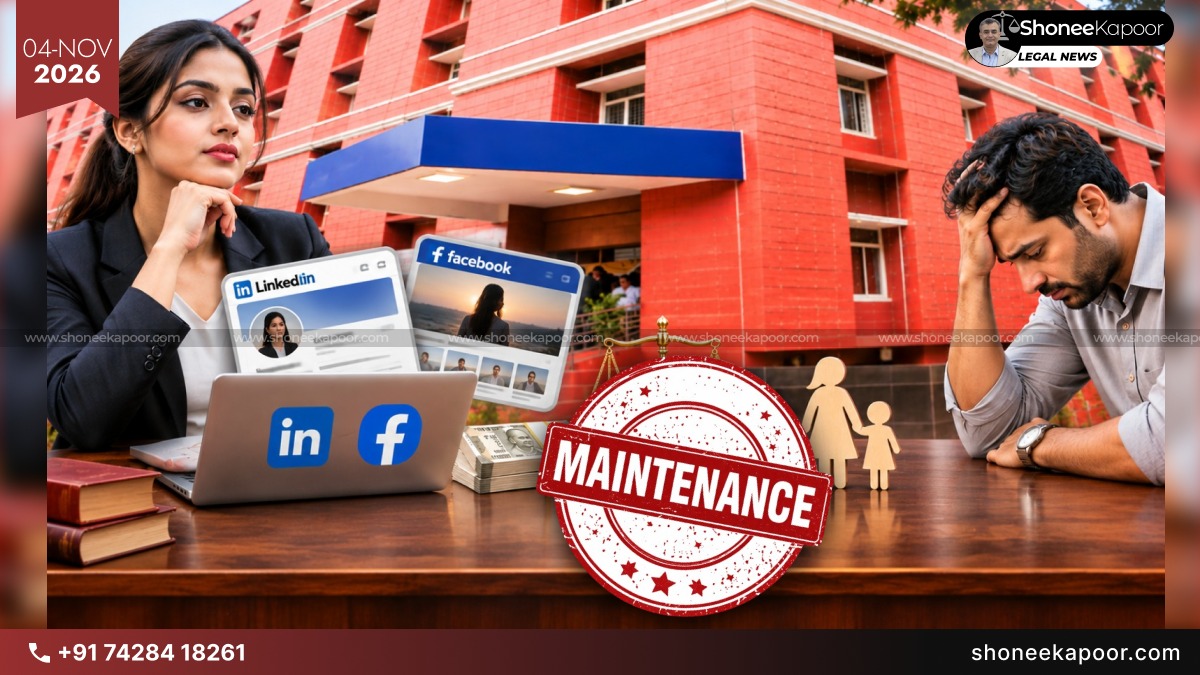
Can A Wife’s LinkedIn Profile Prove Financial Independence? Bengaluru Court Orders Husband To Pay ₹20,000 Monthly Maintenance

Curated by NEWS DESK
Editorial DeskKARNATAKA: A Bengaluru Sessions Court has ruled that a wife's LinkedIn profile, Facebook photographs and educational qualifications cannot automatically prove that she is financially independent or justify denying her maintenance claim.
Additional Sessions Judge Mohan Prabhu allowed the wife's appeal and directed the husband to pay ₹20,000 monthly maintenance, holding that the evidence produced by him failed to establish her actual income.
The couple married in Bengaluru in 2014 and later moved to the United States, where the husband worked as an engineer. They had a son before matrimonial disputes arose between them.
In November 2017, the wife returned to India with their child and began living with her parents. She later filed a domestic violence case under the Protection of Women from Domestic Violence Act, 2005, alleging physical, psychological and financial abuse.
In April 2025, the Magistrate Court awarded ₹15,000 monthly child maintenance, ₹1.6 lakh annually towards educational expenses and ₹8 lakh compensation to the wife.
However, the Magistrate rejected the wife's separate maintenance claim, considering her educational qualifications and earning capacity.
Both the husband and wife challenged the order before the Bengaluru Sessions Court.
The husband argued that his wife was working in a private company and was financially capable of maintaining herself. To support his claim, his counsel produced LinkedIn profile details, Facebook photographs and other pictures.
The Sessions Court recorded:
“The trial court records show that while addressing the arguments, the learned counsel for the respondent has produced certain photographs, LinkedIn profile and Facebook profile photos, and contended that the petitioner is working,”
However, the Court found that these social media documents did not establish the wife's actual employment or income. It also noted that the documents were produced only during arguments.
The Court observed:
“The learned magistrate rightly held that the documents produced by the learned counsel for the respondent at the time of arguments cannot be relied,”
The Court further explained that even if the wife had secured employment, it would not automatically mean that she earned enough to support herself and her minor child.
It stated:
“Even if it is presumed that the petitioner has joined some job, then also it cannot be held that the petitioner is having sufficient income so as to maintain herself and her child,”
While examining the financial status of both spouses, the Sessions Court noted that the wife was unemployed when she filed the domestic violence complaint.
Significantly, the husband's own statement of assets and liabilities did not mention any employment, income or income-generating property belonging to the wife.
The Court clarified that educational qualifications, earning capacity and actual income are different factors. Merely being educated or capable of working does not automatically establish financial independence.
The Court also considered the responsibilities of a parent raising a minor child.
It observed:
“The mother who has custody of child not only has to spend money on the upbringing of the child but also spending substantial time and efforts in bringing up the child. We cannot calculate the same in terms of money,”
The Sessions Court also referred to economic abuse under the Domestic Violence Act, which includes deprivation of financial resources in circumstances covered by the law.
Accordingly, the Bengaluru Sessions Court allowed the wife's appeal and directed the husband to pay ₹20,000 per month as maintenance, reversing the Magistrate's earlier refusal to grant her separate maintenance.
EXPLANATORY TABLE OF LAWS AND SECTIONS
| Law / Section | What It Means | Application in This Case |
|---|---|---|
| Protection of Women from Domestic Violence Act, 2005 | Provides legal remedies against domestic violence, including financial relief and compensation. | Wife filed proceedings alleging physical, psychological and financial abuse. |
| Section 3, DV Act | Defines domestic violence, including economic abuse. | Court discussed economic abuse and financial deprivation. |
| Section 20, DV Act | Allows monetary relief, including maintenance and expenses arising from domestic violence. | Relevant to the maintenance awarded to the wife and child. |
| Section 22, DV Act | Provides for compensation and damages for injuries arising from domestic violence. | Relevant to the Magistrate's ₹8 lakh compensation award. |
| Section 29, DV Act | Provides for appeals against Magistrate's orders to the Sessions Court. | Both parties challenged the Magistrate's order. |
CASE DETAILS
| Particular | Details |
|---|---|
| Case Title | Wife v. Husband |
| Court | Bengaluru Sessions Court, Karnataka |
| Presiding Judge | Additional Sessions Judge |
| Original Court | Magistrate Court, Bengaluru |
| Original Order | April 2025 |
| Child Maintenance | ₹15,000 per month awarded by the Magistrate |
| Child's Educational Expenses | ₹1.6 lakh annually awarded by the Magistrate |
| Compensation to Wife | ₹8 lakh awarded by the Magistrate |
| Wife's Monthly Maintenance | ₹20,000 ordered by the Sessions Court |
| Evidence Produced by Husband | LinkedIn profile, Facebook photographs and other photographs |
| Final Decision | Wife's appeal allowed; separate monthly maintenance granted |
KEY TAKEAWAYS
- ₹20,000 Maintenance Ordered: Bengaluru Court directed the husband to pay monthly maintenance to his wife.
- LinkedIn Not Enough: Husband's evidence from LinkedIn and Facebook failed to prove the wife's actual income.
- Educated Wife Can Claim Maintenance: Educational qualifications and earning capacity alone cannot justify denying maintenance.
- Husband's Financial Burden: The Court considered the wife's childcare responsibilities while determining maintenance.
- Proof Matters, Not Allegations: Husbands must produce reliable evidence of the wife's actual earnings to effectively contest maintenance claims.
Share Your Thoughts
Comments are moderated before publication.