
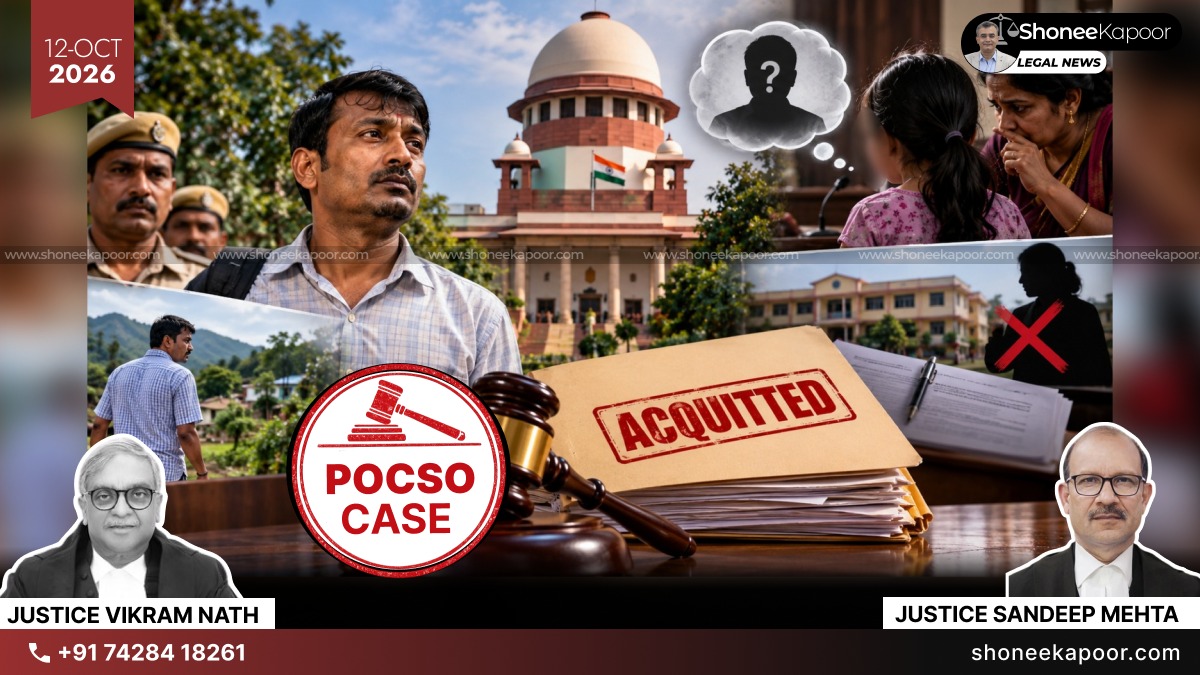
POCSO Case | Supreme Court Acquits Man Over Victim's Failure To Identify Him In Court And Unexplained Delay In FIR

Curated by NEWS DESK
Editorial DeskNEW DELHI: The Supreme Court of India has acquitted a man convicted under Section 6 of the POCSO Act, after finding that the prosecution failed to establish his guilt beyond reasonable doubt.
A Division Bench of Justice Vikram Nath and Justice Sandeep Mehta, in its judgment dated October 9, 2026, set aside the man's 10-year rigorous imprisonment, observing that the victim and a key witness failed to identify him, while serious contradictions and missing evidence made the conviction unsafe.
Read Also:- What is POCSO act and how is it interpreted by Indian Courts
The case arose from allegations that the accused sexually assaulted an 11-year-old girl with 40% intellectual disability at her residence in Meghalaya on May 28, 2015.
The victim's mother lodged an FIR on June 8, 2015, nearly 10 days after the alleged incident. On December 7, 2021, the Special POCSO Court convicted the man and sentenced him to 10 years' rigorous imprisonment and a Rs. 1 lakh fine. The Meghalaya High Court upheld his conviction on March 29, 2022.
The accused challenged the conviction before the Supreme Court, arguing that the prosecution had failed to establish his identity as the offender and that important defence evidence had been ignored.
During cross-examination, the victim's cousin admitted that she could not recognise the accused and that his name had been supplied by the victim's mother.
She stated:
“I do not know the accused person and cannot recollect his face now. PW1 told me the accused's name. PW1 told me that U Char committed the crime when I went to inform her in the morning. If this person, U Char, comes to my house, I will not be able to recognise him. I do not know how PW1 knows U Char committed the crime. I never attended school.”
The victim also admitted that she could not remember the alleged offender's face and that the Special Public Prosecutor had instructed her on what to say in court.
The Supreme Court noted her statement:
“Before coming to the courtroom today I had met the Special Prosecutor. The Special Prosecutor had told me what to say before this Court today.”
The Court found that these admissions raised serious doubts about the reliability of the prosecution evidence, particularly regarding the identity of the accused.
It further noted that the prosecution failed to examine the schoolteacher whose disclosure allegedly prompted the FIR. The victim's mother had also omitted important facts from the original complaint, while the defence was denied an effective opportunity to cross-examine two medical witnesses.
The Court rejected the State's attempt to shift the burden of proof onto the accused merely because he was allegedly seen in a garden near the victim's house.
Importantly, the Supreme Court found that the accused had produced credible evidence supporting his claim that he was in another village for a property transaction at the relevant time. However, both lower courts wrongly dismissed this defence.
The Court held that the cumulative effect of the delayed FIR, contradictory statements, failure to identify the accused, missing material witness and credible defence evidence made the conviction unsustainable.
Accordingly, the Supreme Court set aside the trial court and Meghalaya High Court judgments, acquitted the man by granting him the benefit of doubt, and directed his immediate release from custody if he was not required in any other case.
EXPLANATORY TABLE OF LAWS AND SECTIONS
| Law / Section | What It Means | Relevance in This Case |
|---|---|---|
| Section 6, POCSO Act, 2012 | Prescribes punishment for aggravated penetrative sexual assault against children. | Rupon was convicted under this provision. The Supreme Court set aside his conviction. |
| Section 161 CrPC | Allows police to examine witnesses during an investigation. | Statements of prosecution witnesses were recorded during investigation. |
| Section 164 CrPC | Allows a Magistrate to record statements during investigation. | Earlier statements of the victim and her cousin were examined in the proceedings. |
| Section 173(2) CrPC | Governs submission of the police report after investigation. | The chargesheet was filed under this provision. |
| Section 313 CrPC | Gives an accused an opportunity to explain evidence appearing against him. | Rupon denied the allegations and claimed innocence. |
| Section 106, Indian Evidence Act, 1872 | Concerns the burden of proving facts especially within a person's knowledge. | The Court rejected the State's argument for shifting the burden onto Rupon. |
| Section 11, Indian Evidence Act, 1872 | Makes certain facts relevant when they affect the probability or improbability of facts in issue. | Discussed through a precedent concerning important omissions in an FIR. |
CASE DETAILS
| Particular | Details |
|---|---|
| Case Title | C v. State of Meghalaya |
| Case Number | Criminal Appeal arising out of SLP (Crl.) No. 11881 of 2022 |
| Neutral Citation | 2026 INSC 1102 |
| Court | Supreme Court of India |
| Bench | Justice Vikram Nath and Justice Sandeep Mehta |
| Judgment Date | October 9, 2026 |
| Appellant | Charming Rupon |
| Respondent | State of Meghalaya |
| Counsel for Appellant | Senior Advocate Gaurav Agrawal |
| Counsel for Respondent | Advocate General Amit Kumar |
| Result | Appeal allowed; POCSO conviction and 10-year sentence set aside; accused acquitted with direction for release, subject to any other case. |
KEY TAKEAWAYS
- 10-Year Sentence Overturned: A man faced a serious POCSO conviction that the Supreme Court ultimately found unsustainable.
- Accused Not Identified: Neither the victim nor her cousin could identify the man in court. Both said the victim's mother gave him the name.
- Prosecution Evidence Questioned: The victim admitted being instructed by the prosecutor, while a crucial teacher was never examined.
- Man's Defence Ignored: Both lower courts wrongly brushed aside credible alibi evidence supporting the accused.
- 10-Year Sentence, Prosecution Failed: The Supreme Court acquitted the man after finding serious gaps in the evidence. His conviction raises serious questions about how unreliable evidence was allowed to put his liberty at stake.
Share Your Thoughts
Comments are moderated before publication.