
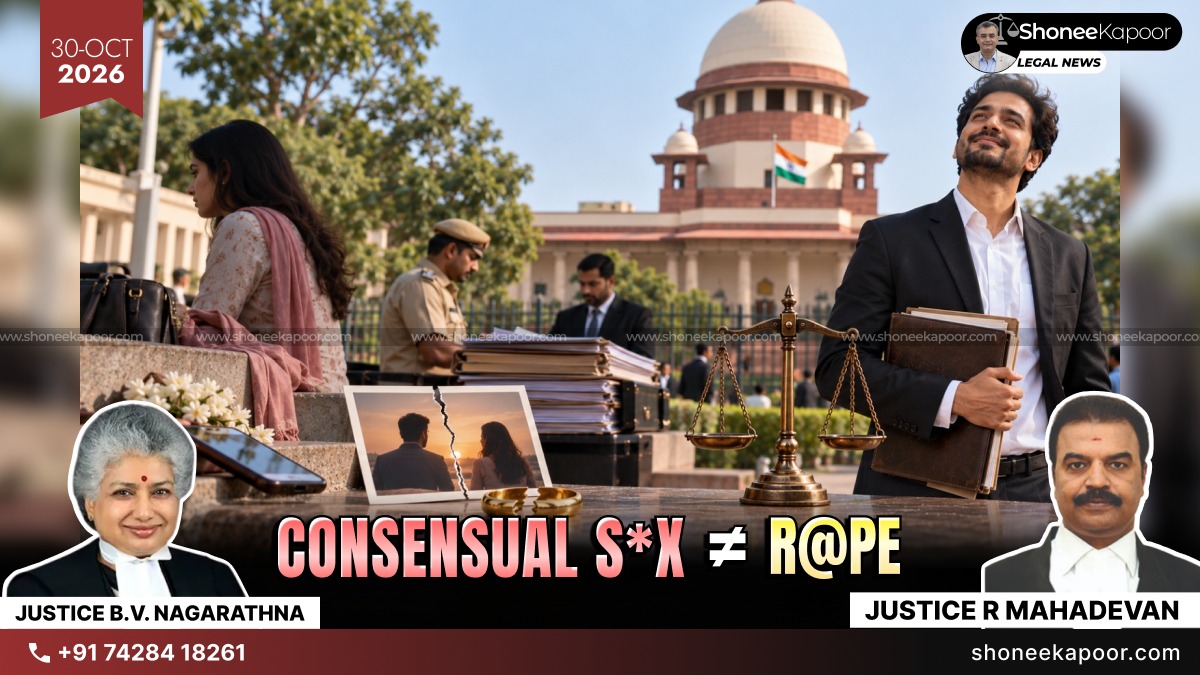
Failed Consensual Relationships Cannot Be Turned Into False Rape Cases & Trap Men Indefinitely: Supreme Court Raises Concern

Curated by NEWS DESK
Editorial DeskNEW DELHI: The Supreme Court of India has raised serious concerns over rape allegations filed after the breakdown of consensual relationships, clarifying that a failed relationship cannot automatically turn past consensual sexual acts into a criminal offence.
A bench of Justice B.V. Nagarathna and Justice R. Mahadevan made these observations while discharging a man accused of rape on the alleged false promise of marriage.
The Court highlighted a “disturbing trend in recent years” where consensual relationships are later scrutinised to find grounds for criminal prosecution following a breakup.
The judges distinguished between consent obtained through a “mirage of deceit and falsehood at the outset,” and an “experience of regret for having consented to past sexual acts owing to the later demise of the relationship."
The Supreme Court explained that regret after a breakup “cannot constitute a consensual relationship as a crime” and cannot justify criminal proceedings merely because the relationship has ended.
Importantly, the Court observed that treating every failed relationship as a potential rape case “denudes the man of any agency entirely,” effectively denying men the freedom to end consensual relationships without fearing criminal allegations.
The judgment emphasised that consent, deception and dishonest intention behind a marriage promise must be carefully examined. A breakup alone does not prove that a man entered a relationship with fraudulent intentions.
The Supreme Court also recognised that criminalising failed consensual relationships could undermine genuine rape complaints and expose accused men to serious consequences affecting their liberty, dignity and reputation.
The Supreme Court further stated:
“Such an approach denudes the man of any agency entirely as the mere factor of being in a consensual relationship at one point would bind him to it entirely for fear of being accused of rape at a subsequent point of time. In such a scenario can it be said that the man has no right to withdraw from the relationship? Can the decision be termed as deceit or fraud? Clearly not,”
The bench held that physical intimacy during a consensual relationship cannot be retrospectively branded as [an] act of rape merely because the relationship soured and no longer subsists.
The Court cautioned against using rape laws to criminalise failed relationships, observing that Rape being a heinous offence, must be reserved for situations where there is real sexual violence, coercion or manipulation of consent.
It further warned that turning every failed relationship into a rape allegation dilutes the gravity of the offence alleged or rather negates the very allegation of crime.
However, the judges also acknowledged that rape “strikes at the core of a woman's bodily autonomy and dignity.” Genuine complaints “must be pursued with rigour where facts clearly show sexual assault and violence.”
EXPLANATORY TABLE OF LAWS AND SECTIONS
| Law / Section | What It Means | Application in This Case |
|---|---|---|
| Section 375 IPC | Defines rape, including circumstances involving consent obtained under a misconception of fact. | Relevant to the legal distinction between valid consent and consent allegedly obtained through deception. |
| Section 376 IPC | Prescribes punishment for rape. | Relevant to the rape allegation discussed in the judgment. |
| Section 90 IPC | Explains when consent given under fear or misconception of fact is not legally valid. | Relevant to determining whether consent was obtained through deception from the beginning. |
| Section 69 BNS | Punishes sexual intercourse by deceitful means or a promise to marry made without intending to fulfil it, where the act does not amount to rape. | Relevant to the broader legal issue, but not confirmed as a charge in this case. |
CASE DETAILS
| Particular | Details |
|---|---|
| Case Title | Santhosh Kumar N.P. v. State–Station House Officer & Anr. |
| Court | Supreme Court of India |
| Bench | Justice B.V. Nagarathna and Justice R. Mahadevan |
| Case Number | SLP (Crl.) Nos. 10173–10174/2025 |
| Diary Number | 33755/2025 |
| Decision Reported | Man discharged from rape charges arising from an alleged false promise of marriage |
KEY TAKEAWAYS
- Breakup Is Not Rape: A woman cannot turn a consensual relationship into a rape case simply because the man refused to continue it.
- Men Are Not Relationship Prisoners: No man should be forced to stay with a woman under the threat of criminal prosecution.
- Regret Is Not Rape: A woman's change of mind cannot retrospectively criminalise a man's past consensual acts.
- Rape Laws Are Not Revenge Weapons: Criminal law must punish genuine sexual offences, not become a tool to settle scores after breakups.
- Men's Freedom Is Not Negotiable: A woman has every right to end a relationship. A man deserves the same freedom without facing criminal allegations merely for walking away.
Share Your Thoughts
Comments are moderated before publication.