
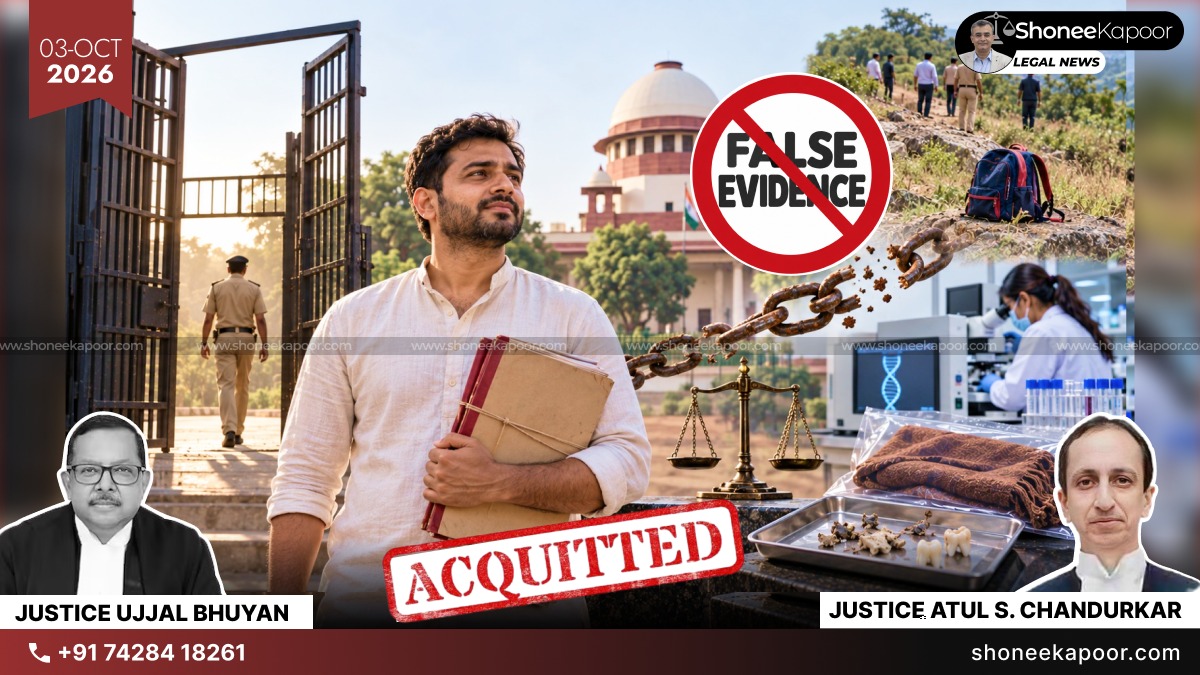
Rape-Murder Case | Man Convicted for Female Child Victim Even Though DNA & Recovered Bones Were Male? Supreme Court Acquits Him

Curated by NEWS DESK
Editorial DeskNEW DELHI: The Supreme Court has acquitted Man, who had been convicted of raping and murdering his minor maternal niece, after finding serious gaps in the prosecution's circumstantial, forensic and DNA evidence.
A Division Bench of Justice Ujjal Bhuyan and Justice Atul S. Chandurkar allowed the appeal on 1 October 2026 and set aside the conviction and life imprisonment upheld by the Sikkim High Court. The Court found that the prosecution had failed to establish Gurung's guilt beyond reasonable doubt.
The case arose from the disappearance of the minor child on 6 November 2013. According to the prosecution, Gurung had asked his maternal niece to accompany him when he went to purchase vegetables. His mother did not permit him to take the child. Later, both Gurung and the child were found missing.
A missing report was lodged on 12 November 2013. Police traced Gurung several months later in Siliguri. An FIR was registered on 13 May 2014, after the prosecution alleged that Gurung had admitted while being brought back that he had raped the child and then throttled her.
The child's body was never recovered. The prosecution relied upon alleged last-seen evidence, recovery of articles, bones and teeth, DNA evidence, FSL reports, a brown shawl and Gurung's statement under Section 313 CrPC.
The Sessions Court convicted him on 20 April 2016 under Sections 376(2)(i), 302 and 201 IPC, along with Sections 4 and 6 of the POCSO Act, and sentenced him to life imprisonment. The Sikkim High Court later upheld the conviction.
Before the Supreme Court, Gurung's counsel Sangeeta Kumar argued that the conviction rested on an incomplete chain of circumstances. She pointed out that prosecution witnesses could not reliably establish that Gurung was actually last seen leaving with the child. She also questioned the recovery of articles from an area accessible and visible to people and relied upon the forensic and DNA findings that failed to connect Gurung with the alleged crime.
The State of Sikkim, represented by Sameer Abhyankar, defended the concurrent conviction and argued that the circumstances, when read together, pointed towards Gurung's guilt. The State also relied upon his answers under Section 313 CrPC.
The Supreme Court, however, found that the prosecution's chain of circumstances was "broken at various places."
While discussing the danger of conviction purely on circumstantial evidence, the Court referred to Hanumant v. State of Madhya Pradesh and the warning that
"conjecture or suspicion may take the place of legal proof."
The Court found serious weakness in the prosecution's last-seen theory. The victim's grandmother was unsure whether Gurung and the child had left together or separately. The Head Constable and Investigating Officer also admitted that no witness had actually seen Gurung taking the child away.
Referring to the settled law governing last-seen evidence, the Court stressed that such a theory becomes stronger when the time gap is so narrow that intervention by another person becomes improbable. Here, there was a gap of about six months between the child's disappearance and the recovery of the alleged skeletal material.
Read Also:- Section 376 Ipc Judgements
The Court also examined the alleged recovery under Section 27 of the Indian Evidence Act, 1872. Witnesses admitted that the location was near an old road and footpath, was visited by cattle herders and people collecting fodder, and was easily visible.
The Court reiterated that the important question is "whether it was ordinarily visible to others." Since the recovery spot was ordinarily visible and frequented by people, the recovery required careful scrutiny.
The most significant problem arose from the DNA report. The recovered bone fragments were scientifically identified as being of "human male origin". They were also not biologically related to the blood samples taken from the victim's mother and sister.
The victim was female.
The Supreme Court therefore found that the prosecution had failed to establish that the recovered bones and teeth belonged to the child. The Court specifically noted that the bones were male in origin while the victim was female, making the DNA report incapable of supporting the prosecution's case.
The FSL evidence also failed to strengthen the case. The expert could not determine whether dried blood found on the brown shawl was human or animal blood. The soil sample also did not show any human remains.
The prosecution's reliance on the brown shawl also became doubtful because it could not reliably establish ownership, and no witness had seen Gurung take the shawl.
The Supreme Court further rejected the argument that Gurung's answers under Section 313 CrPC could fill the evidentiary gaps. It reiterated that an accused's statement under Section 313 is not substantive evidence and "cannot be used to fill up the gaps" left by prosecution witnesses.
After examining the circumstances together, the Bench held that the prosecution evidence was "woefully short" of proving Gurung's guilt.
The Court found that neither the doubtful last-seen evidence, nor the recovery, DNA findings, FSL report, shawl evidence or Section 313 statement completed the prosecution's chain. It held that the prosecution had not established Gurung's guilt beyond reasonable doubt.
The Supreme Court accordingly set aside the judgments of the Sessions Court and Sikkim High Court, acquitted Man of all charges and directed that he be released forthwith, unless required in any other case.
EXPLANATORY TABLE OF LAWS AND SECTIONS
| Law / Section | What It Means | Application In This Case |
|---|---|---|
| Section 376(2)(i), IPC | Aggravated rape provision applicable at the relevant time, including rape of a girl below the statutorily specified age. | Gurung had been convicted under this provision. The Supreme Court set aside the conviction. |
| Section 302, IPC | Punishment for murder. | The prosecution alleged that Gurung killed the minor after sexually assaulting her. The conviction was set aside. |
| Section 201, IPC | Punishes causing disappearance of evidence or giving false information to screen an offender. | Applied in relation to the prosecution's allegation concerning disposal/concealment of evidence. The conviction was set aside. |
| Sections 4 & 6, POCSO Act, 2012 | Provide punishment for penetrative sexual assault and aggravated penetrative sexual assault respectively. | Gurung's POCSO convictions were also set aside. |
| Section 27, Indian Evidence Act, 1872 | Permits proof of that limited part of information received from an accused in custody which distinctly relates to a fact discovered. | The prosecution relied upon alleged recoveries. The Court found the recovery location ordinarily visible to others and examined the evidence cautiously. |
| Section 313, CrPC | Gives an accused an opportunity to personally explain incriminating circumstances appearing in prosecution evidence. | The Court held that Gurung's answers could not repair an otherwise incomplete prosecution case. |
| Section 374, CrPC | Provides for appeals against convictions. | Gurung had challenged his Sessions Court conviction before the High Court under this provision. |
CASE DETAILS
| Particular | Details |
|---|---|
| Case Title | Santosh Gurung v. State of Sikkim |
| Case Number | Criminal Appeal No. 107 of 2018 |
| Court | Supreme Court of India |
| Bench | Justice Ujjal Bhuyan & Justice Atul S. Chandurkar |
| Judgment Date | 1 October 2026 |
| Neutral Citation | 2026 INSC 1073 |
| Appellant's Counsel | Ms. Sangeeta Kumar |
| State's Counsel | Mr. Sameer Abhyankar |
| Trial Court Case | S.T. (POCSO) Case No. 20 of 2014 |
| High Court Case | Criminal Appeal No. 19 of 2016, High Court of Sikkim |
| Result | Appeal allowed; conviction and sentence set aside; Santosh Gurung acquitted and ordered to be released forthwith unless required in another case. |
KEY TAKEAWAYS
- A Man’s Life Cannot Be Taken Away On Suspicion: Serious allegations still require proof beyond reasonable doubt.
- DNA Evidence Contradicted the Prosecution: The recovered bones were of male origin, while the missing child was female.
- Last-Seen Theory Was Not Enough: No reliable witness established that the man actually left with the child.
- Section 313 Cannot Fix A Weak Case: An accused’s answers cannot fill gaps left by missing prosecution evidence.
- Conviction After Years, Acquittal At The End: The Supreme Court found the evidence “woefully short” and acquitted the man. A grave allegation cannot substitute a complete chain of evidence.
Share Your Thoughts
Comments are moderated before publication.