
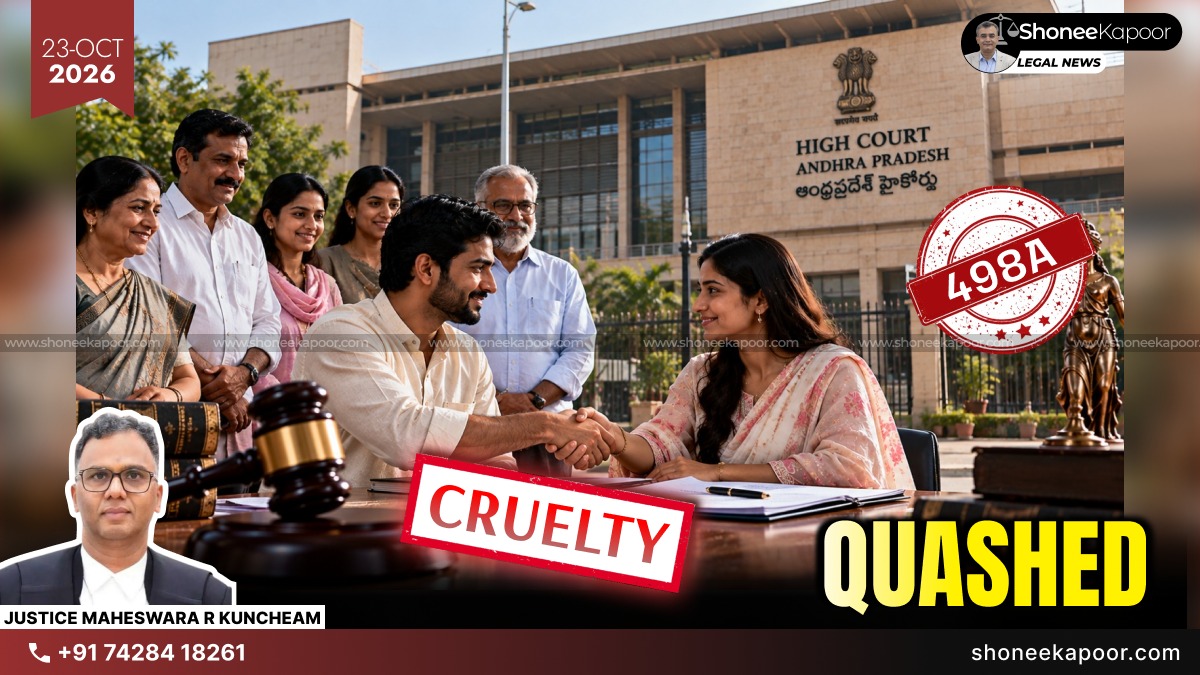
Cruelty & Dowry Harassment Case Against Husband And Family Can Be Quashed After Spouses Amicably Settled Matrimonial Dispute: AP High Court

Curated by NEWS DESK
Editorial DeskANDHRA PRADESH: The Andhra Pradesh High Court has quashed criminal proceedings against a husband and five family members under Section 85 BNS and Sections 3 and 4 of the Dowry Prohibition Act, 1961, after finding that the matrimonial dispute had been voluntarily settled.
A Single Bench of Justice Maheswara Rao Kuncheam, in an order dated August 11, 2026, allowed the husband and his relatives' criminal petition under Section 528 of the Bharatiya Nagarik Suraksha Sanhita (BNSS).
The case arose from C.C. No. 306 of 2026, pending before the Judicial Magistrate of First Class, Srikakulam. The husband and five relatives faced criminal proceedings over allegations of matrimonial cruelty and dowry harassment.
Read Also:- Section 498A IPC Treats Cruelty as Continuing Offence; Matrimonial Cruelty Cases Cannot Be Dismissed Merely Due to Delay in Complaint: Kerala High Court
During the proceedings, both sides informed the High Court that they had amicably settled their matrimonial dispute with the intervention of family elders and well-wishers.
The wife submitted an affidavit stating that she had agreed to the compromise voluntarily, without any force, coercion or misrepresentation.
The petitioners subsequently filed I.A. Nos. 1 and 2 of 2026, requesting the Court to record the compromise and quash the criminal proceedings.
The High Court referred to the Supreme Court's decision in State of M.P. v. Laxmi Narayan, which recognised that criminal proceedings arising from matrimonial or family disputes may be quashed when the parties have genuinely resolved their differences.
The Court also relied on Ram Gopal v. State of M.P. and Naushey Ali v. State of Uttar Pradesh, reiterating that the nature of the offence, voluntary settlement, and the accused's conduct are important considerations.
Explaining the purpose of quashing settled matrimonial disputes, the High Court observed that although Section 498A IPC is a non-compoundable offence, the High Court can exercise its inherent powers under Section 482 CrPC in appropriate cases.
The Court clarified that the purpose is not to encourage compromise in genuine cruelty cases, but to prevent unnecessary criminal proceedings when the dispute has been resolved, and conviction is unlikely.
Both parties appeared before the High Court, where the wife personally confirmed that she had voluntarily entered into the settlement.
The Court also found no adverse criminal antecedents or conduct against the accused. It observed that ending the proceedings would promote peace between the parties without affecting the administration of criminal justice.
Accordingly, the Andhra Pradesh High Court quashed the entire BNS Section 85 cruelty and dowry case against the husband and five relatives, allowing Criminal Petition No. 6945 of 2026 and both compromise applications.
EXPLANATORY TABLE OF LAWS AND SECTIONS
| Law / Section | What It Means | Relevance in This Case |
|---|---|---|
| Section 85 BNS, 2023 | Punishes cruelty by a husband or his relatives against a married woman. | Criminal proceedings against all six accused were quashed. |
| Section 86 BNS, 2023 | Defines cruelty for the purpose of Section 85. | Explains the legal meaning of cruelty; not separately listed as a charge. |
| Section 3, Dowry Prohibition Act, 1961 | Punishes giving, taking or abetting dowry. | One of the offences in the criminal case. |
| Section 4, Dowry Prohibition Act, 1961 | Punishes demanding dowry. | Proceedings under this provision were also quashed. |
| Section 528 BNSS, 2023 | Preserves the High Court's inherent powers to prevent abuse of court process and secure justice. | Main provision used to quash the proceedings. |
| Section 482 CrPC, 1973 | Earlier provision recognising the High Court's inherent powers. | Discussed in Supreme Court precedents relied upon by the Court. |
| Section 320 CrPC, 1973 | Governs compounding of offences under the former criminal procedure law. | Cited while explaining compromise in non-compoundable offences. |
| Section 498A IPC, 1860 | Former provision dealing with cruelty by a husband or his relatives. | Discussed by the Court in explaining matrimonial case quashing. |
| Section 307 IPC, 1860 | Punishes attempt to murder. | Mentioned in precedent to distinguish serious offences from private disputes. |
| Sections 437, 438 and 439 CrPC | Former provisions concerning bail, anticipatory bail and special bail powers. | Appear in the petition's introductory procedural text, not the operative reasoning. |
| Article 142, Constitution of India | Gives the Supreme Court power to pass orders necessary for complete justice. | Discussed in the quoted Supreme Court precedent. |
| Prevention of Corruption Act and Arms Act | Special legislation concerning corruption and weapons-related offences. | Mentioned in precedent as examples requiring different treatment when considering compromise. |
CASE DETAILS
| Particular | Details |
|---|---|
| Case Title | X & Ors. vs State of Andhra Pradesh & Anr |
| Case Number | Criminal Petition No. 6945 of 2026 |
| Case Identification Number | APHC010422252026 |
| Court | High Court of Andhra Pradesh at Amaravati |
| Bench | Justice Maheswara Rao Kuncheam |
| Order Date | August 11, 2026 |
| Counsel for Petitioners | Advocate P. Nagendra Reddy |
| Counsel for State | K. Sandeep, Assistant Public Prosecutor |
| Counsel for Wife | Heard by the Court, but name not specified in the judgment |
| Trial Proceedings | C.C. No. 306 of 2026, Judicial Magistrate of First Class, Srikakulam |
| Compromise Applications | I.A. Nos. 1 and 2 of 2026 |
| Result | Criminal petition and compromise applications allowed; entire criminal proceedings quashed against all six accused. |
KEY TAKEAWAYS
- Husband and Five Relatives Get Relief: Andhra Pradesh High Court quashes BNS Section 85 cruelty and dowry proceedings against all six accused.
- Wife's Voluntary Settlement Accepted: Court confirms the wife agreed to compromise without coercion or pressure.
- Non-Compoundable Case Quashed: High Court invokes Section 528 BNSS to end criminal proceedings despite the offences being non-compoundable.
- Unnecessary Harassment Prevented: Court recognises that continuing settled matrimonial cases may amount to abuse of legal process.
- Criminal Proceedings Finally End: With no adverse antecedents found, the husband and five relatives are spared further prosecution in the settled dispute.
Share Your Thoughts
Comments are moderated before publication.