
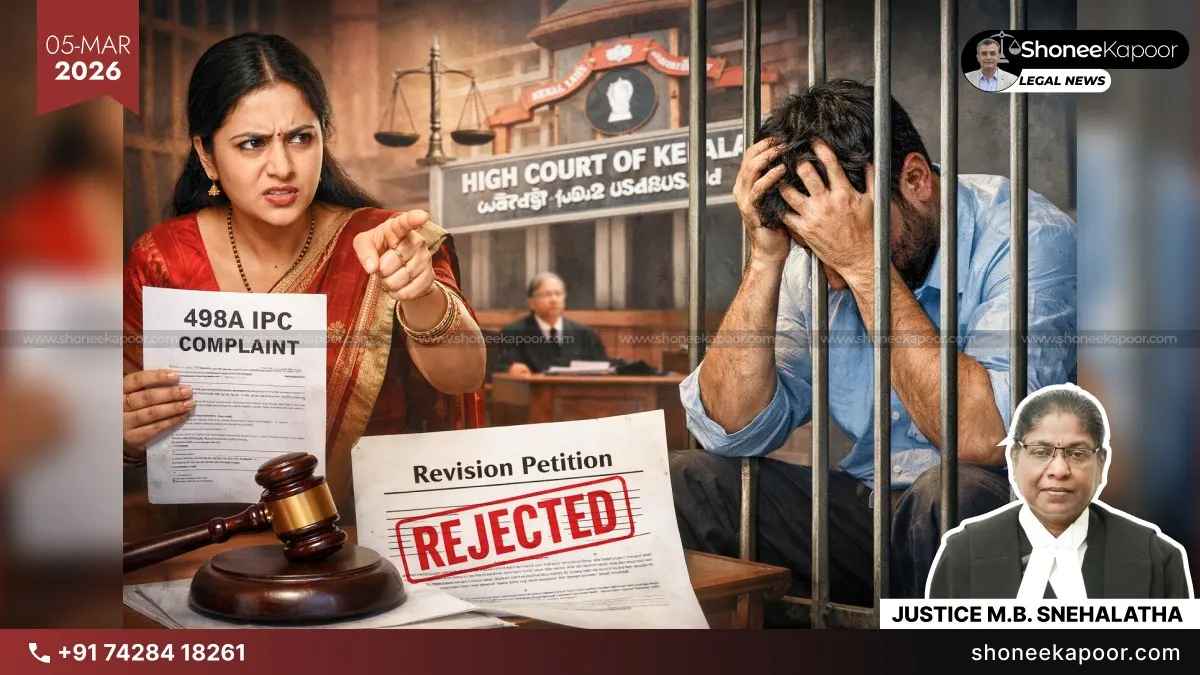
Section 498A IPC Treats Cruelty as Continuing Offence; Matrimonial Cruelty Cases Cannot Be Dismissed Merely Due to Delay in Complaint: Kerala High Court

Written and analysed by Shonee Kapoor
Legal Consultant, Author & Men's Rights ActivistCan a husband still face conviction even if the complaint is filed after a long delay?
The Kerala High Court held that cruelty under Section 498A of the IPC is a continuing offence, so delay alone cannot be a ground to dismiss the case.
ERNAKULAM: A recent judgment of the Kerala High Court delivered by Justice M.B. Snehalatha examined a criminal revision filed by a husband challenging his conviction under Section 498A IPC for cruelty related to dowry demands.
The husband argued that the trial and appellate courts wrongly evaluated the evidence and that the delay in filing the complaint made the allegations doubtful. He also pointed out inconsistencies in witness statements and requested that the conviction be set aside.
The Court explained that its powers in revision are limited and interference is allowed only in rare situations. The Court observed:
“Unless the finding of the court, whose decision is sought to be revised, is shown to be perverse or untenable in law or is grossly erroneous or glaringly unreasonable or where the decision is based on no material or where the material facts are wholly ignored or where the judicial discretion is exercised arbitrarily or capriciously, the courts may not interfere with the decision in exercise of their revisional jurisdiction.”
After examining the evidence, the Court found that the wife’s testimony about repeated harassment and assault was supported by neighbours and medical records showing injuries during pregnancy.
The High Court rejected the argument regarding delay in lodging the complaint and clarified:
“Matrimonial cruelty is a continuing offence, as the suffering of the victim does not end with a single isolated incident but continues so long as oppressive conduct persists.”
At the same time, the case also highlights the difficult position faced by the husband during the legal process. His challenge mainly relied on pointing out delays and inconsistencies, but the Court held that such factors alone were not enough to overturn a conviction when the testimony of the complainant was considered credible. This meant that despite his arguments, the scope of revisional review left him with very limited relief.
Justice Snehalatha also noted that courts must evaluate such testimony carefully and stated:
“The testimony of a victim of matrimonial cruelty must be appreciated with sensitivity, and realism and a hyper-technical approach in such matters would defeat the very object of Section 498A IPC.”
The Court further observed:
“Assaulting the wife in connection with dowry demands is not a mere domestic dispute but a serious offence rooted in greed, coercion and gender based violence.”
While confirming the conviction, the High Court did grant partial relief to the husband by reducing the punishment. The earlier sentence was reduced from one year of simple imprisonment to six months’ imprisonment, along with a fine.
The ruling shows how courts treat allegations of matrimonial cruelty seriously and why even delayed complaints can still result in conviction when supported by witness testimony and medical evidence, leaving the accused with limited scope to challenge findings at the revisional stage.
Explanatory Table: Laws and Sections Involved
| Law / Section | Purpose | How Applied in This Case |
| Section 498A IPC | Punishes cruelty or harassment by a husband or his relatives, especially in relation to dowry demands. | The husband was convicted under this section for allegedly subjecting his wife to cruelty and physical assault connected to dowry demands. |
| Section 34 IPC | Provides liability when a criminal act is done by several persons with a common intention. | The prosecution initially alleged that the husband and his mother acted together in committing cruelty. |
| Section 313 CrPC | Allows the accused to explain the evidence presented against him during trial. | The accused was questioned under this provision and denied the allegations against him. |
| Section 397 CrPC | Gives higher courts the power to examine records of lower courts to check legality or correctness of orders. | The husband approached the High Court using revisional jurisdiction under this provision. |
| Section 401 CrPC | Defines the revisional powers of the High Court while reviewing decisions of subordinate courts. | The High Court clarified that interference in revision is limited and possible only when the earlier judgment is clearly illegal or unreasonable. |
Case Details
- Case Title: Praveen Kumar @ Kannan v State of Kerala
- Court: Kerala High Court
- Case Number: Criminal Revision Petition No. 573 of 2018
- Bench: Justice M.B. Snehalatha
- Neutral Citation: 2026:KER:15653
- Date of Judgment: 19 February 2026
- Counsels
- For Revisionist / Accused: Adv. Vishnu Premkumar (Amicus Curiae)
- For Respondent / State: Smt. Maya M N, Public Prosecutor
key Takeways
- In many matrimonial disputes, a husband can still face conviction even when the complaint is filed after a significant delay, because cruelty is often treated as a “continuing offence.”
- Testimony of the wife alone, if considered credible and supported by surrounding circumstances like neighbour statements or medical records, can become the central basis for conviction.
- Once a trial court and appellate court accept the allegations, it becomes extremely difficult for the husband to overturn the findings in revision because higher courts have limited powers to re-examine evidence.
- Inconsistent statements or delay in complaints are not always treated as fatal to the prosecution case, which often leaves the accused husband with very limited grounds for defence.
- The reality of matrimonial litigation is that even when some relief is granted, it usually comes only in the form of reduced punishment rather than complete relief from conviction.
This Could Change Your Case-Get FREE Legal Advice-Click Here!
Disclaimer: The views and opinions expressed in this article are those of the Indian courts and do not necessarily reflect the official policy or position of “ShoneeKapoor.com” or its affiliates. This article is intended for informational and educational purposes only. The content provided is not legal advice, and viewers should not act upon this information without seeking professional counsel. Viewer discretion is advised.
Related Articles

The Silent Crisis: Men Destroyed by False Allegations in India – How Laws Meant for Protection Are Destroying Innocent Men
Laws Meant for Protection Are Destroying Innocent Men. An FIR is filed and a man’s life collapses before any evidence...

What Legal Remedies Are Available For Men In India? 498A, Divorce, Maintenance, Custody & False Cases
Know the legal remedies available for men in India against false 498A, maintenance, domestic violence, custody battle...
How To Remove Name From 498A FIR: An Innocent Husband’s Legal Guide
A false 498A FIR can destroy a man’s reputation, career, and family before trial even begins. This legal guide explai...
Share Your Thoughts
Comments are moderated before publication.