
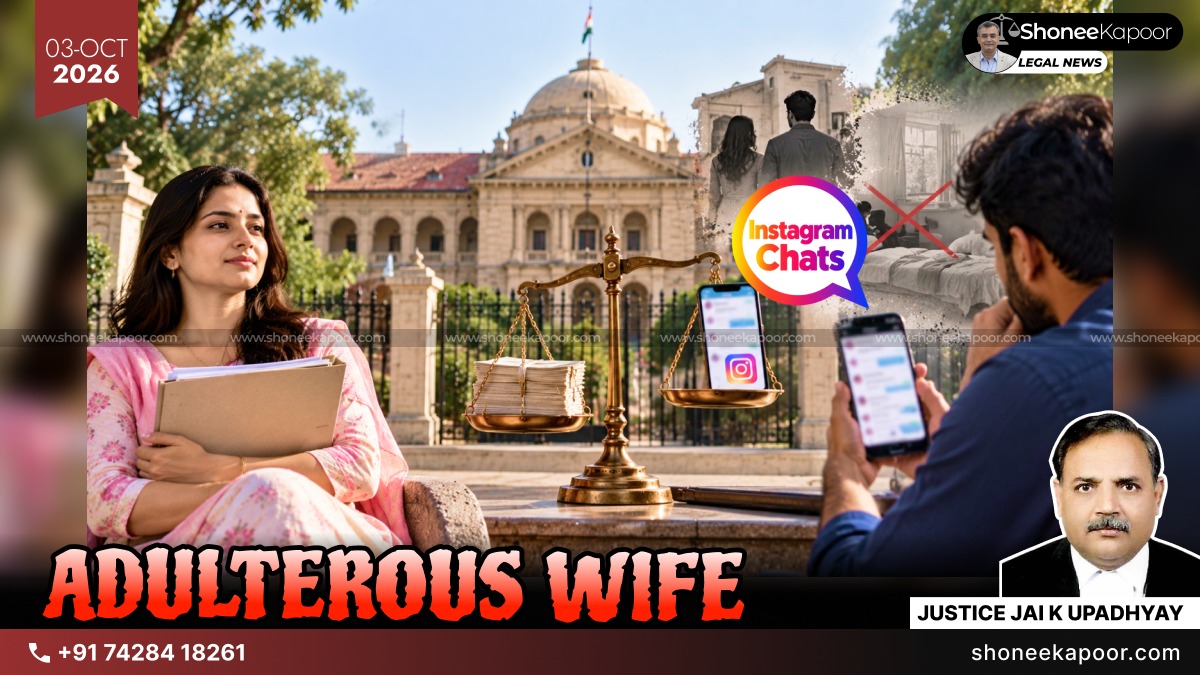
Instagram Chats Of Wife With Another Man Not Enough To Prove Adultery: Allahabad High Court Directs Husband To Continue Paying Maintenance

Curated by NEWS DESK
Editorial DeskUTTAR PRADESH: The Allahabad High Court held that a husband cannot deny maintenance to his wife merely by producing Instagram chats allegedly exchanged with another man. The Court said that to invoke the statutory bar against maintenance, the husband must produce clear evidence showing that the wife is continuously “living in adultery.”
Justice Jai Krishna Upadhyay passed the order on 29 September 2026 while dismissing Criminal Revision No. 7800 of 2025. The husband had challenged an order dated 1 October 2025 passed by the Principal Judge, Family Court, Sambhal at Chandausi in Case No. 924 of 2024, granting maintenance to his wife.
The husband argued that his wife had left the matrimonial home without sufficient reason and was allegedly “living in adultery” with an advocate. To support this allegation, he relied mainly on printouts of Instagram chats allegedly exchanged between the wife and the advocate. According to him, these chats established an adulterous relationship.
The wife opposed the claim. It was argued that “living in adultery” requires a continuing course of adulterous conduct and cannot be established merely through isolated interactions or suspicion. It was also argued that the Instagram chats lacked the required statutory certification for electronic evidence.
The High Court examined the purpose of maintenance law and observed that maintenance proceedings are meant to prevent neglect and destitution. It referred to the Supreme Court decisions in Dukhtar Jahan v. Mohd. Farooq and Rajnesh v. Neha, while noting that the burden of establishing a statutory disqualification from maintenance lies on the person alleging it.
Explaining the legal meaning of “living in adultery,” the Court held that the expression indicates a continuous, ongoing and habitual course of adulterous conduct. It cannot automatically be inferred from conversations, professional associations or unsupported suspicion.
The Court further held that electronic evidence must meet the legal requirements for admissibility. Referring to Section 65-B of the Indian Evidence Act, 1872, and the Supreme Court rulings in Arjun Panditrao Khotkar v. Kailash Kushanrao Gorantyal and Anvar P.V. v. P.K. Basheer, the Court noted that the Instagram chats relied upon by the husband lacked the mandatory statutory certificate.
The Court then made the crucial observation:
“Even if, for the sake of argument, the contents of the unverified chats were to be perused, mere text messages on a social media platform, without corroborative evidence of physical intimacy or cohabitation, are thoroughly insufficient to legally establish that the wife is continuously living in adultery.”
The Court found that the husband had failed to discharge the burden of proving a continuous adulterous lifestyle. It therefore found no legal error or perversity in the Family Court’s decision and dismissed his criminal revision. The maintenance order was consequently affirmed.
EXPLANATORY TABLE OF LAWS AND SECTIONS
| Law / Section | What It Means | Application In This Case |
|---|---|---|
| Section 125, CrPC, 1973 | Provides a summary remedy for maintenance to eligible wives and other dependants. It also contains statutory circumstances in which a wife may be disentitled to maintenance, including “living in adultery.” | The High Court described the maintenance proceedings before the Family Court as under provisions akin to Section 125 CrPC. |
| Section 144, BNSS, 2023 | Current BNSS provision governing maintenance of wives, children and parents; its framework includes the bar concerning a wife living in adultery. | Bar & Bench identified Section 144 BNSS as the corresponding current provision while explaining the Court's ruling. |
| Sections 438 & 442, BNSS, 2023 | Provisions invoked for the criminal revision before the High Court. | The husband filed the revision under these provisions challenging the Family Court's maintenance order. |
| Section 65-B, Indian Evidence Act, 1872 | Governs admissibility requirements for electronic records, including statutory certification in applicable circumstances. | The Court found that the Instagram chat printouts lacked the mandatory certification and could not be treated as admissible electronic evidence on that basis. |
CASE DETAILS
| Particular | Details |
|---|---|
| Case Title | SK v. State of U.P. and Another |
| Case Number | Criminal Revision No. 7800 of 2025 |
| Court | High Court of Judicature at Allahabad |
| Bench | Justice Jai Krishna Upadhyay |
| Decision Date | 29 September 2026 |
| Neutral Citation | 2026:AHC:203794 |
| Revisionist’s Counsel | Devdeep Malviya |
| Opposite Parties’ Counsel | Ashutosh Upadhyay, G.A., Sujeet Kumar |
| Family Court Case | Case No. 924 of 2024, Principal Judge, Family Court, Sambhal, situated at Chandausi |
| Impugned Order | 1 October 2025 |
| Result | Criminal revision dismissed; Family Court maintenance order affirmed |
KEY TAKEAWAYS
- Instagram Chats Alone Cannot Prove Adultery: A husband cannot defeat a maintenance claim merely by producing his wife’s private chats with another man.
- Husband Carries the Burden: If a man alleges that his wife is “living in adultery,” he must prove continuous adulterous conduct with cogent evidence.
- Suspicion Is Not Evidence: Messages, conversations or association with another man do not automatically establish an adulterous relationship.
- Electronic Evidence Must Be Legally Proved: Screenshots and chat printouts can fail if the statutory requirements for electronic evidence are not satisfied.
- A Serious Defence Needs Serious Evidence: The law permits a husband to raise adultery against maintenance, but the evidentiary threshold means that allegations without legally admissible proof will not protect him from a maintenance order.
Share Your Thoughts
Comments are moderated before publication.