
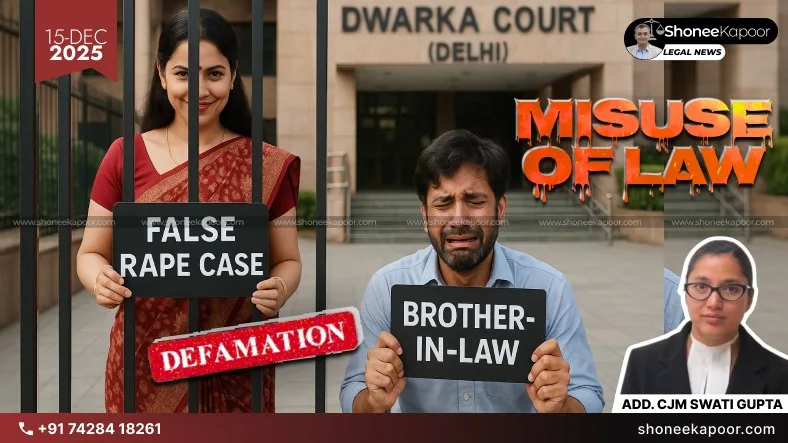
False Rape Case Against Brother-In-Law | “Innocent Men Are Suffering”: Delhi Court Convicts Woman, Orders Jail And Fine For Defamation

Curated by NEWS DESK
Editorial DeskA Delhi court held a woman guilty of defamation for making false rape and sexual harassment allegations against her brother-in-law. The court ruled that the complaint was fabricated and caused wrongful arrest and imprisonment of an innocent man.
NEW DELHI: A Delhi court has convicted a woman for defamation after finding that she made false allegations of rape and sexual harassment against her brother-in-law, which resulted in his arrest and 41 days of judicial custody.
The case highlights the serious consequences of filing false criminal complaints and the damage caused to an innocent person’s reputation and liberty.
Additional Chief Judicial Magistrate Swati Gupta of the Dwarka Courts sentenced the woman to simple imprisonment for three months and imposed a fine of Rs. 5,000. However, the court allowed her application for suspension of sentence for one month to give her time to file an appeal against the conviction.
The criminal defamation case was filed by the brother-in-law, who is a doctor by profession. The accused woman, his sister-in-law, had earlier lodged an FIR against him and other members of the family. The complainant stated before the court that the allegations made in the FIR were false, fabricated, frivolous, and defamatory, and were filed with the intention to harass him and his family.
In her complaint, the woman had alleged that her brother-in-law had a bad eye on her, flirted with her, forcibly kissed her, and sexually assaulted her. Based on these allegations, the man was arrested and remained in judicial custody for 41 days. Later, during the trial, the woman failed to support her own allegations, and as a result, the man and other family members were acquitted of all charges.
While convicting the woman for defamation, the court took serious note of her conduct during the trial. The judge observed that the woman admitted during her cross-examination that she had filed a false complaint on the instructions of police officials.
“Firstly, in my considered opinion, the accused cannot be permitted to keep changing her stand and keep on blaming someone else for her false statements made on oath in Court. Secondly. it is unbelievable that a woman against whom an offence of rape has been committed, would resile from her allegations of rape for the purpose of settlement,”
-the Court said.
The court further clarified that even though settlement is not permissible in rape cases, this does not give a complainant the right to withdraw or change her statement under the excuse of settlement.
It also observed that the woman was educated and should have understood the seriousness of rape allegations. The court stated that if the accusations were genuine, she should have resolved her matrimonial dispute separately, without affecting her right to pursue the rape case on its own merits.
According to the court, the woman appeared more interested in settling her matrimonial dispute than in pursuing the serious allegation of rape against her brother-in-law. This conduct further weakened her credibility and supported the claim that the allegations were false.
“In view of the above discussion, it is concluded that the complainant has been successful in establishing his case beyond reasonable doubt and all the ingredients of offence u/s 499 IPC have been proved against the accused. The complaint of the complainant is allowed, and the accused Ms. Jayshree is hereby convicted of the offence under Section 499 r/w 500 of the Indian Penal Code, 1872,”
-the Court said.
This judgment reinforces the principle that false and malicious allegations, especially in serious offences like rape, not only destroy lives but also amount to criminal defamation and must be dealt with strictly under the law.
Explanatory Table of Laws & Sections Involved
| Law | Section | Explanation | How It Applied in This Case |
| Indian Penal Code, 1872 | Section 499 | Defines the offence of criminal defamation. Any false statement made with the intention to harm, or knowing that it will harm, the reputation of a person amounts to defamation. | The court held that the woman made false rape and sexual harassment allegations which harmed the reputation, liberty, and career of her brother-in-law. |
| Indian Penal Code, 1872 | Section 500 | Prescribes punishment for defamation, which may include simple imprisonment, fine, or both. | The woman was convicted under this section and sentenced to three months’ simple imprisonment along with a fine of Rs. 5,000. |
| Indian Penal Code, 1872 | Section 499 read with Section 500 | Establishes conviction and punishment together for criminal defamation. | The court concluded that all ingredients of defamation were proved beyond reasonable doubt and convicted the accused accordingly. |
Case Summary
| Particular | Details |
| Case Title | Not specified in the available judgment text |
| Court | Dwarka Courts, Delhi |
| Presiding Judge / Bench | Additional Chief Judicial Magistrate Swati Gupta |
| Complainant | Brother-in-law (Doctor by profession) |
| Accused | Ms. Jayshree |
| Nature of Case | Criminal Defamation |
| Allegations Made Earlier | False allegations of rape and sexual harassment against brother-in-law |
| Period of Custody Suffered by Complainant | 41 days of judicial custody |
| Trial Outcome of Rape Case | Accused and family members acquitted as the woman did not support her allegations |
| Final Decision in Defamation Case | Woman convicted for defamation |
| Sentence | Simple imprisonment for three months |
| Fine | Rs. 5,000 |
| Suspension of Sentence | One month granted to enable filing of appeal |
Key Legal Finding
The court clearly held that a complainant cannot escape responsibility after making serious allegations by later changing her version or blaming others. The judgment emphasized that false rape allegations, when proven to be fabricated, amount to criminal defamation and attract penal consequences under IPC Sections 499 and 500.
Key Takeaways
- False rape allegations are not “mistakes” — they are crimes that destroy reputation, liberty, and careers, and courts are now holding complainants accountable.
- A woman cannot change her stand in court after sending an innocent man to jail and then escape responsibility by blaming police or circumstances.
- Even in serious offences like rape, misuse of law for matrimonial pressure or settlement exposes the complainant to criminal defamation.
- Innocent men can lose months of freedom, dignity, and social standing due to false FIRs — accountability is the only deterrence.
- This judgment strengthens the fight for gender-neutral justice by clearly stating that law is for protection, not for vendetta or extortion.
This Could Change Your Case-Get FREE Legal Advice-Click Here!
Disclaimer: The views and opinions expressed in this article are those of the Indian courts and do not necessarily reflect the official policy or position of “ShoneeKapoor.com” or its affiliates. This article is intended for informational and educational purposes only. The content provided is not legal advice, and viewers should not act upon this information without seeking professional counsel. Viewer discretion is advised.
Related Articles
5 Rights Every Husband Should Know In India: Most Ignored Legal Protections
Every Indian husband must know these 5 ignored legal rights in 498A, maintenance, arrest, custody and false matrimoni...
Real Court Cases Where False Allegations Backfired On Wife
Real Indian court cases where false 498A, dowry, cruelty and defamatory allegations against husbands backfired, leadi...
Share Your Thoughts
Comments are moderated before publication.