
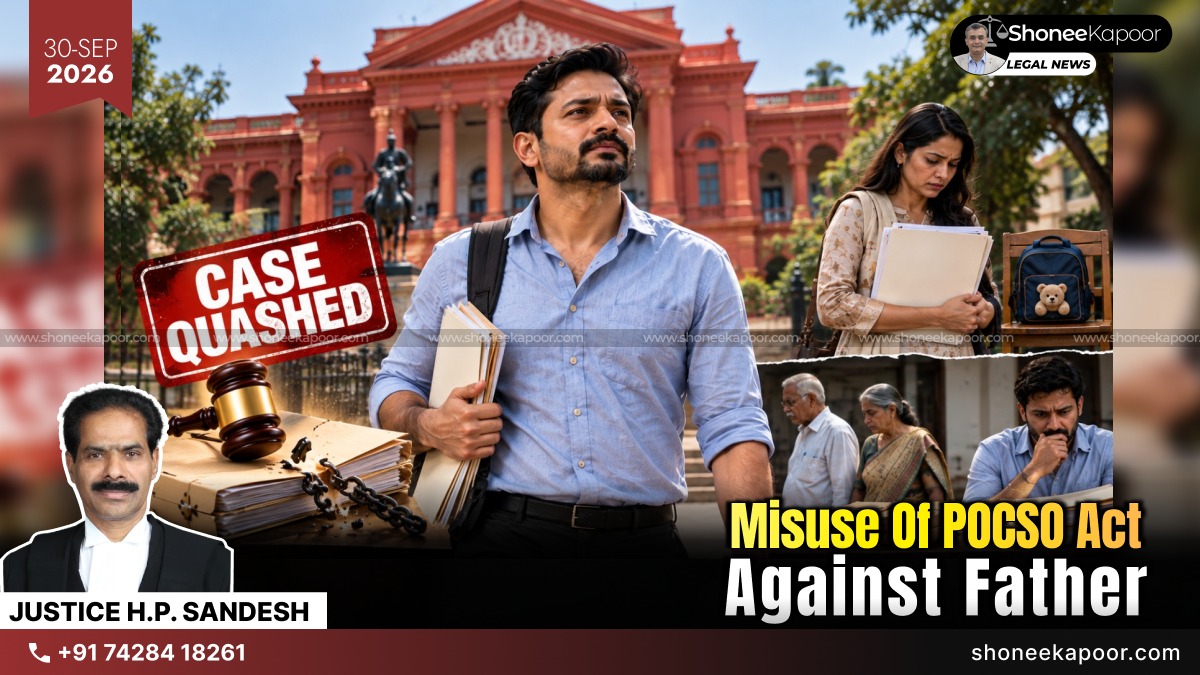
False POCSO Case Against Father | Wife Filed It 5 Days After Custody Plea Was Rejected: Karnataka HC Calls It “Afterthought” & Quashes Proceedings

Curated by NEWS DESK
Editorial DeskKARNATAKA: The Karnataka High Court quashed POCSO and IPC proceedings against a father after finding the case a “classic example of afterthought” and a case of “personal vengeance against the husband”. The Court found important inconsistencies in the allegations and noted the absence of documentary material supporting the claim that the child had been molested.
Justice H.P. Sandesh, in an order dated 25 September 2026, decided two connected criminal petitions arising from a long-running matrimonial dispute. One petition concerned allegations under Section 354A(1) IPC and Sections 7 and 11(ii) of the POCSO Act against the husband. The connected petition concerned Section 498A IPC, assault, criminal intimidation and dowry allegations against the husband and his parents.
The matrimonial dispute had also reached the Family Court. The father had filed proceedings seeking custody of his daughter, and an interim arrangement permitted him to take the child on Saturday and return her to the mother on Monday. The wife's application under Order 39 Rules 1 and 2 CPC was later dismissed on 18 March 2017.
The POCSO complaint was filed on 23 March 2017, shortly after the wife's application in the guardianship proceedings was dismissed. The High Court considered this sequence significant when examining whether continuing the criminal proceedings would amount to an abuse of process.
The Court also examined the NIMHANS material. According to the judgment, the child had been taken to NIMHANS with complaints relating to refusal to attend school, fear of being separated from the mother and fear of being taken away by the father. The Court noted that the NIMHANS letter did not contain an allegation that the child had been subjected to any sexual act.
Another important issue was the child's statement recorded under Section 164 CrPC. The Court found inconsistency between that statement and the complaint filed by the mother. It also observed that the child was in the mother's custody and stated that the statement “appears to be tutored”. The judgment further recorded that there was no documentary proof before the Court showing molestation.
After considering the matrimonial litigation, custody proceedings, timing of the complaint, medical material and inconsistencies, the High Court made a strong finding:
“classic example of afterthought”
The Court further recorded:
“for personal vengeance against the husband, a false case was registered”
It held that continuing the proceedings would amount to an abuse of process and that the High Court could exercise its powers under Section 482 CrPC, despite the rejection of the father's discharge application and the framing of charges.
The judgment also referred to the Supreme Court's observations concerning the rise of false, frivolous and vexatious matrimonial litigation and the need for courts to exercise caution where criminal proceedings are allegedly used with mala fide motives in matrimonial disputes.
In the connected 498A and dowry case, however, the High Court distinguished between the husband and his parents. It found that the allegations against accused Nos. 2 and 3, the husband's parents, were essentially that they had instigated accused No. 1. The Court noted that the couple had shifted away and were not residing with accused Nos. 2 and 3. It therefore found this a fit case to quash the proceedings against the parents.
The husband did not receive the same relief in the 498A case. The Court noted specific allegations against him concerning cruelty, additional demand and assault and held that these issues were matters for trial. His petition for quashing that case was therefore dismissed
Accordingly, the High Court completely quashed the POCSO proceedings against the father in Spl. C.C. No.559/2017. In the connected matrimonial criminal case, the Court quashed proceedings only against accused Nos. 2 and 3, while allowing the case against the husband to continue.
EXPLANATORY TABLE OF LAWS AND SECTIONS
| Law / Section | What It Means | Application in This Case |
|---|---|---|
| Section 482 CrPC | Inherent power of the High Court to prevent abuse of court process and secure the ends of justice. | Used to quash the POCSO proceedings against the father and the matrimonial criminal proceedings against his parents. |
| Section 354A(1) IPC | Deals with specified forms of sexual harassment. | Invoked against the father in the case that was ultimately quashed. |
| Section 7 POCSO Act | Defines sexual assault against a child involving sexual intent and physical contact without penetration. | One of the principal POCSO provisions invoked against the father. |
| Section 11(ii) POCSO Act | Covers specified conduct amounting to sexual harassment of a child when accompanied by sexual intent. | Proceedings under this provision were also quashed. |
| Section 164 CrPC | Permits a Magistrate to record statements or confessions during investigation. | The child's statement was considered by the Court and compared with the mother's complaint. |
| Section 498A IPC | Punishes cruelty by a husband or his relatives against a married woman. | Case against the husband's parents was quashed, but proceedings against the husband were not quashed. |
| Section 323 IPC | Punishment for voluntarily causing hurt. | Part of the connected matrimonial criminal case. |
| Section 506 IPC | Punishment for criminal intimidation. | Invoked in the connected case. |
| Section 34 IPC | Fixes joint liability where a criminal act is done by several persons with a common intention. | Read with the IPC offences alleged in the matrimonial case. |
| Sections 3 & 4, Dowry Prohibition Act | Deal respectively with giving/taking dowry and demanding dowry. | Invoked in the connected case. Proceedings were quashed against the husband's parents but continued against him. |
| Section 7(1)(b), Guardians and Wards Act | Relates to the court's power concerning guardianship orders. | The father had approached the Family Court in the guardianship proceedings. |
| Order 39 Rules 1 & 2 CPC | Provides for temporary injunctions in appropriate cases. | The wife's application was dismissed before the POCSO complaint was filed. |
CASE DETAILS
| Particular | Details |
|---|---|
| Case Title | U v. State of Karnataka & Another |
| Case Numbers | Criminal Petition No. 220 of 2018 C/W Criminal Petition No. 8868 of 2017 |
| Court | High Court of Karnataka at Bengaluru |
| Bench | Justice H.P. Sandesh |
| Order Date | 25 September 2026 |
| Petitioner's Counsel | K. Diwakara, Senior Counsel, for Hitesh Gowda and Aditya Kasturkar, Advocates |
| State Counsel | M. Divakar Maddur, HCGP |
| Respondent No. 2 Counsel, Crl.P. 220/2018 | Reny Sebastin, Advocate |
| Respondent No. 2 Counsel, Crl.P. 8868/2017 | Melanie Sebastin, Advocate |
KEY TAKEAWAYS
- POCSO Case Against Father Quashed: The High Court found sufficient grounds to stop the criminal proceedings against the husband.
- Court Called It “Personal Vengeance”: The judgment described the case as a “classic example of afterthought” and recorded that a false case was registered “for personal vengeance against the husband”.
- Medical Material Did Not Support Molestation Claim: The Court noted that the relied-upon NIMHANS letter contained no allegation of any sexual act against the child.
- Custody Battle Was Crucial: The complaint came after the father obtained interim custody rights and after the wife's application in the guardianship proceedings was dismissed.
- A Man Can Get His Case Quashed, But Not His Lost Years Back: The father had to fight a grave POCSO prosecution arising amid matrimonial and custody litigation before the High Court ultimately quashed it as an abuse of process.
Share Your Thoughts
Comments are moderated before publication.