
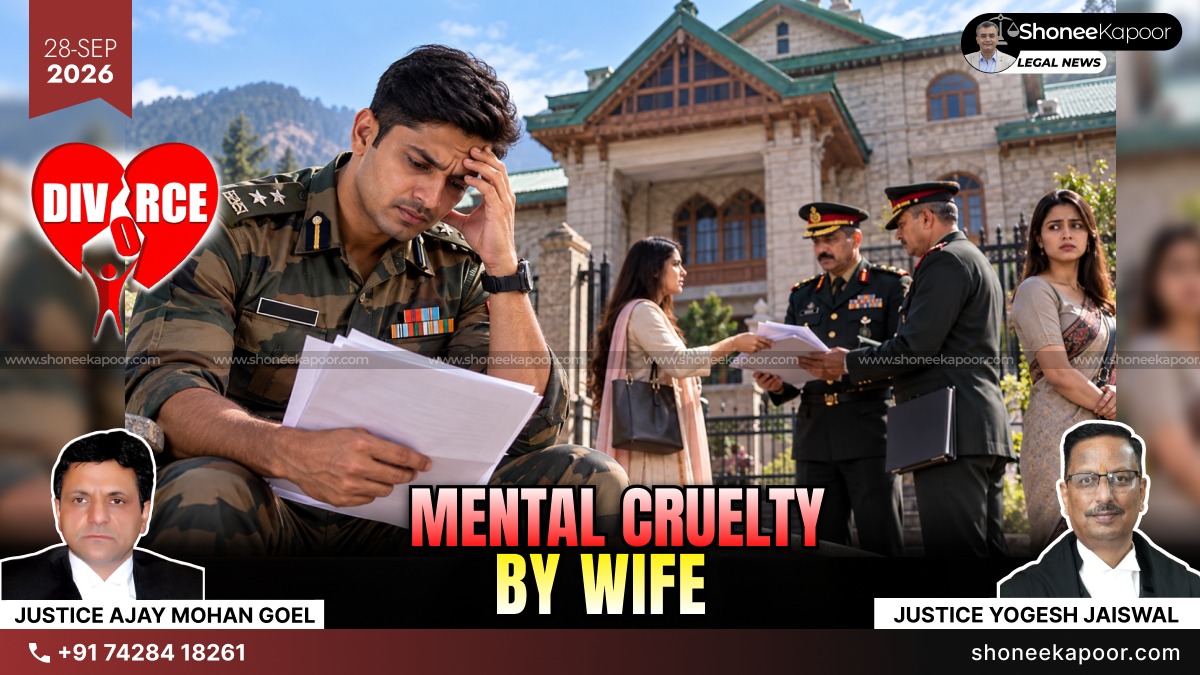
Wife Falsely Accused Army Husband of Having an Affair With His Bhabhi: HP High Court Calls It a “Grave Assault on His Character” and Mental Cruelty, Upholds Divorce

Curated by NEWS DESK
Editorial DeskHIMACHAL PRADESH: The Himachal Pradesh High Court has upheld a decree of divorce granted to an Army officer after his wife made unsubstantiated allegations of an illicit relationship with his sister-in-law and sent complaints containing those allegations to his superior officers in the Army.
A Division Bench of Justice Ajay Mohan Goel and Justice Yogesh Jaswal dismissed the wife’s appeal and held that allegations attacking the husband’s character, honour and professional reputation, when not proved, amounted to mental cruelty under Section 13(1)(i-a) of the Hindu Marriage Act, 1955.
The couple married on April 23, 2002 and had two children. They lived together intermittently for about nine years before their matrimonial relationship deteriorated. The husband approached the Family Court seeking divorce on the grounds of cruelty and desertion.
The husband alleged several acts of cruelty, including quarrels, complaints, criminal proceedings and harassment. However, the High Court did not automatically accept all these allegations.
The Court held that the mere registration of criminal cases against the husband and his brother could not, by itself, establish matrimonial cruelty unless evidence showed the complaints were false, malicious, or unjustified.
The case ultimately turned on the wife’s allegations that her husband was maintaining an illicit relationship with his sister-in-law, or Bhabhi, and her admitted act of sending complaints concerning these allegations to his Army superiors.
During cross-examination, the wife admitted that she had made complaints against her husband to the Army authorities. Her brother also confirmed that she had made such complaints. The Court found that the allegations contained in those complaints remained unsupported by cogent evidence.
The High Court observed:
“There can be no dispute that the allegations levelled by the wife regarding an alleged relationship between her husband and his sister-in-law (Bhabhi) directly impinge upon his character, honour, and reputation.”
The Court further said:
“These unsubstantiated accusations imputing unchastity, marital infidelity, and an extra-marital affair constitute a grave assault on the character and standing of the petitioner-husband.”
The Bench found that the wife had failed to establish the allegations against her husband and held:
“In our view, making unproven or false allegations by the wife against her husband, accusing him of maintaining illicit relationships (such as with his sister-in-law) and broadcasting these complaints to his superior officers in the Army, amounts to grave mental cruelty under matrimonial law.”
The Court placed particular importance on the fact that the allegations went beyond the private matrimonial dispute and were communicated to the husband’s professional superiors.
It observed:
“The armed forces operate on a strict code of conduct, discipline, and high moral standards.”
The Court added:
“Where a spouse writes formal complaints to superior officers, alleging illicit or immoral behaviour, it directly targets the official's professional standing and credibility within the force.”
According to the Bench:
“Such allegations are not ordinary domestic squabbles.”
The Court further observed:
“They are calculated actions that deeply humiliate the official in front of his colleagues, superiors, and subordinates, making it impossible for him to maintain his dignity or command respect at his workplace.”
The wife argued that her complaints were intended to protect the matrimonial relationship. The High Court rejected this explanation and relied on the Supreme Court judgment in Joydeep Majumdar v. Bharti Jaiswal Majumdar, where complaints damaging a spouse’s dignity, reputation and career had been considered while examining mental cruelty.
The Court also rejected the argument that the husband had to prove a negative by independently establishing that the affair allegations were false. Since the wife had made the accusations, she had the opportunity to prove them, but failed to do so.
The Bench held that the unsubstantiated allegations had caused mental agony and cruelty to the husband, affecting both his personal dignity and professional reputation.
The High Court, however, did not uphold divorce on the separate ground of desertion. The parties had allegedly stopped living together in July 2011, while the divorce petition was filed on May 21, 2013. The statutory requirement of two continuous years of desertion before filing the petition had therefore not been completed.
The Court nevertheless found mental cruelty independently proved through the unsubstantiated affair allegations communicated to the Army authorities. It dismissed the wife’s appeal and upheld the divorce decree.
The wife had also sought enhancement and realisation of maintenance directly before the High Court. The Bench held that the statutory remedy for altering or enhancing maintenance must first be pursued before the competent Family Court.
EXPLANATORY TABLE OF LAWS AND SECTIONS
| Law / Section | What It Means | Relevance In This Case |
|---|---|---|
| Section 13(1)(i-a), Hindu Marriage Act, 1955 | Permits divorce where one spouse has treated the other with cruelty after marriage. | The High Court held that the wife’s unsubstantiated affair allegations sent to the husband’s Army superiors amounted to mental cruelty. |
| Section 13(1)(i-b), Hindu Marriage Act, 1955 | Permits divorce where one spouse has deserted the other continuously for at least two years immediately before the divorce petition. | This ground failed because two complete years had not elapsed between the alleged desertion and filing of the divorce petition. |
| Section 24, Hindu Marriage Act, 1955 | Deals with maintenance pendente lite and litigation expenses during matrimonial proceedings. | The Court noted that even if the wife’s maintenance application was treated under Section 24, it had become infructuous after disposal of the main appeal. |
| Section 498A IPC | Punished cruelty by a husband or his relatives against a married woman. | An FIR under this provision had been registered against the husband. The High Court held that mere registration of the FIR did not itself prove matrimonial cruelty against him. |
| Sections 323, 325 and 506 IPC | Concern voluntarily causing hurt, voluntarily causing grievous hurt and criminal intimidation respectively. | These provisions were part of the criminal case referred to in the matrimonial proceedings. |
| Section 354 IPC | Concerned assault or criminal force against a woman with intent to outrage her modesty. | The judgment recorded that a case under this provision had also been registered against the husband’s brother. |
| Section 127 CrPC | Provides for alteration of maintenance on proof of changed circumstances. | The High Court held that the statutory remedy for enhancement of maintenance had to be pursued before the Family Court. |
| Section 151 CPC | Preserves the inherent powers of civil courts to make orders necessary for justice or to prevent abuse of process. | The wife invoked this provision to enhance and realise maintenance, but the High Court held that inherent powers could not replace the specific statutory maintenance remedy. |
CASE DETAILS
| Particulars | Details |
|---|---|
| Case Title | Wife v. Husband |
| Court | High Court of Himachal Pradesh, Shimla |
| Case Number | FAO (FC)-2 of 2021 |
| Neutral Citation | 2026:HHC:40628 |
| Date of Judgment | 22 September 2026 |
| Reserved On | 11 September 2026 |
| Bench | Justice Ajay Mohan Goel and Justice Yogesh Jaswal |
| Judgment Authored By | Justice Yogesh Jaswal |
| Appellant | Wife |
| Respondent | Husband |
| Counsel for Appellant | Ms. Seema Sood, Advocate |
| Counsel for Respondent | Mr. Naveen K. Bhardwaj, Advocate |
| Impugned Order | Principal Judge, Family Court, Kangra at Dharamsala, dated 28 September 2020 |
KEY TAKEAWAYS
- Unproven affair allegations can amount to mental cruelty. A wife cannot attack her husband’s character without evidence and treat it as a routine matrimonial dispute.
- Taking allegations to the husband’s workplace made the harm more serious. Complaints to his Army superiors affected his dignity and professional reputation.
- The Court called such allegations a “grave assault” on the husband’s character and standing. His reputation mattered both inside and outside the marriage.
- Not every case filed against a husband automatically proves cruelty. The High Court separately refused to treat the criminal cases as cruelty merely because they had been registered.
- Men do not have to silently absorb character assassination in marriage. The High Court upheld the divorce on mental cruelty, while separately rejecting the desertion ground.
Share Your Thoughts
Comments are moderated before publication.