
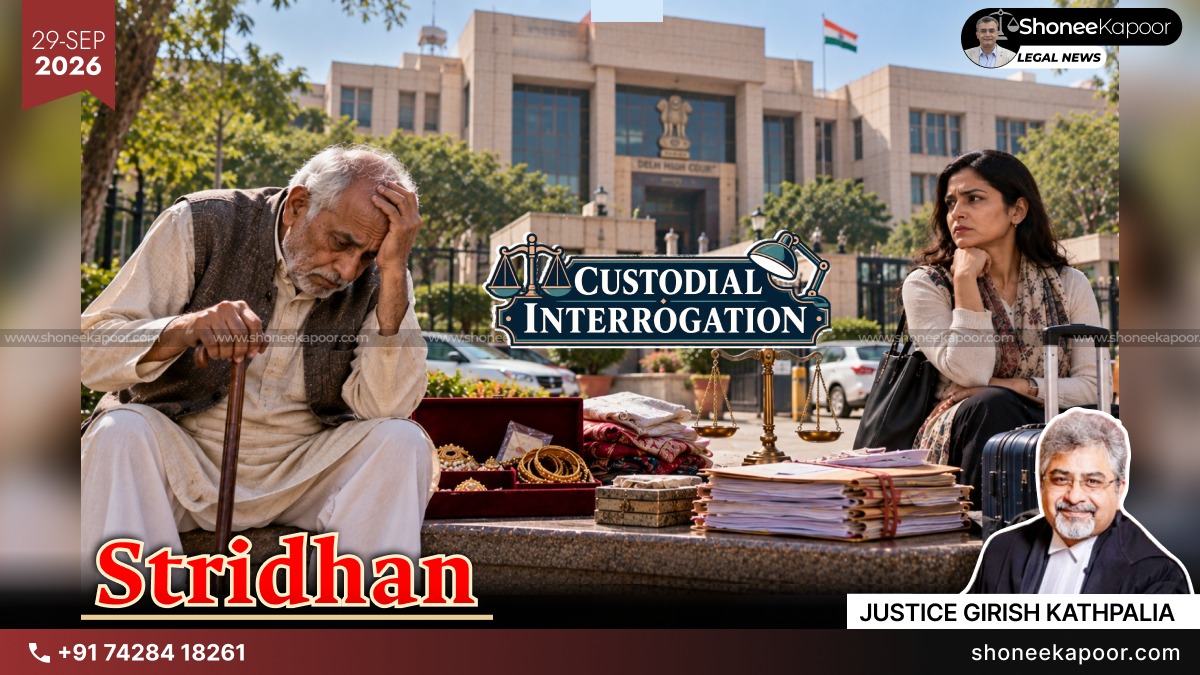
Wife’s Stridhan Recovery Needs No Custodial Interrogation: Delhi High Court Grants Anticipatory Bail To 80-Year-Old Father-In-Law

Curated by NEWS DESK
Editorial DeskNEW DELHI: The Delhi High Court has granted anticipatory bail to an around 80-year-old father-in-law facing serious allegations in a matrimonial dispute, holding that custodial interrogation was not required merely for recovery of stridhan. The Court also questioned the investigating officer’s claim that the accused had failed to join the investigation.
Justice Girish Kathpalia was hearing the anticipatory bail plea of Harcharan Singh Bhalla in FIR No. 158/2026 registered at PS Mukherjee Nagar. The FIR was initially registered under Sections 498A, 406 and 34 IPC. Sections 354, 354A and 376 IPC and Section 74 BNS were subsequently added. The allegations of sexual misconduct were made against the petitioner, who is the complainant’s father-in-law.
The petitioner argued that he was a retired government servant and the allegations had been made to pressurise his son amid matrimonial litigation. The complainant, a permanent resident of Canada, opposed bail and alleged that her stridhan remained with her in-laws. The State also argued that the petitioner had failed to join the investigation despite notices.
Read Also:- Section 498a IPC | 498a Judgments | False Dowry Case | 498a Misuse
However, the Court found an important gap in this claim. When asked to produce the notices allegedly served on the petitioner, the Investigating Officer stated that they had been issued only verbally. No Case Diary supporting those alleged verbal notices was produced. The Court observed that this exercise “fails to inspire confidence”.
The Court further held:
“I find no hesitation to hold that the IO does not need the accused/applicant to join the investigation.”
On the prosecution’s argument that custody was needed to recover stridhan, the Court said:
“As regards the issue of custodial interrogation also, the only purpose mentioned is the recovery of stridhan. But for that, custodial interrogation is certainly not a requisite.”
The Court also made it clear that a bail proceeding cannot be converted into a mechanism for recovery of matrimonial property. It noted that the complainant had not initiated any appropriate legal proceedings for recovery of her stridhan till then.
Before examining the individual allegations, the High Court referred to Arnesh Kumar v. State of Bihar, (2014) 8 SCC 273 and the Supreme Court’s concern over automatic arrests in matrimonial cases. Justice Kathpalia observed that exaggerated allegations under Sections 498A/406 IPC had earlier resulted in not only husbands but also their immediate and sometimes distant family members being arrested.
The Court then made a significant observation about a more recent pattern in matrimonial FIRs. It noted that after safeguards against routine arrest, allegations of serious sexual misconduct are sometimes added against husbands and other male family members. At the same time, the Court expressly cautioned against treating every such allegation as false:
“Not all cases alleging sexual misconduct in matrimonial FIRs are false and not all cases so alleging are true. With this understanding, I have examined the present case.”
On the facts before it, the Court noted that the alleged incidents were stated to have occurred in May 2022 or earlier, while the FIR was lodged on 29 April 2026. It found no convincing circumstances at the bail stage to explain the prolonged silence and also noted that the FIR did not mention specific dates for the alleged offences. Family photographs placed before the Court depicted the petitioner, complainant and her child as a happy family.
Read Also:- Why I Believe 498A IPC / Section 85 BNS Needs Structural Reform To Prevent Misuse
However, the Court carefully limited these observations to the bail proceedings:
“Of course, I must also add a cautious rider that these aspects have been observed only for the limited purposes of anticipatory bail and the final view shall be taken by the trial court on the basis of evidence adduced.”
The prosecution also argued that the petitioner could be a flight risk because other family members were settled in Canada. The Court rejected this contention for lack of cogent material and held that the conduct attributed to other family members could not, by itself, deprive the elderly petitioner of his liberty.
The case also involved a dispute over the complainant’s three-year-old child, whose custody the Ontario Court of Justice had granted to her husband in Canada. On parental conflict and child custody, the High Court observed:
“The proper perspective is that it is the child who has right to co-parenting through both parents.”
Considering the overall circumstances, the Court found no reason to deprive the petitioner of his liberty. It allowed his anticipatory bail application and directed that, in the event of arrest, he be released on a personal bond of ₹25,000 with one surety of the same amount.
EXPLANATORY TABLE OF LAWS AND SECTIONS
| Law / Section | What It Means | Relevance In This Case |
|---|---|---|
| Section 498A IPC | Cruelty by husband or his relatives against a married woman | One of the offences in the original matrimonial FIR |
| Section 406 IPC | Criminal breach of trust | Invoked in connection with allegations including non-return of stridhan |
| Section 34 IPC | Acts done by several persons in furtherance of common intention | Applied with the original IPC offences |
| Section 354 IPC | Assault or criminal force against a woman intending to outrage her modesty | Subsequently added to the FIR |
| Section 354A IPC | Sexual harassment | Subsequently added against the father-in-law |
| Section 376 IPC | Rape | Subsequently added on the basis of the sexual misconduct allegations |
| Section 74 BNS | Assault or use of criminal force against a woman with intent to outrage her modesty | BNS offence subsequently added to the case |
| Arnesh Kumar v. State of Bihar, (2014) 8 SCC 273 | Supreme Court safeguards against unnecessary and automatic arrest, particularly discussed in the context of Section 498A cases | Relied upon by the High Court while discussing arrest in matrimonial disputes |
CASE DETAILS
| Particular | Details |
|---|---|
| Case Title | Harcharan Singh Bhalla v. The State (Govt. of NCT Delhi) |
| Case Number | BAIL APPLN. 2318/2026 & CRL.M.A. 18228/2026 |
| CNR Number | DLHC010264722026 |
| Neutral Citation | 2026:DHC:8403 |
| Court | High Court of Delhi at New Delhi |
| Bench | Justice Girish Kathpalia |
| Decision Date | 28 September 2026 |
| Petitioner Counsel | Mr. Ajit Sharma, Mr. Ashutosh Senger, Ms. Sukrti Gupta and Kanchan Singh, Advocates |
| State Counsel | Mr. Hitesh Vali, APP for the State, with IO/SI Krishan Pal Singh |
| Complainant Counsel | Mr. Varun Mehlawat and Mr. R. S. Juneja, Advocates |
| FIR | FIR No. 158/2026, PS Mukherjee Nagar |
| Result | Anticipatory bail granted |
| Bail Condition | ₹25,000 personal bond with one surety of like amount |
KEY TAKEAWAYS
- Stridhan Recovery Doesn’t Require Custody- Delhi HC said custodial interrogation is not required merely to recover stridhan.
- 80-Year-Old Father-In-Law Faced Serious Allegations- The elderly man faced matrimonial and serious sexual offence allegations before getting anticipatory bail.
- Court Questioned Verbal Police Notices- The IO claimed notices were given verbally. The Court said this “fails to inspire confidence.”
- Four-Year Delay Came Under Scrutiny- The alleged incidents were from 2022 or earlier, while the FIR was registered in 2026.
- Bail Cannot Become A Recovery Tool- A man’s liberty cannot be compromised merely to secure recovery of matrimonial property.
Share Your Thoughts
Comments are moderated before publication.