
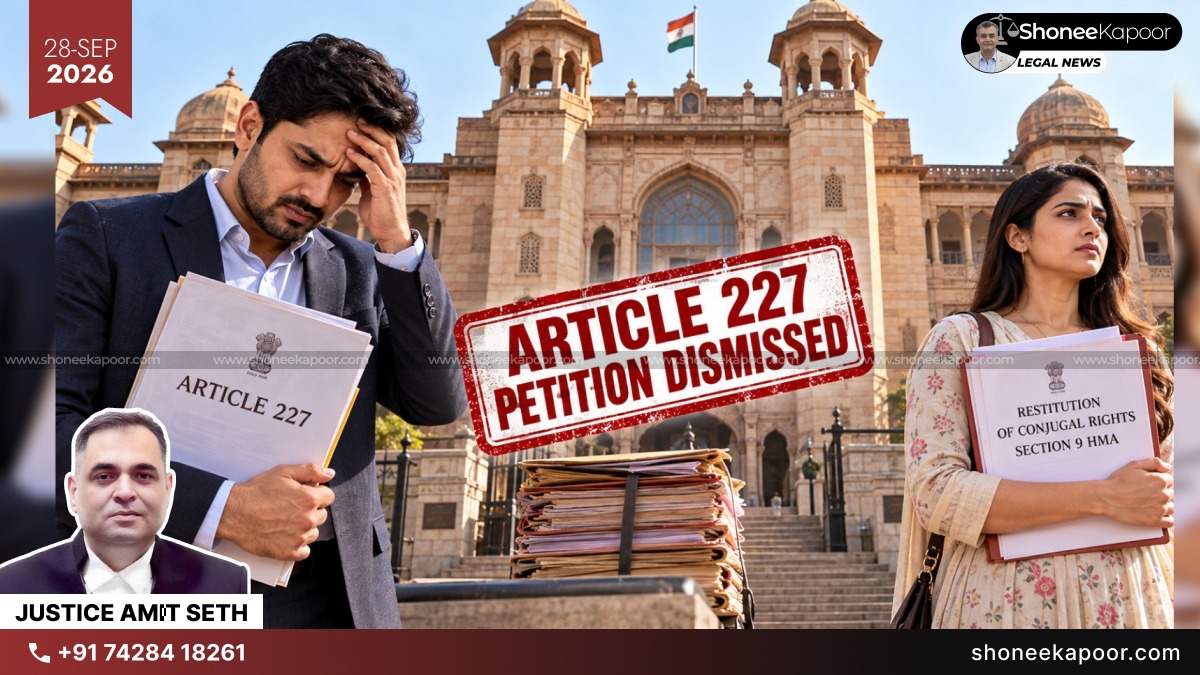
Section 9 Hindu Marriage Act | Spouse Cannot Use Article 227 to Quash Restitution of Conjugal Rights Plea: MP High Court

Curated by NEWS DESK
Editorial DeskMADHYA PRADESH: The Madhya Pradesh High Court has dismissed a husband’s petition seeking to quash his wife’s restitution of conjugal rights proceedings under Section 9 of the Hindu Marriage Act, 1955, holding that a petition under Article 227 of the Constitution was not maintainable for this purpose.
Justice Amit Seth was dealing with a petition filed by the husband against proceedings initiated by his wife before the Family Court, Gwalior.
The husband claimed that the wife’s Section 9 case was “a gross abuse of process of law” and had been filed “for the sheer purpose of harassing the petitioner/husband.”
According to the husband, he had himself filed proceedings for restitution of conjugal rights in 2018, but the wife had refused to live with him. He therefore argued that her subsequent Section 9 petition was a “counter-blast” to his divorce proceedings. The husband claimed that the parties had been separated since March 2007.
The wife opposed his petition on maintainability. Her counsel argued that the High Court’s supervisory power under Article 227 “cannot be invoked to supplant the original jurisdiction of the subordinate court or to bypass statutory remedies.”
The litigation had an unusual procedural history. On 18 June 2025, a Coordinate Bench had allowed the husband’s petition and quashed the wife’s Section 9 proceedings. However, on the wife’s review petition, the Court recalled that order on 13 August 2025, after considering the Supreme Court judgment in K. Valarmathi and Others v. Kumaresan.
Before Justice Amit Seth, counsel for the husband relied upon Rinju v. Santosh, Surya Dev Rai v. Ram Chander Rai and Others and the Madras High Court decision in K. Sivakumar v. Anita Udayakumar to support the maintainability of his petition.
The High Court examined the Family Courts Act, the Hindu Marriage Act, and the Code of Civil Procedure. It noted that Section 10 of the Family Courts Act makes the CPC applicable to proceedings before a Family Court and that a decree under Section 9 HMA is subject to the statutory appellate framework.
The Court held that
“the proceedings under Section 9 of the HM Act are civil proceedings qua which the Court is competent to pass a decree of restitution of conjugal rights.”
Referring to the Supreme Court decisions in Jacky v. Tiny Alias Antony and Others and K. Valarmathi, the High Court further observed that
“in no case can power under Articles 226 and 227 of the Constitution of India be exercised to question a plaint.”
The Court cautioned against bypassing the proper legal procedure just to get a quick result, observing that doing so could defeat procedural safeguards and substantive legal rights.
The husband also sought to rely upon Article 226 of the Constitution. The High Court noted that he had filed his petition under Article 227 and that the Supreme Court had “partly overruled” Surya Dev Rai and Another v. Chhabi Nath and Others. The latter decision held that judicial orders of civil courts are not amenable to writ jurisdiction under Article 226.
The Court also found that the earlier review order dated 13 August 2025 had considered the relevant arguments and had “attained finality inter se between the parties.” It was therefore binding between the husband and wife.
Accordingly, the MP High Court dismissed the husband’s Article 227 petition on maintainability, without deciding the factual merits of his allegation that the wife’s case was intended to harass him.
Importantly, the dismissal did not leave the husband without recourse. The Court expressly granted him liberty to seek remedy as may be permissible in law. He can therefore raise his permissible objections through the appropriate statutory procedure rather than using Article 227 to directly quash the pending matrimonial proceedings.
EXPLANATORY TABLE OF LAWS AND SECTIONS
| Law / Provision | What It Means | Relevance In This Case |
|---|---|---|
| Section 9, Hindu Marriage Act, 1955 | Provides a remedy for restitution of conjugal rights where one spouse withdraws from the society of the other without reasonable excuse. | The wife filed the proceedings under this provision before the Family Court, Gwalior. |
| Section 28, Hindu Marriage Act, 1955 | Deals with appeals from decrees and certain orders passed under the HMA. | Relied upon while examining the statutory nature of the remedy and appellate framework. |
| Section 10, Family Courts Act, 1984 | Broadly applies CPC procedure to suits and proceedings before Family Courts, subject to the Act and applicable rules. | Supported the Court’s conclusion that the Section 9 proceeding was a civil proceeding governed by an established statutory procedure. |
| Section 19, Family Courts Act, 1984 | Provides the appellate framework for judgments and orders of Family Courts, subject to statutory conditions. | Relevant to the availability of statutory remedies against Family Court decisions. |
| Order VII Rule 11, CPC | Permits rejection of a plaint on specified statutory grounds. | The earlier review proceedings considered the Supreme Court’s ruling that the CPC provides its own mechanism for challenging a plaint and that this procedure should not be bypassed through Article 227. |
| Article 226, Constitution of India | Gives High Courts writ jurisdiction to enforce fundamental rights and other legal rights. | The husband alternatively relied upon Article 226, but the Court referred to the rule that judicial orders of civil courts are not amenable to writ jurisdiction under Article 226. |
| Article 227, Constitution of India | Gives every High Court supervisory jurisdiction over courts and tribunals within its territory. | The husband invoked this provision to seek quashing of the wife’s Section 9 proceedings. The Court held that it could not be used here to bypass the prescribed civil procedure and statutory remedies. |
CASE DETAILS
| Particulars | Details |
|---|---|
| Case Title | D v. G |
| Court | High Court of Madhya Pradesh, Gwalior Bench |
| Case Number | Miscellaneous Petition No. 2816 of 2024 |
| Neutral Citation | 2026:MPHC-GWL:29158 |
| Date of Order | 23 September 2026 |
| Bench | Justice Amit Seth |
| Petitioner | Husband |
| Respondent | Wife |
| Counsel for Petitioner/Husband | Shashank Sharma, Haush Sharma and Atif, Advocates |
| Counsel for Respondent/Wife | Madan Mohan Shrivastava, Advocate |
| Decision | Husband’s Article 227 petition dismissed as not maintainable; liberty granted to seek remedy permissible in law. |
KEY TAKEAWAYS
- Husband alleged harassment: He argued that the wife’s Section 9 HMA case was a “counter-blast” to his divorce proceedings and was filed to harass him.
- Article 227 route rejected: The MP High Court held that Article 227 cannot be used to directly quash the wife’s restitution proceedings.
- Merits were not decided: The Court did not decide whether the husband’s allegations against the wife were true or false. The petition failed on maintainability.
- Earlier relief was recalled: The husband had earlier succeeded in getting the wife’s Section 9 proceedings quashed, but that order was subsequently recalled on the wife’s review petition.
- Husband can still challenge legally: The Court expressly preserved his liberty “to seek remedy as may be permissible in law.” He must therefore raise his objections through the appropriate legal procedure.
Read Also:- Why Not To File The Restitution Of Conjugal Rights?
Share Your Thoughts
Comments are moderated before publication.