
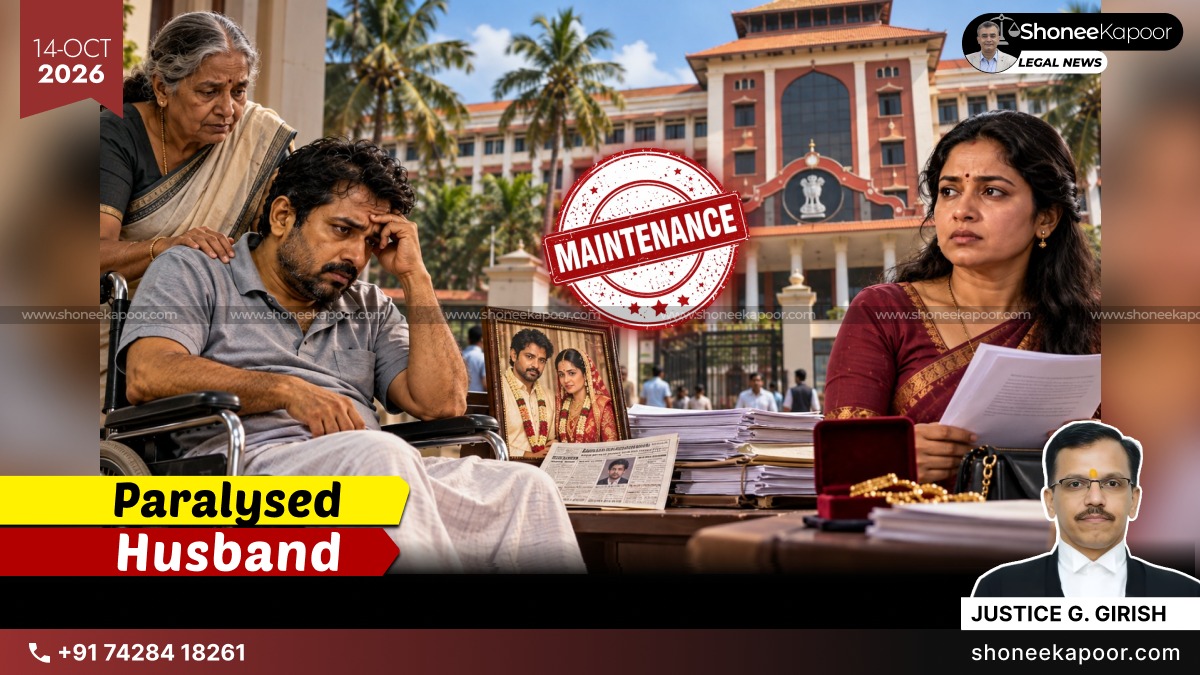
70% Permanently Disabled Husband Ordered To Pay Maintenance | "Physical Disability Immaterial If He Has Means To Maintain Wife": Kerala High Court

Curated by NEWS DESK
Editorial DeskKOCHI: The Kerala High Court has dismissed a 70% physically disabled husband's petition against ₹10,000 monthly maintenance awarded to his former wife, holding that physical disability alone cannot exempt a husband from paying maintenance if he has sufficient financial resources.
Justice G. Girish, in a judgment dated September 30, 2026, upheld the Family Court, Kottayam's maintenance order, observing that the husband had knowingly entered into marriage despite being unable to fulfil his conjugal obligations.
The couple married on August 1, 2015, after the husband published a matrimonial advertisement in a leading newspaper. It was his second marriage, and the marriage was never consummated.
The husband claimed that a paralytic stroke suffered on October 29, 2012, had left him physically incapable of maintaining a marital relationship. He also stated that he had published the matrimonial advertisement only to find someone to care for him and his mother.
After their marriage broke down, the wife approached the Family Court seeking divorce, maintenance and return of gold ornaments and money.
The Family Court granted divorce on the ground of cruelty but rejected the wife's claim for gold ornaments and money. However, it directed the husband to pay ₹10,000 monthly maintenance.
Challenging the order before the Kerala High Court, the husband argued that his severe physical disability prevented him from working or earning. His counsel submitted medical records and a certificate from the Medical Board, General Hospital, Pathanamthitta, confirming 70% permanent locomotor disability affecting his whole body.
The High Court acknowledged the husband's medical condition but held that physical inability to work does not automatically establish financial inability to pay maintenance.
The Family Court had considered the husband's statements that he and his mother had paid the marriage expenses and that he had supported his wife financially while they lived together. Based on these circumstances, it concluded that the husband had sufficient financial resources but was concealing his income.
The Court also accepted the finding that the wife lacked sufficient means to maintain herself.
Significantly, the High Court observed that the husband's 70% disability did not invalidate the maintenance order, as his financial capacity had not been assessed merely on whether he was an ‘able-bodied person’.
The Court further examined the husband's admission that he had published the matrimonial advertisement to find someone to care for him and his mother, despite knowing that he could not perform his marital and conjugal obligations.
It held that the husband had entered into marriage under these circumstances and could not subsequently avoid his responsibility to pay maintenance.
Accordingly, the Kerala High Court dismissed RPFC No. 122 of 2024, finding no illegality or error in the Family Court's decision and upholding ₹10,000 monthly maintenance to the divorced wife.
EXPLANATORY TABLE OF LAWS AND SECTIONS
| Law / Section | What It Means | Application to This Case |
|---|---|---|
| Section 125 CrPC | Provides maintenance to eligible wives, children and parents who cannot maintain themselves. | The underlying maintenance case was filed in 2019. The order does not expressly identify this section. |
| Section 144 BNSS | Current provision broadly corresponding to Section 125 CrPC. | Relevant to maintenance proceedings under the current procedural law, but not cited in this judgment. |
| Section 13(1)(ia), Hindu Marriage Act, 1955 | Provides divorce on the ground of cruelty in marriages governed by the Act. | Divorce was granted on cruelty grounds, but the judgment does not identify the statutory provision or personal law applied. |
CASE DETAILS
| Particular | Details |
|---|---|
| Case Title | A v. D |
| Court | High Court of Kerala at Ernakulam |
| Bench | Justice G. Girish, Single Judge |
| Case Number | RPFC No. 122 of 2024 |
| Neutral Citation | 2026:KER:74921 |
| CNR Number | KLHC010998502024 |
| Family Court Case | MC No. 137 of 2019 |
| Family Court Order | 14 November 2023 |
| Date of High Court Order | 30 September 2026 |
| Counsel for Husband | K. Saneesh Kumar; V.B. Santhini |
| Counsel for Wife | Ananthakrishnan A. Kartha; Anil D. Kartha; Suresh G.; Sharath Eldo Philip; Sreekumar G.; Ananthasankar A. Kartha |
| Final Decision | Husband's revision petition dismissed; ₹10,000 monthly maintenance upheld |
KEY TAKEAWAYS
- 70% Disabled, Yet Ordered To Pay! A husband suffering from permanent physical disability was still directed to pay ₹10,000 monthly maintenance.
- Unable To Work, But Maintenance Continues! Despite medical evidence of severe disability, the husband's claim of inability to earn failed because the Court found he had sufficient resources.
- Supporting His Wife Became Evidence Against Him! The husband's past spending on marriage and financial support for his wife were used to assess his ability to pay maintenance.
- 70% Disability, No Relief From Maintenance! The Court upheld financial liability despite acknowledging his serious medical condition, relying on findings that he had sufficient means.
- A Disabled Man's Suffering Deserves Justice Too! A husband's 70% disability cannot be ignored. Men deserve fair maintenance decisions based on actual financial capacity, not merely past expenses or presumed income.
Share Your Thoughts
Comments are moderated before publication.