
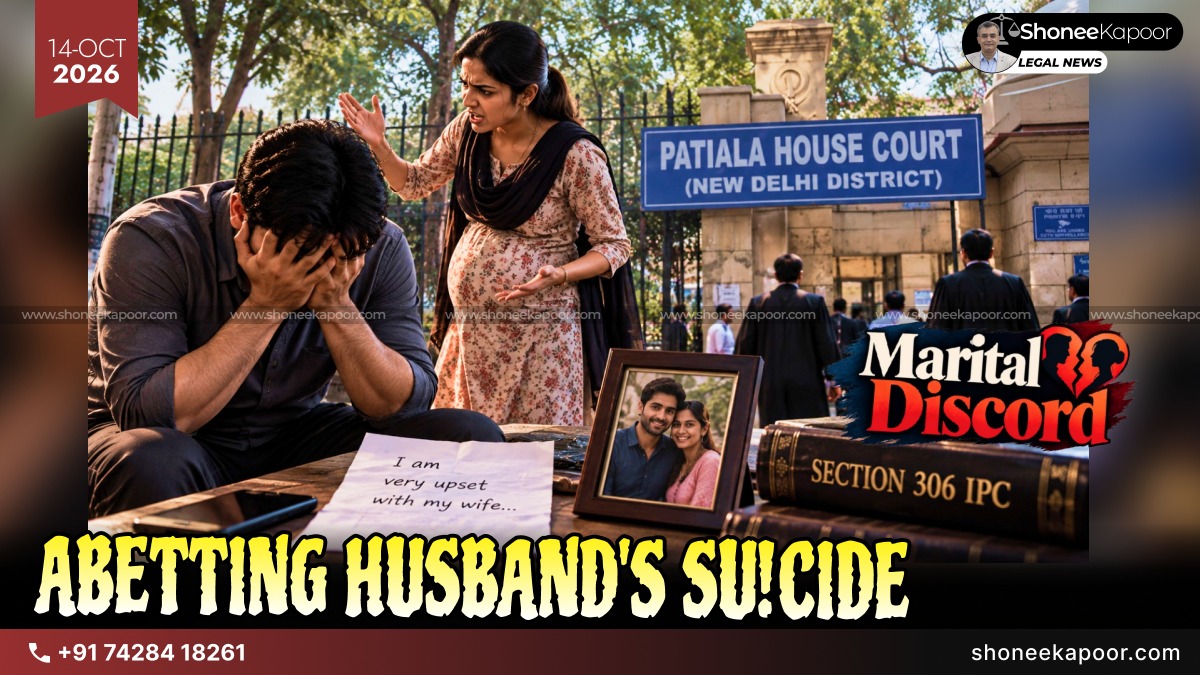
306 IPC | Husband Died By Suicide After Being Subjected To Matrimonial Discord, Yet Wife Accused Of Abetting His Suicide Walks Free! Delhi Court Acquits Woman

Curated by NEWS DESK
Editorial DeskNEW DELHI: A Delhi Sessions Court has acquitted a wife accused of abetting her husband's suicide, ruling that matrimonial disputes, verbal arguments and harsh words alone cannot establish criminal liability under Section 306 IPC.
The Additional Sessions Judge of the Patiala House Courts, Delhi, delivered the judgment on September 10, 2026, acquitting the wife after the prosecution failed to prove intentional instigation or abetment beyond a reasonable doubt. The judgment was reported by PTI on October 13, 2026.
The case involved Husband, who died by suicide on July 20, 2015, at his rented accommodation in Munirka, Delhi. He had married his wife on February 22, 2015, just five months before his death. His wife was pregnant at the time.
According to the prosecution, his wife frequently quarrelled with him over his small mobile shop and allegedly pressured him to leave the business and find a job. Husband's family claimed that these repeated arguments caused him serious mental harassment and emotional distress.
The prosecution accused his wife of “mentally torturing” her husband.
During the investigation, police recovered a suicide note from the husband's clothing, in which he stated that he was “very upset” with his wife. He alleged that she accused him “day and night” of having an extramarital affair, which he denied.
In his suicide note, Husband also expressed distress over living away from his parents and sought legal punishment for his wife.
However, the Delhi Court observed that the prosecution witnesses had mainly described verbal arguments and failed to establish any specific act proving that the wife had intentionally driven Husband towards suicide.
The Court explained that abetment of suicide under Section 306 IPC requires evidence of intentional instigation, encouragement or assistance, along with a sufficiently direct connection between the accused's conduct and the suicide.
It clarified that hurtful remarks, marital quarrels or emotional harassment do not automatically amount to criminal abetment without the required intention and supporting evidence.
The Court observed that matrimonial disputes, arguments, taunts and harsh words, even when hurtful or abusive, do not automatically amount to abetment of suicide under Section 306 IPC. Criminal liability cannot be imposed merely because a person faced marital problems or was emotionally affected by their spouse's behaviour.
The judgment further noted that people react differently to mental stress, humiliation, financial difficulties and matrimonial problems, depending on their personal circumstances and emotional strength.
The Court observed:
“A person differently situated, confronted with the same matrimonial or financial circumstances, may respond differently, having regard to his responsibilities, family circumstances and capacity to cope with emotional distress,”
The Court found no evidence of any direct, active or intentional act by wife immediately before Husband's suicide that could establish the legal ingredients of abetment.
It concluded:
“Consequently, even if the allegations of matrimonial discord and the alleged harsh words are accepted in their entirety, they do not, in the facts and circumstances of the present case, establish the ingredients of abetment of suicide beyond reasonable doubt.”
Accordingly, the Delhi Sessions Court acquitted the wife of abetment of her husband's suicide under Section 306 IPC, nearly 11 years after Husband's death.
EXPLANATORY TABLE OF LAWS AND SECTIONS
| Law / Section | What It Means | Application In This Case |
|---|---|---|
| Section 306 IPC | Punishes abetment of suicide with imprisonment of up to 10 years and a fine. | Wife was acquitted because intentional abetment was not proved. |
| Section 107 IPC | Defines abetment through instigation, conspiracy or intentional assistance. | The Court found insufficient evidence of the required conduct and intention. |
| Section 173 CrPC | Governs the police report submitted after investigation. | The chargesheet was filed following the investigation. |
| Section 294 CrPC | Provides a procedure for admitting or denying the genuineness of documents. | The accused admitted the post-mortem report during trial. |
| Section 161 CrPC | Concerns police examination of witnesses during investigation. | Witness statements formed part of the prosecution evidence. |
| Section 65B, Indian Evidence Act, 1872 | Governs admissibility requirements for electronic records. | Electronic evidence and the related certificate were included in the trial record. |
CASE DETAILS
| Particular | Details |
|---|---|
| Case Title | State Vs. Wife |
| Court | Additional Sessions Judge-02, New Delhi District, Patiala House Courts |
| Case Number | SC 362/2019 |
| CNR Number | DLND010142912019 |
| FIR Number | 1209/2015 |
| Date of Judgment | 10 September 2026 |
| Final Decision | Accused acquitted under Section 306 IPC |
KEY TAKEAWAYS
- Husband's Suicide, Wife Acquitted: Husband died within five months of marriage, leaving a suicide note expressing distress over his wife's conduct.
- Mental Harassment Alleged, Abetment Not Proved: The Court held that matrimonial quarrels and harsh words alone cannot establish abetment under Section 306 IPC.
- If Roles Were Reversed? Section 113A permits a presumption of abetment in certain cases involving a married woman's suicide, but offers no equivalent protection when a husband dies.
- Why This Legal Double Standard? A husband can face a statutory presumption when the required conditions are proved, while a wife faces no corresponding presumption in an equivalent case.
- Men Deserve Equal Legal Protection: A man's suicide deserves equal scrutiny, equal legal safeguards and equal justice. Gender should never determine whose suffering matters.
Share Your Thoughts
Comments are moderated before publication.