
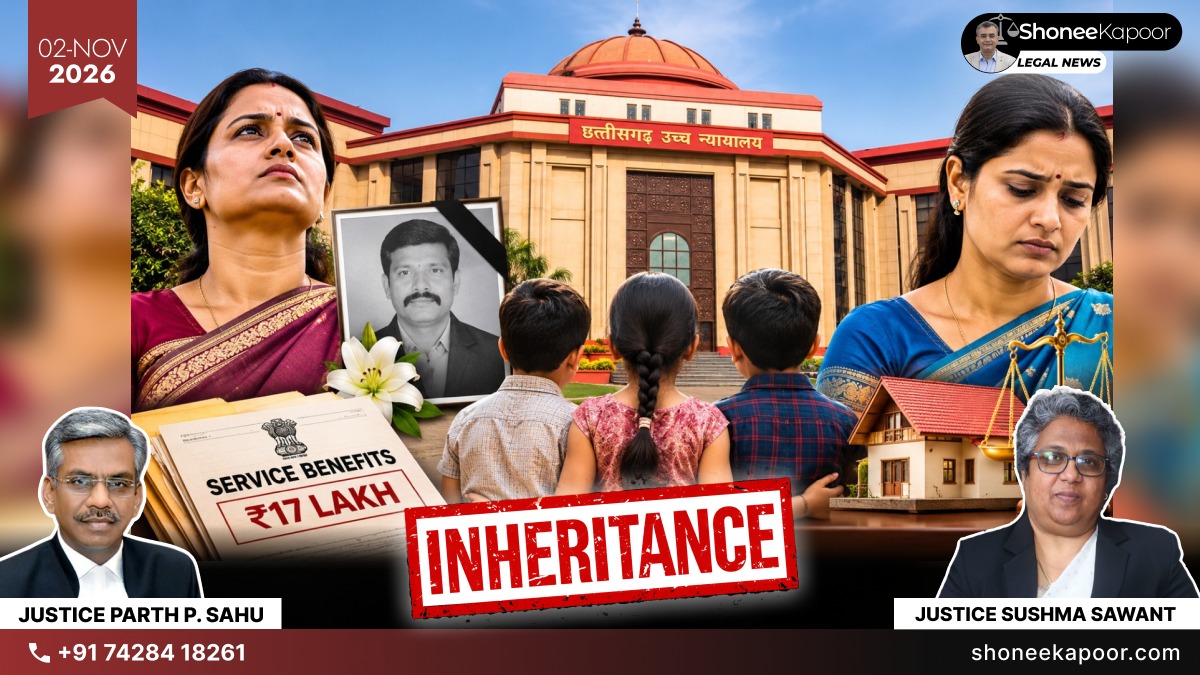
Two Women Claim Deceased Husband’s Property, Neither Recognised As Lawful Wife, Yet 3 Children Get Equal Inheritance Rights: Chhattisgarh HC Explains

Curated by NEWS DESK
Editorial DeskCHHATTISGARH: The Chhattisgarh High Court has ruled that neither of the two women claiming to be the lawful wife of a deceased government employee was legally entitled to that status. However, the Court recognised the equal inheritance rights of all three biological children in their father's immovable property.
A Division Bench of Justice Parth Prateem Sahu and Justice Sushma Sawant delivered the judgment on 13 October 2026 while deciding two appeals arising from a family property dispute.
The dispute began after Sukhidas Kurre, an Assistant Veterinary Services Area Officer, died on 12 August 2015. Two women, Shobha Sahu and Ashok Lata Kurre, claimed rights over his property and approximately ₹17 lakh in service-related benefits.
The first woman, Shobha Sahu, had executed a customary separation agreement dated 10 July 2000 and subsequently entered another relationship with Arun Sahu. However, she later questioned the validity of that agreement while claiming rights as the deceased man's lawful wife.
The High Court examined her service records, which identified Arun as her husband. It also considered her admission that Arun was nominated to receive 100% of her service-related dues.
Rejecting her contradictory stand, the Court observed:
"A party cannot be permitted to approbate and reprobate according to the advantage sought to be derived from the same document."
The Bench further explained that a person cannot accept and reject the same transaction according to convenience.
The second woman also claimed to be the deceased employee's lawful wife. However, during cross-examination, she admitted that her earlier marriage to Dhanesh Kosle had never been legally dissolved.
The High Court held that her previous marriage was still legally subsisting, preventing her from being recognised as the deceased man's lawful wife.
After examining both claims, the Court concluded that
"neither the first wife nor the second wife was the legally wedded wife of deceased Sukhidas on the date of his death."
However, the High Court distinguished between marital status and children's inheritance rights.
The Court found that all three children were the biological children of the deceased, and their parentage was not disputed.
The Bench held that
"all three children are entitled to an equal share therein."
Accordingly, the High Court recognised equal inheritance rights for all three children in their deceased father's immovable property, irrespective of the legal status of their mothers' marriages.
The dispute also involved approximately ₹17 lakh in pension, GPF, gratuity and other service-related benefits.
However, the Court declined to uphold the declaratory relief concerning these dues because the parties had not sought the necessary recovery relief or paid the required court fees.
The Bench permitted the parties to approach the competent court for succession-certificate proceedings under Part X of the Indian Succession Act, 1925, wherever applicable.
The Chhattisgarh High Court therefore protected the children's equal shares in their father's immovable property while leaving the competing claims over ₹17 lakh service dues to be resolved through appropriate legal proceedings.
EXPLANATORY TABLE OF LAWS AND SECTIONS
| Law / Section | What It Means | Application in This Case |
|---|---|---|
| Section 5, Hindu Marriage Act, 1955 | Sets conditions for a valid Hindu marriage, including that neither party has a living spouse. | The second woman's earlier undissolved marriage affected her claim as lawful wife. |
| Section 96, CPC, 1908 | Allows appeals against original civil decrees. | Both appeals challenged the Trial Court's decree. |
| Section 107, CPC, 1908 | Gives appellate courts powers to examine and decide issues. | High Court examined the legality of the relief granted. |
| Section 34, Specific Relief Act, 1963 | Permits declarations of legal rights, subject to conditions concerning further relief. | A declaration alone was insufficient to recover the ₹17 lakh service dues. |
| Part X, Indian Succession Act, 1925 | Governs succession certificates for qualifying debts and securities. | Parties were allowed to seek succession certificates for applicable service dues. |
CASE DETAILS
| Particular | Details |
|---|---|
| Case Title | Smt. ALK & Others v. State of Chhattisgarh & Others |
| Court | Chhattisgarh High Court, Bilaspur |
| Bench | Justice Parth Prateem Sahu and Justice Sushma Sawant |
| Judgment Date | 13 October 2026 |
| Neutral Citation | 2026:CGHC:44253-DB |
| Case Numbers | FA No. 163/2023 & FA No. 209/2023 |
| Nature of Case | Civil Appeals – Matrimonial Status, Property Inheritance & Service Benefits |
| Counsel for Appellants | Senior Advocate Manoj Paranjpe, assisted by Advocate Shivangi Agrawal |
| Counsel for State | Deputy Advocate General Sumit Singh |
| Counsel for Contesting Respondents | Advocate Pranav Tiwari |
| Original Court | Additional District Judge, Rajnandgaon |
| Original Decree Date | 12 September 2023 |
| Final Decision | Neither woman recognised as lawful wife; three biological children entitled to equal shares in deceased father's immovable property; service-dues relief left to appropriate proceedings. |
KEY TAKEAWAYS
- Two Women, One Deceased Husband's Property: Both claimed wife's rights, but neither was recognised as his lawful wife.
- Marriage Cannot Be a Matter of Convenience: First woman's contradictory stand on customary separation rejected.
- Existing Marriage Cannot Be Ignored: Second woman's undissolved marriage defeated her claim as lawful wife.
- A Father's Property Is Not Up for Exclusive Claims: All three biological children secured equal inheritance rights.
- ₹17 Lakh Service Dues Remain Disputed: The court refused declaratory relief without proper legal proceedings.
Share Your Thoughts
Comments are moderated before publication.