
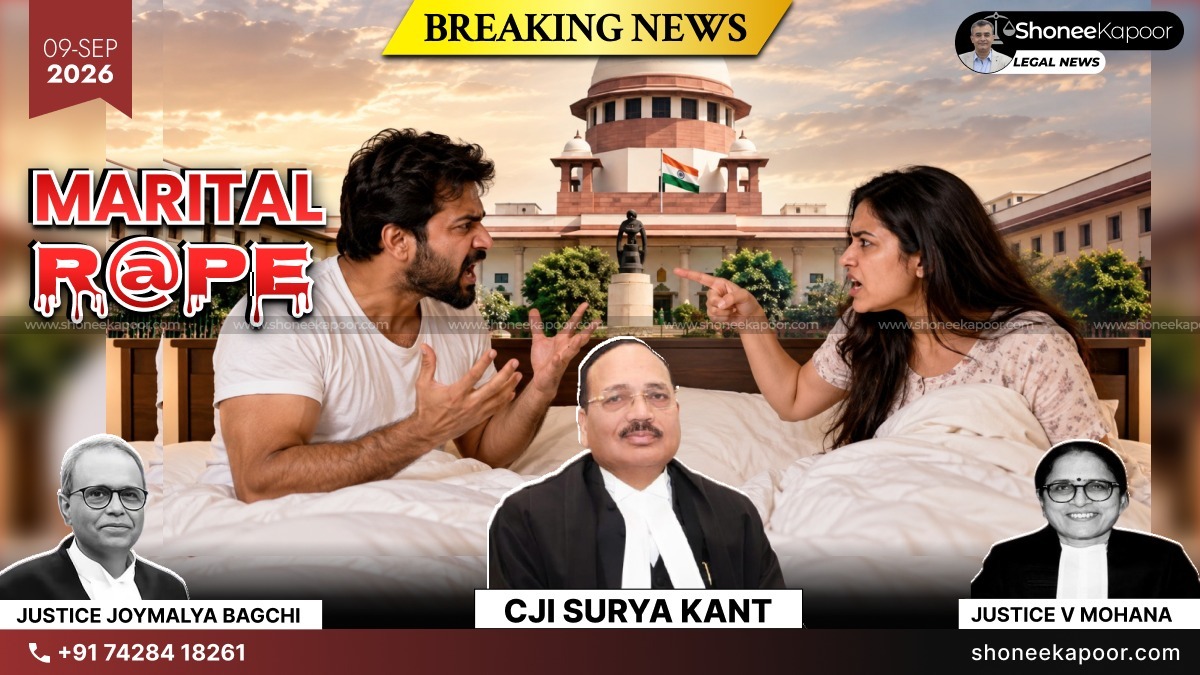
BREAKING | Marital Rape Exception | “Marriage Doesn’t Extinguish Autonomy, But Can Husband Be Prosecuted For Rape?” Supreme Court To Decide

Written and analysed by Vaibhav Ojha
Head Of Legal CommunicationsIf the law expressly excludes sexual acts between spouses from the offence of rape, can a husband still be prosecuted for rape without first striking down that exception? The Supreme Court will now examine both the validity of the marital rape exception and the limits of criminal prosecution within marriage.
NEW DELHI: The Supreme Court on September 9 said it will take up for final hearing the batch of petitions challenging the marital rape exception after three weeks.
The issue before the Court concerns whether non-consensual sexual acts by a husband against his adult wife should be prosecuted as rape and whether the existing statutory exception is constitutionally valid.
Under the earlier Indian Penal Code (IPC), Exception 2 to Section 375 excluded sexual intercourse or sexual acts by a man with his own wife, provided she was not under 18 years of age, from the definition of rape.
The Bharatiya Nyaya Sanhita, 2023 (BNS), which replaced the IPC from July 1, 2024, continues a similar marital exception under Section 63.
A Bench comprising Chief Justice of India Surya Kant, Justice Joymalya Bagchi and Justice V Mohana noted that the Central government had filed its response and directed the parties to complete the necessary compilations before final hearing.
The Court directed:
"The Union Government has filed its reply in the connected matters also. A copy thereof shall be supplied to all learned counsel appearing in the connected cases within two days. We are informed that the other pleadings are complete. The nodal counsel, on behalf of the petitioners, shall compile the pleadings and prepare a combined compilation, along with a separate set of documents/pleadings relied upon by the parties. The respondents' compilation, as well as citations to be relied upon, shall also be exchanged. List these matters for final hearing after 3 weeks on a Wednesday and Thursday,"
During the hearing, the Supreme Court made an important distinction between individual autonomy within marriage and the power of a criminal court to prosecute a person for an act which the penal statute currently excludes from the offence of rape.
The Court accepted the broader argument that marriage does not destroy the individual autonomy of a woman. At the same time, it stressed that rape is a penal offence and criminal prosecution must operate according to the law as it presently stands.
Justice Bagchi observed:
"We fully appreciate the submission that there is no question of marriage resulting in an extinction of individual autonomy. Point well taken. Now see the law as it stands. It is a penal law. And therefore, before a person can be prosecuted, rightly or wrongly, a constitutional court has to render a verdict that the exception is unreasonable or manifestly arbitrary. Only then can prosecution on that score be permitted,"
This observation brings an important criminal-law question into focus. The debate is not merely about whether a married woman has autonomy. The Court must also decide whether a husband can be exposed to prosecution for the specific offence of rape while Parliament's statutory exception continues to remain in force.
The Supreme Court indicated that it would examine two separate legal questions. First, if the marital rape exception is upheld, whether the conduct in question can nevertheless constitute an offence. Second, whether the exception itself should survive constitutional scrutiny.
The Chief Justice remarked:
"We will answer both questions. One, suppose the provision is sustained, despite that, whether it constitutes an offence. (Two), their direct challenge is to the provision itself, that it is not liable to be sustained,"
The Court will therefore also consider the legal consequences of reading down the marital rape exception. One of the central issues is whether courts can, through interpretation, bring within the definition of rape an act that the legislature has expressly excluded from that offence.
This question has significant consequences for both victims and accused persons. Protection against sexual violence within marriage is an important legal concern, but criminal law also requires certainty about what conduct constitutes an offence before an individual is prosecuted and exposed to serious penal consequences.
The Supreme Court further clarified that the marital rape exception does not mean that violence committed during marriage is completely protected from criminal law.
Where the conduct causes grievous injury, physical harm or death, other penal offences may apply depending on the facts and evidence of the particular case.
The Court stated:
"The question before us is whether, despite such status as a victim, the State defines it as rape or not. Where grievous injury or harm is caused, there are other provisions. There may be offences under Sections 323, 324 or culpable homicide. So it is not that the offence is restricted only within the four corners of rape as defined under the Indian Penal Code. The exception does not protect a perpetrator if he has caused grievous injury or death,"
The constitutional dispute has been pending since the Delhi High Court delivered a split verdict in 2022.
Justice Rajiv Shakdher held that Exception 2 to Section 375 IPC, which protected a husband from rape prosecution for non-consensual sexual acts against his adult wife, was unconstitutional.
Justice C Hari Shankar, however, upheld the exception. He concluded that the legislative classification had an intelligible differentia.
The conflicting opinions ultimately brought the constitutional question before the Supreme Court.
The Central government has supported retaining the existing marital rape exception and has argued that the issue has significant social dimensions and cannot be viewed purely as a legal question.
Senior Advocates Indira Jaising, Gopal Sankaranarayanan, Karuna Nundy and NS Nappinai appeared for different petitioners.
Solicitor General Tushar Mehta represented the Central government.
The Supreme Court has now made it clear that the final hearing will address the issue at two levels: whether the marital rape exception itself is constitutionally valid and what criminal liability can exist if the exception continues to remain part of the law.
The eventual judgment could have major consequences for matrimonial and criminal law in India because it will have to balance bodily autonomy and protection from sexual violence with statutory interpretation, constitutional limits and the fundamental principle that criminal liability must have a clear basis in penal law.
LAWS AND SECTIONS EXPLAINED
| LAW / SECTION | WHAT IT PROVIDES | RELEVANCE TO THIS CASE |
|---|---|---|
| Section 375 IPC | Defined the offence of rape under the former IPC. | The constitutional controversy originally arose from its marital exception. |
| Exception 2 to Section 375 IPC | Excluded specified sexual intercourse/sexual acts by a man with his own adult wife from the definition of rape. | This is the old statutory marital rape exception under challenge in the connected proceedings. |
| Section 63 BNS, 2023 | Current provision defining the offence of rape. | It replaced Section 375 IPC after the BNS came into force. |
| Exception 2 to Section 63 BNS | States that sexual intercourse or sexual acts by a man with his own wife, where the wife is not under 18, are not rape. | This is the current marital rape exception whose constitutional implications are being examined. |
| Section 323 IPC | Punishment for voluntarily causing hurt under the former IPC. | The Court referred to other criminal offences being available where bodily harm is caused. |
| Section 324 IPC | Former IPC provision concerning voluntarily causing hurt by dangerous weapons or means. | Mentioned by the Court while explaining that the marital rape exception does not create blanket immunity for other violence. |
| Culpable Homicide Provisions | Penal provisions dealing with causing death in circumstances amounting to culpable homicide. | The Court stressed that the exception from rape does not immunise conduct causing death. |
| Section 377 IPC | Former provision concerning specified “unnatural offences”; its application has been substantially altered after constitutional rulings. | Section 377 allegations form part of the background of the Hrishikesh Sahoo litigation. |
| Section 498A IPC | Punished cruelty by husband or relatives of husband against a married woman. | One of the offences forming part of the underlying criminal allegations in Hrishikesh Sahoo. |
| Section 506 IPC | Criminal intimidation. | Also recorded among allegations in the underlying criminal case. |
| POCSO Act, Section 10 | Punishment relating to aggravated sexual assault against a child. | Separate allegations relating to the daughter also arose in the underlying Sahoo proceedings. |
CASE DETAILS
| PARTICULAR | DETAILS |
|---|---|
| Court | Supreme Court of India |
| Date of Proceedings | September 9, 2026 |
| Nature of Matter | Batch of petitions concerning the constitutional validity and interpretation of the marital rape exception |
| Leading Connected Matter | Hrishikesh Sahoo v. State of Karnataka & Ors. |
| Case Number | SLP (Crl.) Nos. 4063-4064/2022 |
| Important Connected Petition | Red Dot Foundation v. Union of India & Others, W.P. (Crl.) No. 217/2026; tagged with SLP (Crl.) Nos. 4063-4064/2022. |
| Issue | Whether the marital rape exception is constitutionally valid and, if it survives, whether conduct excluded from “rape” can nevertheless attract criminal prosecution under other provisions |
| Current Status | Pending. Final hearing directed to be listed after three weeks, on Wednesdays and Thursdays |
| Final Judgment? | No. The Supreme Court has not yet decided the constitutional challenge. |
BENCH
- Chief Justice of India Surya Kant
- Justice Joymalya Bagchi
- Justice V. Mohana
COUNSELS TODAY - SEPTEMBER 9 PROCEEDINGS
For various petitioners:
Senior Advocate Indira Jaising
Senior Advocate Gopal Sankaranarayanan
Senior Advocate Karuna Nundy
Senior Advocate N.S. Nappinai
For Union of India:
Solicitor General Tushar Mehta
KEY TAKEAWAYS
- The Supreme Court has not criminalised marital rape yet. The constitutional challenge is still pending.
- A husband cannot automatically be prosecuted for rape while an express statutory exception continues to exist.
- The Court itself stressed that penal liability must have a clear legal basis before prosecution is permitted.
- Marriage is not immunity from violence. Hurt, grievous injury, homicide and other offences can still apply on proven facts.
- For men, the larger issue is due process. A serious accusation cannot be allowed to become punishment before the law itself clearly defines the offence.
Share Your Thoughts
Comments are moderated before publication.