
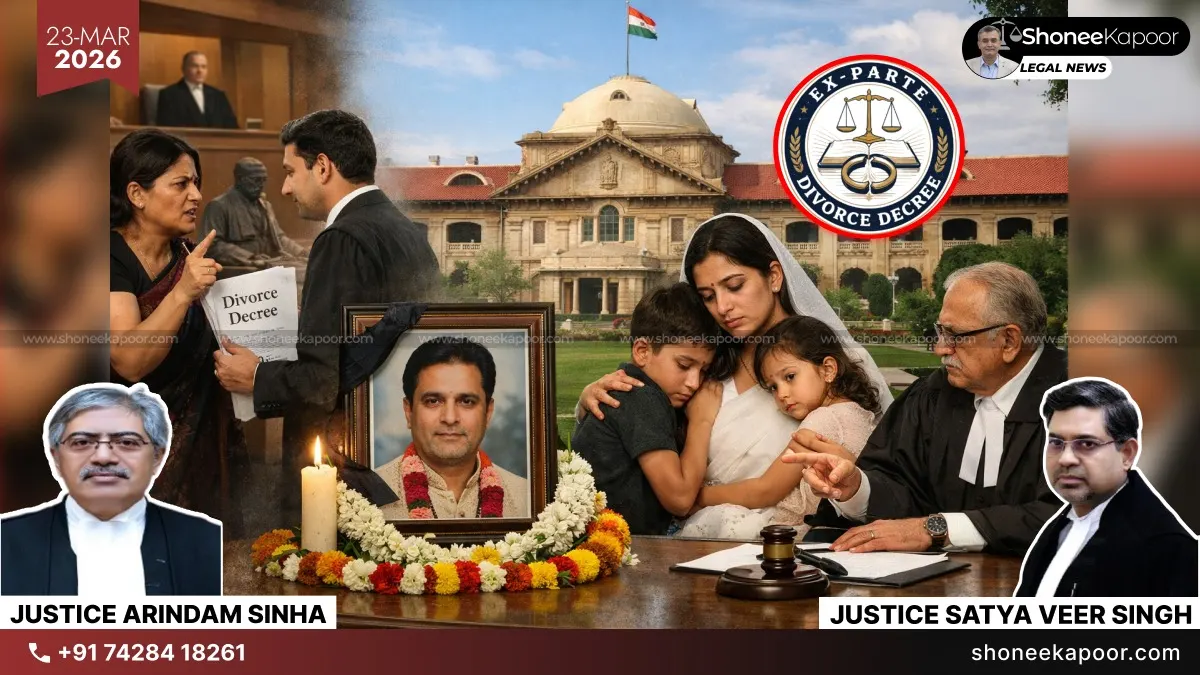
Before the Allahabad High Court, a long-settled divorce was challenged only after the husband’s death to claim financial benefits:
Is it legally permissible to reopen a 30-year-old ex-parte divorce decree when it affects the rights of the second wife and children?
PRAYAGRAJ: In a judgment dated 16 March 2026, the Allahabad High Court, led by Justice Arindam Sinha and Justice Satya Veer Singh rejected an attempt by a first wife to set aside a 1991 ex-parte divorce decree after the husband’s death in 2023. The move came only when she tried to claim death benefits, directly affecting the second wife and her children.
The Family Court had earlier allowed this request despite a delay of over 30 years. However, the High Court examined whether such a challenge is legally valid when the husband is no longer alive.
After analysing the facts, the Court found that reopening such a case would unfairly disturb the settled rights of the second wife, who had no role in the original proceedings and no opportunity to defend allegations like fraud or improper service.
The Court made an important observation on the position of the parties and the effect of such delayed action:
“One thing is clear to us. It is that appellants cannot prove anything as fact regarding service of summons nor substituted service taken place in the second matrimonial case, decreed ex-parte on 13th November, 1991. Appellant no. 1 was stranger to the proceeding. Hence, respondents could not prosecute the application for setting aside the decree against such persons, as substitutes of the dead person. Restoration of the original matrimonial case in such circumstances renders respondent no. 1 to have status of widow, thereby displacing respondent no. 1 completely, without her being able to say anything in respect of the allegations on questions of fact regarding service of the summons nor the substituted service.”
The Court also highlighted that once the husband has died, matrimonial disputes lose their legal foundation and cannot be revived. It relied on the principle laid down in Smt. Yallawwa vs. Smt. Shantavva (1997), where the Supreme Court held that such proceedings become personal and abate after death.
Importantly, the Court noted the timing and intent behind the application and held:
“The application of respondent no. 1 for setting aside the ex-parte judgment and decree dated 13th November, 1991, with purpose of thereby erasing the second marriage solemnized on 31st December, 1991, the application filed more than 30 years after date of the decree but soon after death of the deceased, was not maintainable.”
The High Court ultimately reversed the Family Court’s order and dismissed the application. It made it clear that legal processes cannot be used after decades to unsettle marriages and claim benefits when the other party is no longer alive to defend.
Explanatory Table: Laws & Sections Involved
| Law / Section | Purpose | How Applied in This Case |
| Order IX Rule 13 CPC, 1908 | Allows setting aside ex-parte decree if proper notice not served or valid reason shown | Core issue — whether divorce decree can be challenged after husband’s death |
| Order IX Rule 9 CPC, 1908 | Bars fresh suit if earlier case dismissed for default | Used to argue second divorce case itself was not valid |
| Section 15, Hindu Marriage Act, 1955 | Allows remarriage after appeal period expires | Court noted second marriage was legally valid after limitation period |
| Section 19, Family Courts Act, 1984 | Provides 30-day limitation for appeal | Important to show divorce decree became final long ago |
| Principle from Smt. Yallawwa vs. Shantavva (1997) | Matrimonial proceedings end (abate) after death of spouse | Key reasoning — no legal right survives after husband’s death |
Case Details
- Case Title: Smt. Geeta Rani And 2 Others vs. Smt. Maya Devi And 4 Others
- Court: High Court of Judicature at Allahabad
- Case Number: First Appeal No. 969 of 2025
- Neutral Citation: 2026:AHC:53216-DB
- Date of Judgment: March 16, 2026
- Bench: Hon’ble Justice Arindam Sinha & Hon’ble Justice Satya Veer Singh
- Counsels:
- For Appellants: Ratnesh Kumar Pandey, Sanjay Kumar Mishra
- For Respondents: Rajjan Singh, Shreya Gupta, Shreyas Srivastava
Key Takeaways
- Court refused to allow reopening of a 30-year-old divorce after husband’s death, stopping misuse of legal process against men and their second families.
- It was clearly held that rights do not survive after death, so such delayed challenges cannot be used to claim benefits or disturb settled status.
- Judgment protects second wife and children from retrospective litigation, where they had no role in the original dispute.
- Court flagged that filing case immediately after death raises serious doubt on intent, especially when no action was taken for decades.
- Law cannot be used post-death to rewrite marriage history or extract financial advantage, ensuring finality and legal certainty for men.
This Could Change Your Case-Get FREE Legal Advice-Click Here!
Disclaimer: The views and opinions expressed in this article are those of the Indian courts and do not necessarily reflect the official policy or position of “ShoneeKapoor.com” or its affiliates. This article is intended for informational and educational purposes only. The content provided is not legal advice, and viewers should not act upon this information without seeking professional counsel. Viewer discretion is advised.
