



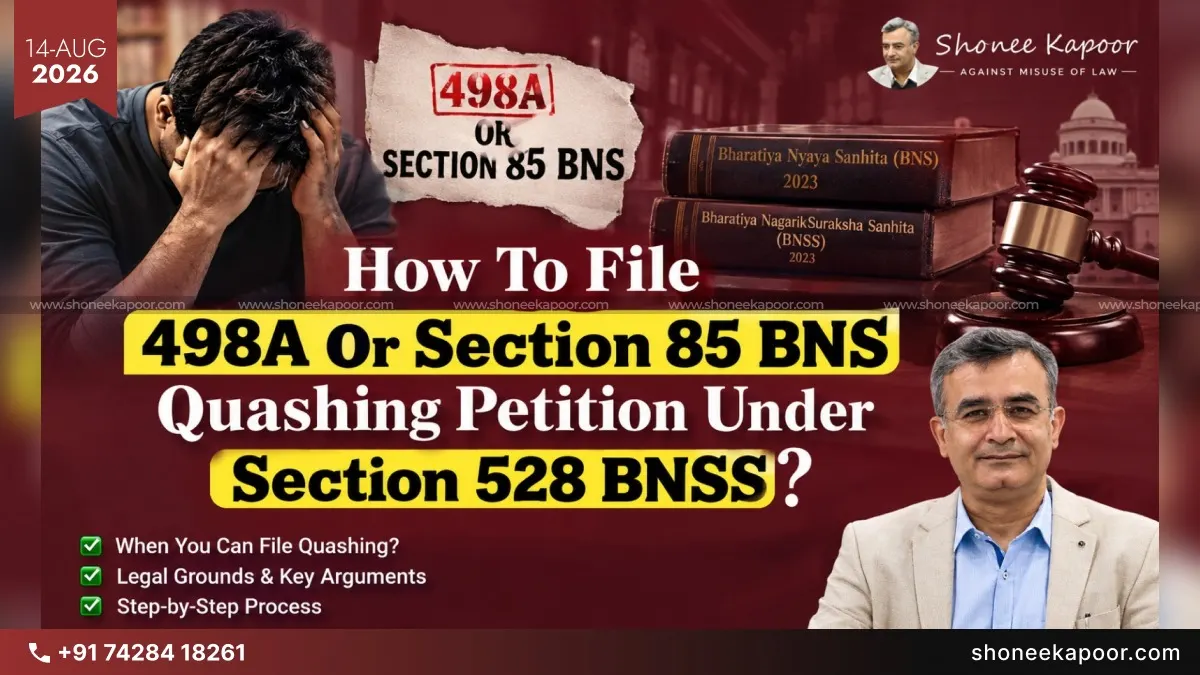
Facing a 498A IPC or Section 85 BNS case? Know when and how to file a quashing petition under Section 528 BNSS, the documents required and the latest Supreme Court rulings.
NEW DELHI: A 498A or Section 85 BNS case does not have to reach trial merely because an FIR has been registered. If the allegations do not disclose the ingredients of the offence, are vague and omnibus, or continuing the criminal case itself amounts to abuse of process, the High Court can quash the proceedings.
But remember one thing: quashing is not a second trial before the High Court. A successful quashing petition attacks the legal sustainability of the prosecution itself.
First, Do Not Confuse Section 482 BNSS With Section 528 BNSS
This is where many outdated legal articles are now getting the law wrong.
Under the old Code of Criminal Procedure, 1973, the High Court exercised its inherent powers under Section 482 CrPC.
Under the Bharatiya Nagarik Suraksha Sanhita, 2023, the corresponding inherent power of the High Court is now Section 528 BNSS. It permits the High Court to pass orders necessary to prevent abuse of the process of any Court or otherwise secure the ends of justice. Section 482 BNSS, on the other hand, deals with anticipatory bail.
There is one important exception. Under Section 531(2)(a) BNSS, an appeal, application, trial, inquiry or investigation already pending immediately before BNSS came into force continues under the old CrPC. Therefore, depending on the date and procedural history of the case, Section 482 CrPC may still govern an older pending proceeding.
WHAT IS SECTION 85 BNS?
Section 85 BNS punishes a husband or relative of the husband who subjects a married woman to cruelty, with imprisonment which may extend to three years and fine.
The actual definition of “cruelty” is contained in Section 86 BNS. Broadly, it covers wilful conduct likely to drive the woman to suicide or cause grave injury or danger to her life, limb or physical or mental health, and harassment connected with coercion for an unlawful demand for property or valuable security.
That is important in quashing.
Every matrimonial quarrel, allegation of bad behaviour, family disagreement or use of the word “harassment” does not automatically satisfy Sections 85 and 86 BNS. The statutory ingredients still have to be made out.
WHEN CAN A 498A OR SECTION 85 BNS CASE BE QUASHED?
The foundation remains State of Haryana v. Bhajan Lal, 1992 Supp (1) SCC 335. The Supreme Court identified illustrative situations where criminal proceedings can be stopped at the threshold, including where the allegations taken at face value do not constitute an offence, the allegations are inherently improbable, there is a legal bar, or the prosecution is manifestly mala fide and instituted for vengeance.
In a matrimonial case, the strongest quashing situations generally arise where the statutory ingredients are missing; relatives have been implicated through vague and omnibus allegations; no individual role, incident, date, place or demand is attributed to an accused; reliable material makes an allegation inherently unsustainable; or the surrounding chronology, coupled with absence of specific allegations, demonstrates an abuse of criminal process.
A mere statement that “the case is false” is not enough. Similarly, ordinary contradictions requiring evidence and cross-examination are generally matters for trial, not a quashing court.
SUPREME COURT: VAGUE 498A ALLEGATIONS CANNOT BECOME A CRIMINAL TRIAL BY DEFAULT
In Shobhit Kumar Mittal v. State of Uttar Pradesh & Another, 2025 INSC 1152, the Supreme Court examined allegations against the husband’s brother. The FIR did not specify the time, date, place, manner of alleged harassment or particulars of the alleged dowry demand.
The Supreme Court held:
“Mere general allegations of harassment without pointing out the specific details would not be sufficient”
The Court applied Bhajan Lal and quashed the FIR and consequential proceedings only against the appellant.
This distinction matters. Quashing is accused-specific. One relative may get the FIR quashed while proceedings against the husband or another accused may continue.
What Actually Happened In Court In A 2026 Supreme Court 498A Case?
In Dr. Sushil Kumar Purbey & Anr. v. State of Bihar & Ors., 2026 INSC 212, the father-in-law and mother-in-law approached the Supreme Court after the High Court had refused to quash the case against them while granting relief to the sister-in-law.
Counsel for the parents-in-law argued that the allegations were general and omnibus, no specific role was assigned to them, and the criminal complaint appeared to be a counterblast to the husband’s earlier divorce proceedings.
On the other side, senior counsel for the complainant argued that the allegations were specific and that the trial had already reached an advanced stage.
The Supreme Court examined the FIR and found no specific overt act, particular date, place or individual act attributed to the parents-in-law. Even the allegation that they “would quarrel” was held insufficient to sustain the offences. The Court also clarified that delay alone would not justify quashing, but when read with the absence of specific allegations, it supported the defence contention regarding a possible counterblast. The proceedings against the parents-in-law were quashed.
Significantly, the criminal case against the husband continued because he had not sought quashing before the High Court and was not before the Supreme Court.
LATEST 2026 EXAMPLE: KARNATAKA HIGH COURT USES SECTION 528 BNSS TO QUASH SECTION 85 BNS FIR AGAINST IN-LAWS
A very useful current example is Esther Vedamani & Ors. v. State of Karnataka & Anr., Criminal Petition No. 8190/2025, decided by Justice M. Nagaprasanna on 5 August 2026.
The petition was specifically filed under Section 528 BNSS seeking quashing of an FIR containing, among other provisions, Section 85 BNS and Sections 3 and 4 of the Dowry Prohibition Act. The husband was not one of the petitioners.
The petitioners argued that the mother-in-law and other relatives had been unnecessarily dragged into the matrimonial dispute. The complainant appeared party-in-person, filed extensive objections and relied on documents and WhatsApp messages, while the State also sought continuation of the investigation. The High Court nevertheless found the allegations against the petitioning relatives bald, vague and insufficient to constitute the ingredients of Section 85 BNS/Section 498A IPC, and quashed the FIR only against them. The Court expressly left the husband’s case untouched.
That is Section 528 BNSS working in an actual Section 85 BNS matrimonial FIR, not merely an old Section 482 CrPC case.
HOW TO FILE A 498A / SECTION 85 BNS QUASHING PETITION
Step 1: Collect The Complete Criminal Record
Start with the FIR/complaint, current investigation status, charge-sheet if filed, cognizance or summoning order if passed, and relevant orders from connected matrimonial proceedings.
Do not draft a quashing petition from the FIR number alone.
Step 2: Identify The Correct Provision
For a proceeding governed by BNSS, the petition ordinarily invokes Section 528 BNSS. For proceedings protected by the savings clause under Section 531, the old Section 482 CrPC framework may continue to apply.
Step 3: Test Every Allegation Against The Ingredients Of The Offence
Prepare an accused-wise analysis:
What exactly is alleged? Against whom? When? Where? What specific act? What unlawful demand? How does that allegation satisfy Section 85 read with Section 86 BNS?
This exercise often reveals the difference between an emotionally worded complaint and a legally sustainable criminal allegation.
Step 4: Annex Only Documents That Actually Help At The Quashing Stage
Depending upon the case, relevant material may include separate-residence records, official employment or posting records, travel records, prior complaints, matrimonial pleadings, court orders, settlement documents and other reliable records that directly affect the threshold question.
Do not convert the petition into a dump of every WhatsApp message exchanged during the marriage.
Step 5: Draft The Prayer Precisely
The petition should clearly identify what is sought to be quashed: the FIR, charge-sheet/final report, cognizance or summoning order and consequential proceedings, as applicable to the particular petitioner.
Filing requirements such as synopsis, list of dates, affidavit, vakalatnama, annexure format, court fee and e-filing procedure vary between High Courts and must comply with the concerned High Court’s rules.
Step 6: Do Not Assume Filing Quashing Automatically Stops Arrest Or Investigation
A quashing petition and protection from arrest are different remedies. If arrest is apprehended, the question of anticipatory bail under Section 482 BNSS and any appropriate interim relief must be examined separately. Section 528 itself does not mean that investigation automatically stops the moment a petition is filed.
WHAT IF HUSBAND AND WIFE HAVE SETTLED THE MATRIMONIAL DISPUTE?
Settlement is another recognised route for quashing matrimonial criminal proceedings.
The Supreme Court in B.S. Joshi v. State of Haryana, (2003) 4 SCC 675, followed by the Gian Singh line of cases, recognised that the High Court may quash appropriate matrimonial criminal proceedings after a genuine settlement even where the offence is otherwise non-compoundable. The nature and seriousness of every offence in the FIR still matter; settlement is not an automatic eraser for every criminal prosecution.
MY RULE FOR 498A QUASHING
Do not file quashing merely because you say the complaint is false. File it when the record gives the High Court a legal reason to say that the prosecution itself should not continue.
There is a major difference between “I can prove my innocence at trial” and “the law should not force me through this trial at all.”
A good Section 528 BNSS petition is built around the second proposition.
FAQ’S
Yes. A husband or any other accused can approach the High Court where legally sustainable grounds for quashing exist. Relief is examined accused-wise.
For the High Court’s inherent powers, yes, Section 528 BNSS is the corresponding provision. But Section 482 BNSS now deals with anticipatory bail, so the section numbers must not be confused.
Yes, in an appropriate case. Quashing can be sought at the FIR/investigation stage where the required legal threshold is satisfied. Filing of a charge-sheet also does not, by itself, eliminate the High Court’s inherent jurisdiction.
Not automatically. The Supreme Court has repeatedly scrutinised vague and omnibus allegations against relatives and has quashed proceedings where specific involvement and legally necessary particulars were absent.
No automatic protection arises merely from filing it. Anticipatory bail is separately dealt with under Section 482 BNSS, and interim protection depends upon the facts and the Court’s order.
LEGAL NOTE
Quashing jurisdiction is exceptional and fact-specific. The correct provision, relief and documents depend upon the FIR, stage of proceedings, date of commencement and the rules of the concerned High Court.

Leave A Comment