



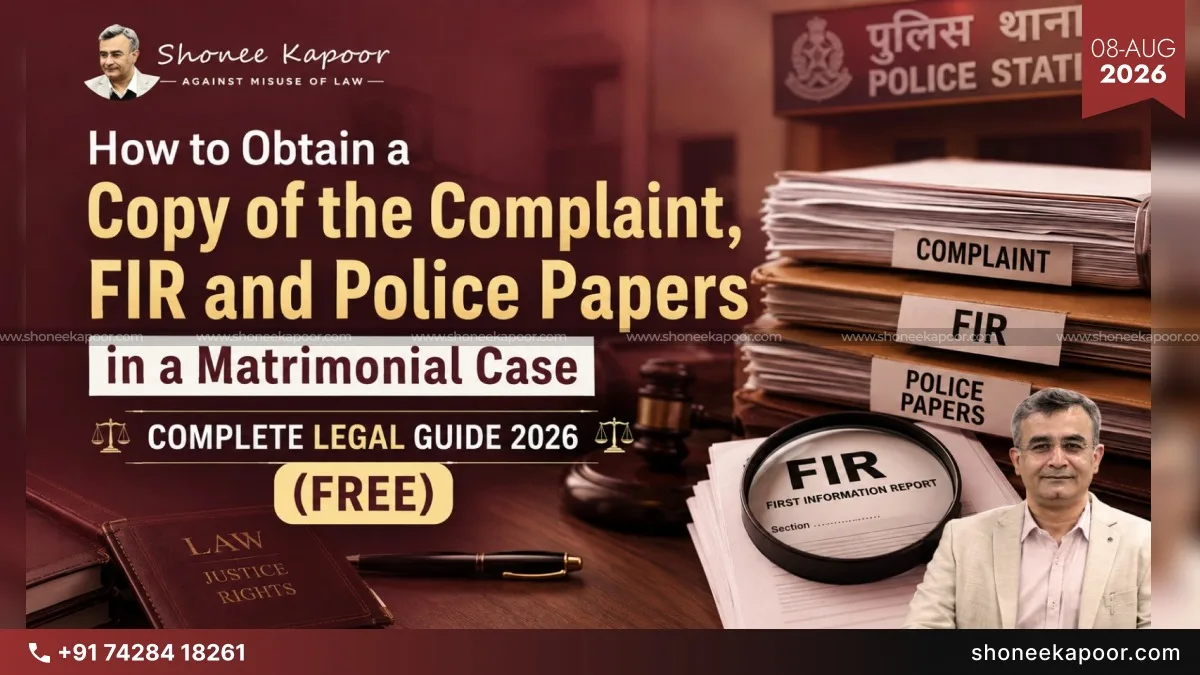
Husband’s legal guide to getting the wife’s complaint, FIR, chargesheet, witness statements and police documents in 2026
NEW DELHI: A matrimonial complaint can set the criminal process in motion long before a husband even knows what has actually been alleged against him.
The first call may come from the CAW Cell, Women Cell or local police station. The husband is asked to appear, explain his side or give a statement. But there is one basic question that should come before any detailed response:
“What exactly is the complaint against me?”
Many husbands make the mistake of answering allegations from memory, hearsay or an officer’s oral summary without first reading the complaint itself.
That is a serious litigation error.
Never defend a case you have not seen on paper.
A CAW Cell complaint, FIR, chargesheet, witness statement, electronic evidence and police case diary are legally different records. The procedure for obtaining each document is different, and the right to access them arises at different stages of the criminal process.
For offences committed after 1 July 2024, allegations of matrimonial cruelty are principally governed by Sections 85 and 86 of the Bharatiya Nyaya Sanhita, 2023. Section 85 prescribes punishment of up to three years and fine, while Section 86 defines the conduct that amounts to cruelty.
For a husband facing such proceedings, the first step should not be panic or an emotional defence.It should be simple:
Obtain the complaint. Obtain the FIR. Know the exact allegations. Then prepare the defence.
FIRST KNOW WHICH DOCUMENT YOU NEED
Do not use “complaint”, “FIR” and “chargesheet” as interchangeable words.
Complaint: The written allegations initially submitted by the wife before the police, CAW Cell, Women Cell or Mahila Thana.
FIR: Formal recording of information relating to a cognizable offence.
Chargesheet/police report: The police report submitted after investigation.
Police papers: Documents and statements forwarded to the court and required to be supplied to the accused under law.
Case diary: The investigating officer’s day-to-day investigation diary. The accused does not have a general right to demand it.
That distinction decides which remedy you should use.
HOW TO GET THE WIFE’S CAW CELL OR POLICE COMPLAINT
If there is only a CAW Cell/Women Cell complaint and no FIR has been registered yet, give a written request to the concerned officer seeking:
- complaint number and date;
- copy of the complaint;
- relevant annexures, where legally permissible; and
- confirmation whether an FIR has been registered.
Take acknowledgement of your request.
Do not assume that Section 230 BNSS automatically gives you the complaint at this stage. Section 230 operates when proceedings have been instituted on a police report.
There is an important older RTI decision here.
In the case of Ritesh Suri v. Delhi Police, decided by the Central Information Commission on 17 August 2011, the CIC directed Delhi Police to provide a husband with the complaint filed against him by his wife before the CAW Cell.
But the RTI position must now be used carefully.
Section 44(3) of the Digital Personal Data Protection Act, 2023, brought into force on 13 November 2025, amended Section 8(1)(j) of the RTI Act concerning personal information. Section 8(2) of the RTI Act, however, continues to permit disclosure where public interest in disclosure outweighs harm to the protected interest.
Therefore, in 2026, do not treat an RTI application as a guaranteed shortcut.
First demand the complaint directly from the authority calling upon you to answer it.
HOW TO GET THE FIR AFTER REGISTRATION
Once an FIR is registered, your position becomes much stronger.
The leading Supreme Court judgment is Youth Bar Association of India v. Union of India, (2016) 9 SCC 473, where it was expressly held that an accused is entitled to get a copy of the First Information Report at an earlier stage.
The Court laid down three important routes.
1. Apply to police/SP
If you reasonably suspect that you have been named in an FIR, you or your representative can apply to the concerned police officer or Superintendent of Police.
The Supreme Court directed the supply of the FIR copy within 24 hours on such application, subject to the applicable copying fee.
2. Apply before the court
Once the FIR has been forwarded to the Magistrate or Special Judge, the accused can seek a certified copy.
The Supreme Court directed that it be supplied within two working days.
3. Download the FIR online
Except for sensitive categories, FIRs are ordinarily required to be uploaded on the police or State Government website within the timeline prescribed in Youth Bar Association.
So when 498A/BNS 85 has been filed
Do not panic.
Ask: What is the FIR number? Which police station? What date? What sections?
Then read the FIR yourself.
Interestingly, during the proceedings, Additional Solicitor General Tushar Mehta told the Supreme Court that the Delhi High Court directions could apply:
“with certain modifications.”
The Supreme Court thereafter issued the nationwide framework for FIR access.
HOW TO GET THE CHARGESHEET AND POLICE PAPERS
After the police report reaches court, Section 230 BNSS becomes extremely important.
It requires the Magistrate to supply specified documents to the accused free of cost, without delay and in any case within 14 days from production or appearance of the accused.
These include:
- police report/chargesheet;
- FIR;
- statements of prosecution witnesses recorded under Section 180(3), subject to lawful exclusions;
- statements or confessions recorded under Section 183; and
- other documents or relevant extracts forwarded with the police report under Section 193(6).
The Allahabad High Court recently reiterated this fourteen-day requirement in Ravi alias Ravindra Singh v. State of U.P., decided on 5 May 2026.
This is not a favour by the prosecution.It is a statutory right.
If documents are missing, file a written Section 230 BNSS application before the Magistrate identifying exactly what has not been supplied.
Do not merely complain orally outside the courtroom.
WHAT DOCUMENTS SHOULD A HUSBAND CHECK?
Compare the chargesheet index with the documents actually supplied.
Depending on the prosecution case, check for:
- original complaint;
- FIR;
- supplementary complaints;
- prosecution witness statements;
- medical documents;
- seizure documents;
- photographs;
- CCTV footage;
- WhatsApp chats;
- audio/video recordings;
- bank records;
- call records;
- electronic-device or forensic reports; and
- other documents relied upon in the chargesheet.
Section 193 BNSS also requires documents accompanying the police report to be properly dealt with for supply to the accused, including electronic service where applicable.
Do not sign casually that “complete documents received” until you have actually checked them.
WHAT ABOUT WHATSAPP, CCTV AND DIGITAL EVIDENCE?
Electronic evidence is also evidence.
In the case of P. Gopalkrishnan @ Dileep v. State of Kerala, (2020) 9 SCC 161, the Supreme Court dealt with electronic material contained in a memory card and recognised the electronic contents as documentary material for disclosure purposes, while also balancing the victim’s privacy.
Therefore, if the prosecution relies on WhatsApp chats, CCTV footage, recordings, photographs or other digital evidence, the defence should ensure meaningful lawful access to that material.
Depending on the nature of the evidence, access may be through a digital copy, cloned copy, inspection or another court-controlled method.
CAN YOU DEMAND THE COMPLETE POLICE CASE DIARY?
No. This is where many badly drafted applications go wrong.
Section 192(5) BNSS specifically says that the accused or his agents are not entitled to call for or inspect police diaries merely because the court refers to them.
So do not write: “Give me the entire police file and case diary.”
Ask for the specific documents to which the law actually gives you access.
Precision gets results. Vague demands get objections.
PRACTICAL STRATEGY FOR HUSBANDS
- Before FIR: Get the complaint number. Ask for the complaint. Preserve notices and messages. Do not give a detailed blind reply without knowing the actual allegations.
- After FIR: Get the FIR number, police station, date, and sections. Download it or use the Youth Bar Association procedure for a certified copy.
- After chargesheet: Demand the complete Section 230 BNSS document set. Compare it against the chargesheet index and identify missing documents immediately.
Most importantly:
Do not answer rumours and defend assumptions.
Defend the case written against you, not the version somebody orally tells you.
FINAL LEGAL POSITION
- A matrimonial complaint can ultimately affect a man’s liberty, career, parents, finances and reputation. Yet many husbands walk into the first police interaction without even reading the complaint.
- That is not cooperation. That is unprepared litigation.
- Know the difference between a complaint, FIR, chargesheet and case diary.
- Use Youth Bar Association for early FIR access.
- Use Section 230 BNSS for the chargesheet and prosecution documents.
- Use RTI cautiously where appropriate.
And never surrender a procedural right merely because someone tells you:
“Give your statement first; you can get the papers later.”
First understand the allegation. Then prepare the defence.
That is how a matrimonial criminal case should be fought: with the record, the law and evidence.
FAQs
He can make a written request to the concerned CAW Cell or police authority. RTI may also be explored, but disclosure is now subject to the amended RTI framework and applicable exemptions.
Yes. Youth Bar Association v. Union of India recognises the accused’s right to obtain the FIR at an earlier stage and lays down routes through the police and court.
Under Section 230 BNSS, specified documents must be supplied without delay and ordinarily within 14 days from the accused’s production or appearance.
If electronic material forms part of the prosecution evidence, the defence can seek lawful access to it, subject to applicable privacy and court safeguards.
No. Section 192(5) BNSS restricts an accused’s general right to inspect or call for the police case diary.

Leave A Comment