
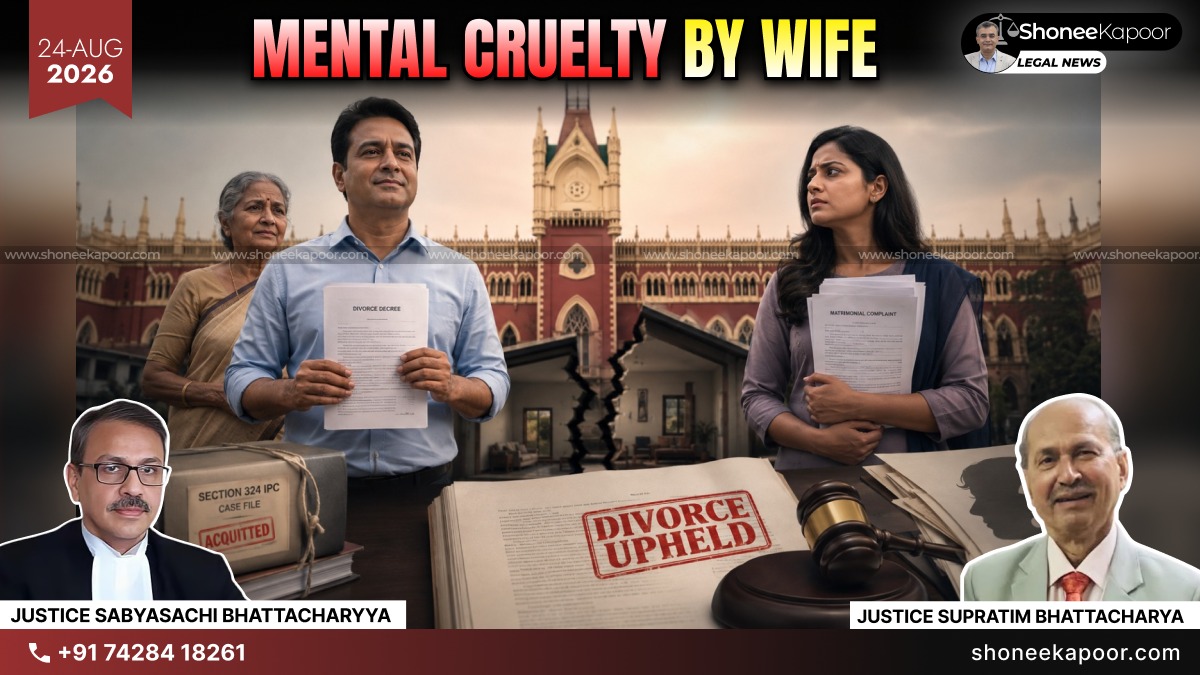
Wife Pressuring Husband To Leave His Widowed Mother Amounts To Mental Cruelty: Calcutta High Court Upholds Divorce Decree In Husband’s Favour

Curated by NEWS DESK
Editorial DeskCan Wife Force Husband To Leave His Dependent Widowed Mother? The Calcutta High Court has now upheld the husband’s divorce after examining years of matrimonial disputes and repeated allegations against him and his family.
KOLKATA: The Calcutta High Court has upheld a decree of divorce granted to a husband after finding that his wife had subjected him to mental cruelty through persistent serious but unsupported allegations and, in the facts of the case, by insisting that he separate from his dependent widowed mother.
A Division Bench of Justice Sabyasachi Bhattacharyya and Justice Supratim Bhattacharya dismissed the wife’s appeal against the December 30, 2021 divorce decree passed by the Additional Principal Judge, Family Court at Calcutta. The parties had married under the Special Marriage Act on June 18, 2009 and had a child in April 2013. They eventually separated and had remained apart for about 11 years by the time the High Court decided the appeal.
The wife argued that asking for a separate residence could not automatically amount to cruelty. She claimed that she wanted to live away from her mother-in-law because of alleged improper behaviour towards the couple’s minor child. The Court, however, found no contemporaneous complaint, supporting document, independent witness or child-welfare complaint substantiating this grave accusation.
The High Court made it clear that modern matrimonial law cannot proceed on the old assumption that a wife must necessarily serve her husband and his family. It observed that society has moved beyond such a “patriarchal and conservative mind-set”. At the same time, the Court held that the circumstances of the particular family could not be ignored.
The husband’s mother was a widow and was admittedly dependent upon him. Once the wife’s stated reason for demanding separation was found unsupported, the Bench held that insistence on separating the husband from his dependent mother could constitute cruelty in the circumstances of this marriage.
The Court observed that “Separate living for its own sake has its place”, but the demand had to be examined against the actual family circumstances of the spouses.
The dispute was also not confined to the mother-in-law. According to the judgment, the wife had made allegations relating to dowry demands, retention of marriage articles, alleged misappropriation of her parental property, forced abortion and mistreatment of the minor child. The Court found several of these allegations either unsupported, inconsistent with the pleadings or contradicted during cross-examination.
The Bench particularly noted that the wife had alleged misappropriation of her parental property without producing supporting documents or even pleading the allegation originally. Her allegation regarding retention of ornaments was also examined against a receipt which she admitted during cross-examination that she had written and signed. The Court said her credibility as a witness had consequently been shaken on several counts.
Another important circumstance concerned a criminal prosecution initiated against the husband under Section 324 IPC. The wife had alleged that he assaulted her with an iron scale. The husband was eventually acquitted in that case for want of supporting evidence, including medical evidence. The High Court considered the impact of such unsuccessful serious accusations while examining the husband’s plea of mental cruelty.
The Court ultimately found a consistent pattern of serious but baseless allegations which had caused humiliation to the husband and his family. It reiterated that an unsupported accusation of a sufficiently grave nature, capable of damaging the character and dignity of a spouse, may itself constitute matrimonial cruelty.
The wife also argued that the parties had occasionally resumed matrimonial relations after separation and that the husband had therefore condoned the alleged cruelty. The Court rejected this argument, holding that occasional resumption of cohabitation does not necessarily wipe out previous matrimonial misconduct.
It held that “Stray incidents of living together as husband and wife do not amount to condonation.” The Court further explained that condonation is conditional and subsequent acts of cruelty can revive the earlier matrimonial grievance.
The Bench also considered the long separation between the parties, the failure of court-referred mediation and the continuing bitterness between them. It relied on Supreme Court principles explaining that an irretrievably broken matrimonial relationship may, depending on the circumstances, itself become relevant when determining cruelty.
The High Court therefore dismissed FAT No. 100 of 2022 and CAN 5 of 2026, affirming the Family Court decree dissolving the marriage. It clarified, however, that the judgment would not prevent the wife from independently seeking permanent alimony, which would have to be decided on its own merits without unnecessary influence from the observations in the divorce judgment.
EXPLANATORY TABLE OF LAWS AND SECTION
| Law / Section | Simple Meaning | Application In This Case |
|---|---|---|
| Section 27(1)(d), Special Marriage Act, 1954 | Allows divorce where one spouse has treated the other with cruelty after marriage. | The husband obtained divorce on the ground of mental cruelty; the High Court upheld it. |
| Section 22, Special Marriage Act | Provides the remedy of restitution of conjugal rights where one spouse withdraws without reasonable excuse. | The wife had sought restoration of matrimonial life through a counterclaim. |
| Section 23A, Hindu Marriage Act, 1955 | Permits a respondent in matrimonial proceedings to seek matrimonial relief through a counterclaim in specified circumstances. | Cited by the wife while supporting her right to make a counterclaim for restitution. |
| Section 23(1)/23(1)(b), Hindu Marriage Act | Requires the matrimonial court to consider statutory bars to relief, including whether cruelty has been condoned. | Discussed while considering whether later cohabitation meant that the husband had forgiven earlier cruelty. |
| Section 13(1)(ia), Hindu Marriage Act | Recognises cruelty as a ground for divorce under the HMA. | Discussed through Supreme Court precedents on irretrievable breakdown and mental cruelty; the Court noted similarity with cruelty under the Special Marriage Act. |
| Order XLI Rule 27, CPC | Allows additional evidence to be produced before an appellate court only in specified circumstances. | The wife sought to introduce a medical prescription at the appellate stage concerning her allegation of forced abortion. The application was rejected. |
| Section 324 IPC | Earlier punished voluntarily causing hurt by dangerous weapons or means. | A criminal case was filed against the husband alleging assault with an iron scale; he was later acquitted for lack of supporting evidence. |
| Protection of Women from Domestic Violence Act, 2005 | Provides civil remedies including protection, residence and monetary relief in domestic-violence proceedings. | The wife had initiated proceedings concerning, among other things, return of her articles; those proceedings were stated to be pending. |
| Article 142, Constitution of India | Gives the Supreme Court power to pass orders necessary to do complete justice. | Referred to while discussing Supreme Court decisions on irretrievable breakdown of marriage. |
| Article 72, Constitution of India | Concerns the President’s constitutional power to grant pardons and related relief. | Appeared in the precedent explaining that matrimonial “condonation” is not equivalent to an absolute presidential pardon. |
CASE DETAILS
| Particular | Details |
|---|---|
| Case Title | Wife v. Husband |
| Case Number | F.A.T. No. 100 of 2022 + CAN 5 of 2026 |
| Court | High Court at Calcutta, Civil Appellate Jurisdiction, Appellate Side |
| Date of Judgment | 21 August 2026 |
| Reserved On | 13 August 2026 |
| Bench | Justice Sabyasachi Bhattacharyya and Justice Supratim Bhattacharya |
| Impugned Judgment | Divorce decree dated 30 December 2021, Additional Principal Judge, Family Court at Calcutta |
| Trial Case | Matrimonial Suit No. 137 of 2015 |
| Counsel for Wife/Appellant | Sanjay Mukherjee, Purnendu Das and Kinjal Kumar Barai, Advocates |
| Counsel for Husband/Respondent | Shyamal Chakraborty, Rajib Ray, Suparna Deb and Sumit Roy, Advocates |
KEY TAKEAWAYS
- False allegations are not a “marital dispute” — they can destroy a man’s life. When serious accusations remain unproved, the husband should not be treated as collateral damage.
- Marriage does not give a wife the right to isolate a man from his dependent widowed mother. A husband cannot be forced to choose between being a son and being a husband without a legally sustainable reason.
- An acquittal does not return the years stolen from a man. He may win the criminal case eventually, but the stigma, litigation, expense and humiliation have already done their damage.
- A few attempts to save the marriage cannot erase sustained cruelty. Men should not be punished for trying to reconcile by later being told that their suffering was “condoned.”
- For men, the accusation often becomes the punishment long before the judgment comes. Years of criminal cases, matrimonial litigation and character assassination can pass before the system finally records that the allegations were unsupported.
Share Your Thoughts
Comments are moderated before publication.