
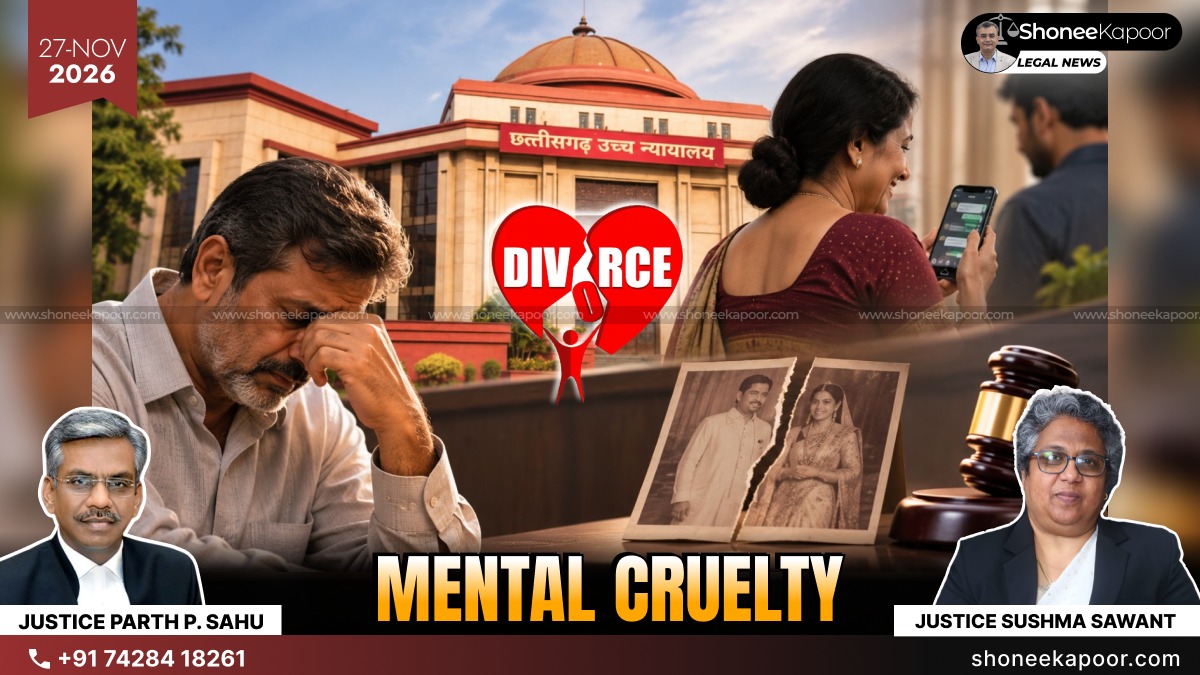
Wife’s Continued Contact With Another Man Amounts To Mental Cruelty: Chhattisgarh HC Grants Husband Divorce After 32 Years Of Marriage

Curated by NEWS DESK
Editorial DeskCHATTISGARH: The Chhattisgarh High Court has granted divorce to a husband on grounds of mental cruelty, holding that a wife’s continued association with another man despite her husband's repeated objections can constitute matrimonial cruelty.
A Division Bench comprising Justice Parth Prateem Sahu and Justice Sushma Sawant, in its judgment dated 25 November 2026, set aside the Family Court judgment that had rejected the husband's divorce petition.
Read Also:- How to File for Divorce in India
The couple married in 1994 according to Hindu customs and had three children, all of whom were residing with their father.
The husband alleged that after six years of marriage, his wife started neglecting her matrimonial responsibilities and inviting other men to their house in his absence.
In 2017, the wife allegedly developed a relationship with another man and continued communicating with him by phone despite her husband's repeated objections.
Read Also:- Divorce Petition Judgements
On 22 August 2017, the husband allegedly caught his wife travelling on a motorcycle with the same man after she had left home to visit her ailing parents.
According to the husband, the wife admitted her mistake and promised to discontinue the relationship. In an attempt to save his marriage, he accepted her assurance and resumed matrimonial life.
However, the wife allegedly continued communicating with the man and subsequently left the matrimonial home on 22 October 2017.
The husband lodged a police complaint on 25 October 2017, but the police reportedly refused to take action, considering it a matrimonial dispute.
The wife denied the allegations and accused her husband of physical assault and maintaining relationships with other women. She also sought ₹50,000 as compensation and ₹5,000 towards litigation expenses.
On 23 November 2019, the Family Court dismissed the husband's divorce petition, prompting him to approach the High Court.
The High Court noted that although the husband had originally filed his petition under the Special Marriage Act, 1954, the marriage was governed by the Hindu Marriage Act, 1955.
The Court examined the testimonies of the couple's children, which supported the husband's allegations.
The daughter testified that her mother continued communicating with the man despite repeated counselling by family members.
The son stated that the man frequently visited their house in his father's absence and that his mother discouraged the children from informing their father. He also testified regarding his mother's stay at the other man's residence.
The High Court observed that the Family Court had failed to properly appreciate the available evidence.
The Court explained that direct evidence of sexual intercourse is not necessary in every case to establish mental cruelty. The circumstances, conduct of the parties and witness statements must also be considered.
The Court further recognised that a husband's efforts to save his marriage cannot, by themselves, become a reason to reject his allegations of cruelty.
Consequently, the High Court allowed the husband's appeal, set aside the Family Court judgment and dissolved the marriage on grounds of cruelty under Section 13(1)(ia) of the Hindu Marriage Act, 1955.
After nearly seven years of litigation following the rejection of his divorce petition, the husband finally secured matrimonial relief.
EXPLANATORY TABLE OF LAWS AND SECTIONS
| Law / Section | What It Means | Application In This Case |
|---|---|---|
| Section 13(1)(i), Hindu Marriage Act, 1955 | Provides divorce on grounds of adultery. | Discussed in relation to the alleged extramarital relationship. |
| Section 13(1)(ia), Hindu Marriage Act, 1955 | Provides divorce on grounds of cruelty. | Husband granted divorce on grounds of mental cruelty. |
| Section 27(1)(a), Special Marriage Act, 1954 | Provides divorce on grounds of sexual intercourse outside marriage. | Originally invoked by the husband. |
| Section 27(1)(d), Special Marriage Act, 1954 | Provides divorce on grounds of cruelty. | Originally invoked in the divorce petition. |
| Section 39, Special Marriage Act, 1954 | Provides for appeals against specified judgments and decrees. | Invoked while challenging the Family Court judgment. |
| Section 19(1), Family Courts Act, 1984 | Permits appeals against qualifying Family Court judgments and orders. | Husband approached the High Court under this provision. |
CASE DETAILS
| Particular | Details |
|---|---|
| Case Title | Harigovind Singh v. Urmila Singh |
| Court | Chhattisgarh High Court, Bilaspur |
| Bench | Justice Parth Prateem Sahu and Justice Sushma Sawant |
| Neutral Citation | 2026:CGHC:48318-DB |
| Case Number | FA(MAT) No. 66 of 2020 |
| Counsel for Husband | Advocate Vivek Kumar Tripathi |
| Counsel for Wife | Advocate Shrikant Kaushik |
| Family Court | Family Court, Baikunthpur, District Korea |
| Family Court Case | Civil Suit No. 25A/2018 |
| Impugned Judgment | 23 November 2019 |
| Final Decision | Husband's appeal allowed; marriage dissolved on grounds of cruelty. |
KEY TAKEAWAYS
- Wife’s Extramarital Association, Husband’s Mental Agony: His suffering was finally recognised as matrimonial cruelty.
- Even Children’s Testimony Was Not Enough: The husband had to approach the High Court to secure justice.
- Attempt To Save Marriage Turned Against Him: His willingness to forgive should not have weakened his case.
- Husband Denied Divorce Despite Evidence: The High Court corrected the Family Court’s failure to properly appreciate the evidence.
- Seven Years of Legal Battle for Freedom: Why should a victimised husband lose years of his life proving his suffering?
Share Your Thoughts
Comments are moderated before publication.