
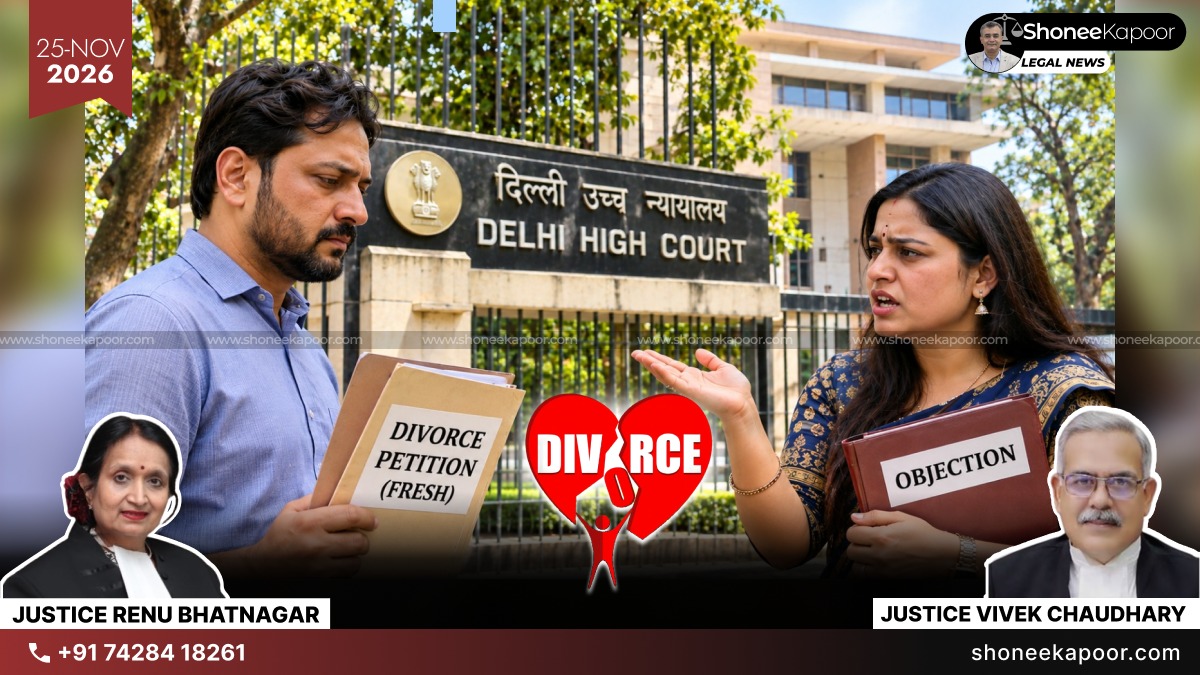
Husband’s Fresh Divorce Petition Maintainable Despite Earlier Withdrawal On Jurisdictional Grounds: Delhi High Court

Curated by NEWS DESK
Editorial DeskNEW DELHI: The Delhi High Court has held that a husband can maintain a fresh divorce petition before the competent court even if his earlier petition was withdrawn without permission to file afresh, where the withdrawal was due to lack of territorial jurisdiction.
The division bench of Justice Vivek Chaudhary and Justice Renu Bhatnagar delivered the judgment on November 20, 2026, protecting substantive matrimonial rights from being defeated merely on procedural grounds.
The Court clarified that withdrawal of a divorce petition due to a genuine jurisdictional defect cannot automatically be treated as abandonment of the right to seek divorce.
The Court observed:
“The provisions of the CPC, where applicable, are not intended to become an instrument for defeating substantive matrimonial rights on technical grounds, particularly where the circumstances demonstrate that the earlier proceeding was withdrawn for bona fide reasons and not with an intention to abandon the underlying claim.”
The present case arose from a marriage solemnised on December 4, 2014, in Jhajjar, Haryana.
After nearly seven years of marriage, the husband filed a divorce petition on the grounds of cruelty before the Gurugram Family Court.
However, on October 21, 2021, he withdrew the petition after discovering that the court lacked appropriate territorial jurisdiction.
The husband subsequently filed a fresh divorce petition before the Dwarka Family Court, Delhi, on the grounds of cruelty and desertion.
The wife filed an application under Order VII Rule 11 CPC, seeking rejection of the husband's second divorce petition.
She argued that the husband withdrew his earlier petition without permission to file a fresh petition and was therefore barred under Order XXIII Rule 1(4) CPC.
On April 13, 2026, the Family Court dismissed her application, following which she approached the Delhi High Court.
The husband argued that the earlier petition was withdrawn solely because of a jurisdictional defect and not because he intended to give up his matrimonial claim.
The High Court examined his withdrawal application and found that the couple had last resided together in Najafgarh, Delhi.
The Court also noted that the earlier divorce proceedings had not reached the evidence stage and that the allegations had never been decided on merits.
A rigid application of procedural provisions in such circumstances would permanently deprive the husband of the opportunity to have his matrimonial grievances adjudicated.
The High Court further distinguished the judgment in Nidhi Jain v. Ankit Jain, where the earlier divorce proceedings had already reached the evidence stage before being voluntarily withdrawn.
The Court observed:
“No petition can progress further in a court having no jurisdiction to try the same. Its withdrawal cannot have the effect to non-suit a petitioner whose case is not decided on merits,”
The Court emphasised that technical procedural requirements should not unnecessarily obstruct the adjudication of genuine matrimonial disputes.
The Court further observed:
“The object of proceedings relating to matrimonial disputes is to ensure that the substantive rights and disputes between the parties are adjudicated on merits and are not defeated merely on account of procedural or technical considerations, unless the statute expressly mandates such consequence in the facts of the case.”
Accordingly, the Delhi High Court dismissed the wife's appeal, allowing the husband to pursue his second divorce petition before the competent Family Court.
EXPLANATORY TABLE OF LAWS AND SECTIONS
| Law / Section | What It Means | Application In This Case |
|---|---|---|
| Section 13, Hindu Marriage Act, 1955 | Provides statutory grounds for divorce. | Invoked by the husband seeking dissolution of marriage. |
| Section 13(1)(ia) HMA | Allows divorce on the ground of cruelty. | Invoked by the husband in his divorce proceedings. |
| Section 13(1)(ib) HMA | Allows divorce on the ground of desertion for at least two continuous years immediately before filing. | Invoked in the second divorce petition. |
| Section 19 HMA | Determines territorial jurisdiction for matrimonial petitions. | Relevant to the withdrawal of the Gurugram divorce petition. |
| Order VII Rule 11 CPC | Provides grounds for rejection of a plaint, including where it is barred by law. | Invoked by the wife to seek rejection of the second divorce petition. |
| Order XXIII Rule 1 CPC | Governs withdrawal of suits and abandonment of claims. | Central provision examined by the High Court. |
| Order XXIII Rule 1(3) CPC | Allows withdrawal with permission to institute fresh proceedings in specified circumstances. | The husband had not obtained such permission. |
| Order XXIII Rule 1(4) CPC | Generally bars fresh proceedings on the same subject matter following withdrawal without permission. | The Court declined to apply the bar rigidly in the particular circumstances. |
| Section 11 CPC | Provides the principle of res judicata, preventing re-adjudication of matters already finally decided. | Examined by the Family Court while rejecting the wife's application. |
| Section 151 CPC | Recognises the inherent powers of courts to secure justice and prevent abuse of judicial process. | Invoked in the wife's application and discussed through judicial precedents. |
| Section 10(3), Family Courts Act, 1984 | Allows Family Courts to formulate procedures to facilitate settlement or ascertain the truth. | Referred to while examining the special nature of matrimonial proceedings. |
| Section 19, Family Courts Act, 1984 | Provides for appeals against qualifying Family Court judgments and orders. | The wife approached the High Court under this provision. |
| Section 20, Family Courts Act, 1984 | Gives the Act overriding effect over inconsistent laws. | Referred to while examining the applicability of procedural provisions. |
| Order XXXII Rules 1–14 CPC | Governs proceedings involving minors and persons of unsound mind. | Appears in the statutory extract reproduced in the judgment; not directly applicable to the dispute. |
CASE DETAILS
| Particular | Details |
|---|---|
| Case Title | X v. Y |
| Court | Delhi High Court |
| Bench | Justice Vivek Chaudhary and Justice Renu Bhatnagar |
| Neutral Citation | 2026:DHC:10256-DB |
| Case Number | MAT.APP.(F.C.) 179/2026 |
| Connected Application | CM APPL. 34051/2026 |
| CNR Number | DLHC010225682026 |
| Judgment Reserved On | September 8, 2026 |
| Judgment Pronounced On | November 20, 2026 |
| Appellant | Wife |
| Respondent | Husband |
| Appellant's Counsel | Mr. Sarojanad Jha, Mr. Suraj Malik, Ms. Rajreeta Ghosh, Mr. Rahul Kumar and Ms. Muskan Saxena, Advocates |
| Respondent's Counsel | Mr. Ajay Sharma and Mr. Mukul Vats, Advocates |
| First Divorce Petition | HMA No. 16/2021 |
| First Family Court | Family Court, Gurugram |
| Withdrawal Date | October 21, 2021 |
| Second Divorce Petition | HMA No. 23/2022 |
| Second Family Court | Principal Judge, Family Court, South-West District, Dwarka, Delhi |
| Final Decision | Wife's appeal dismissed; husband's second divorce petition permitted to proceed. |
KEY TAKEAWAYS
- A Husband’s Right To Seek Divorce Cannot Be Snatched Away: Withdrawal on jurisdictional grounds is not surrender.
- Wife’s Attempt To Block Divorce Proceedings Fails: The High Court rejects her technical objection.
- Marriage Cannot Become A Legal Prison: Procedural defects cannot permanently deny men access to justice.
- Men Deserve A Fair Hearing Too: A husband’s allegations of cruelty deserve adjudication on merits.
- Technicalities Cannot Trump Justice: A man cannot be denied his legal remedies merely because he approached the wrong court.
Share Your Thoughts
Comments are moderated before publication.