
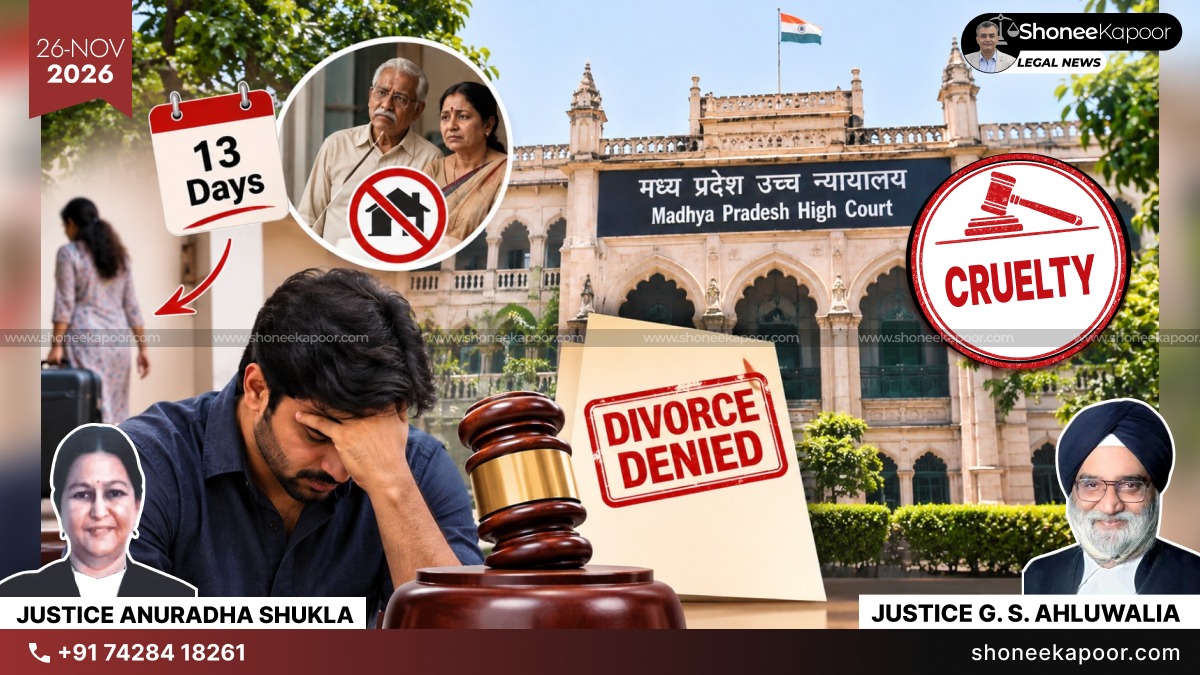
Can A Husband Who Agreed To Live Separately From His Parents Later Seek Divorce On Grounds Of Cruelty By Wife? MP High Court Answers

Curated by NEWS DESK
Editorial DeskMADHYA PRADESH: The Madhya Pradesh High Court has refused to grant divorce to a husband who agreed to live separately from his parents to bring his wife back home, holding that he could not subsequently rely on the same conduct to establish mental cruelty.
A Division Bench comprising Justice G.S. Ahluwalia and Justice Anuradha Shukla, in its judgment dated 3 November 2026, upheld the decision of the Family Court, Datia, rejecting the husband's divorce petition.
The couple married on 24 June 2021. In September 2021, the husband approached his wife's family to resume their matrimonial relationship.
According to the husband, his wife placed two conditions before returning to the matrimonial home: she would not cook for his family and would reside separately from them.
The husband accepted both conditions. However, he alleged that his wife left him again within 13 days, taking jewellery and ₹50,000 in cash.
In September 2023, the husband filed a petition under Section 9 of the Hindu Marriage Act, 1955, seeking restitution of conjugal rights. He obtained an ex parte decree on 7 March 2024.
Following her alleged failure to return, the husband filed for divorce on grounds of cruelty and desertion on 21 May 2024.
The wife denied his allegations and accused him of dowry harassment and threatening her life. She also challenged the manner in which the ex parte decree was obtained.
The husband's counsel argued that the prolonged separation and the wife's insistence on living away from his parents amounted to matrimonial cruelty. He further submitted that the marriage had reached a "dead end".
The High Court noted that the husband had not raised the allegations concerning cooking and separate residence in his earlier restitution petition.
The Bench considered his acceptance of the wife's conditions "most intriguing" and held that he had "consciously condoned" the alleged cruelty.
Referring to Section 23(1)(b) of the Hindu Marriage Act, the Court explained that previously condoned cruelty cannot ordinarily form the basis of divorce.
The husband also relied upon the Supreme Court judgment in Narendra v. K. Meena, concerning a wife's insistence on separating her husband from his parents.
However, the High Court distinguished that judgment because the husband had himself accepted the arrangement.
On the question of non-compliance with the restitution decree, the Court found that the husband had approached the Family Court before completing the mandatory one-year period under Section 13(1A)(ii) of the Hindu Marriage Act.
Consequently, despite years of separation and his earlier attempts to restore the matrimonial relationship, the husband failed to secure a divorce.
The Madhya Pradesh High Court dismissed his appeal and upheld the Family Court's decision.
EXPLANATORY TABLE OF LAWS AND SECTIONS
| Law / Section | What It Means | Application In This Case |
|---|---|---|
| Section 9, Hindu Marriage Act, 1955 | Restitution of conjugal rights. | Husband obtained an ex parte decree seeking restoration of matrimonial life. |
| Section 13(1)(ia), Hindu Marriage Act | Divorce on the ground of cruelty. | Husband alleged matrimonial cruelty by his wife. |
| Section 13(1)(ib), Hindu Marriage Act | Divorce on the ground of continuous desertion for at least two years immediately before filing the petition. | Husband sought divorce on the ground of desertion. |
| Section 13(1A)(ii), Hindu Marriage Act | Permits divorce where conjugal rights have not been restored for at least one year after a restitution decree. | Husband filed his divorce petition before completing the mandatory period. |
| Section 23(1)(b), Hindu Marriage Act | Restricts divorce on the ground of cruelty where the alleged cruelty has been condoned. | Court held that the husband had accepted the conduct subsequently alleged as cruelty. |
| Section 19, Family Courts Act, 1984 | Provides for appeals against eligible Family Court judgments and orders. | Husband challenged the dismissal of his divorce petition. |
CASE DETAILS
| Particular | Details |
|---|---|
| Case Title | Akash v. Smt. Kajal Wife Akash |
| Court | Madhya Pradesh High Court, Gwalior Bench |
| Neutral Citation | 2026: MPHC-GWL:34009 |
| Case Number | First Appeal No. 1573 of 2025 |
| Judgment Date | 3 November 2026 |
| Bench | Justice G.S. Ahluwalia and Justice Anuradha Shukla |
| Appellant | Husband |
| Respondent | Wife |
| Appellant's Counsel | Advocate Rinku Rathour |
| Respondent's Counsel | Advocate Monica Mishra |
| Original Court | Principal Judge, Family Court, Datia |
| Original Case Number | RCSHM/126/2024 |
| Final Decision | Appeal dismissed; rejection of divorce petition upheld. |
KEY TAKEAWAYS
- Husband’s Compromise Used Against Him: Accepting his wife’s conditions weakened his cruelty claim.
- Separated From Parents, Yet Abandoned: Despite accepting her demands, the wife allegedly left him within 13 days.
- Attempt To Save Marriage Backfired: His willingness to reconcile was treated as condonation of cruelty.
- Restitution Decree Failed To Secure Relief: Even after securing a favourable court order, the husband was denied divorce for not meeting the statutory waiting period.
- Years Of Separation, Yet No Freedom: The husband remains legally tied to a broken marriage.
Share Your Thoughts
Comments are moderated before publication.