
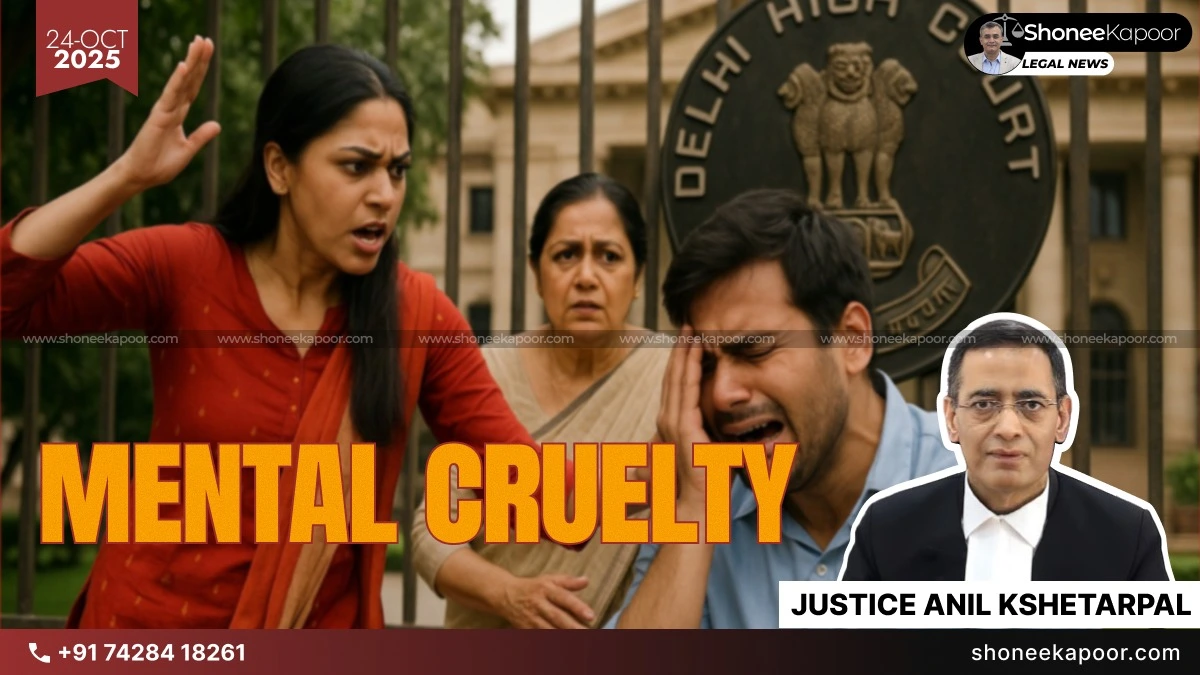
Calling Husband ‘Bastard’ & Abusing His Mother Is Mental Cruelty: Delhi High Court Slams Wife & Upholds Divorce

Written and analysed by Shonee Kapoor
Legal Consultant, Author & Men's Rights ActivistCalling Husband ‘Bastard’ & Abusing His Mother Is Mental Cruelty: Delhi High Court Slams Wife & Upholds Divorce
NEW DELHI: The Delhi High Court has upheld a Family Court order granting divorce to a husband, ruling that when a wife calls her husband a “bastard” and insults his mother with obscene remarks, it amounts to mental cruelty under Section 13(1)(ia) of the Hindu Marriage Act, 1955.
The Division Bench of Justice Anil Kshetarpal and Justice Harish Vaidyanathan Shankar delivered this significant judgment on 17 October 2025 in the case Rita Raj v. Pabitra Roy Chaudhuri (MAT.APP.(F.C.) 2/2024).
Case Background
The couple, both divorcees, married in January 2010. The husband is an advocate, and the wife, a senior officer in the Indian Railway Traffic Service (IRTS). Their marriage broke down within a year, and they began living separately in March 2011.
The husband approached the Family Court seeking divorce on grounds of cruelty, claiming that his wife used filthy language, humiliated him, denied him marital relations, and insulted his mother.
The Family Court dissolved the marriage in August 2023. The wife then appealed before the Delhi High Court, alleging that she was the real victim of cruelty, that she was forced to do household chores, and that her husband made false cases to harass her.
High Court’s Key Findings
After examining the evidence and messages exchanged between the couple, the Delhi High Court found that the wife had indeed sent a series of vile and scandalous text messages to her husband. These included questions about his legitimacy and filthy remarks about his mother’s character.
The Court noted:
“Specific messages dated 09.05.2011, 15.05.2011, and 27.06.2011, which included terms such as ‘bastard’, ‘son of a bitch’, and suggestions that his mother should ‘earn through prostitution’, are by themselves sufficient to constitute mental cruelty of the gravest kind.”
It further observed that:
“Words and communications of the sort proved in this case are not innocuous. The law recognizes that mental cruelty may be visited by persistent and deliberate verbal abuse and conduct that degrades a spouse and injures reputation and self-respect.”
The bench agreed with the Family Court’s conclusion that the wife’s actions had caused grave mental agony to the husband and irreparably damaged the marital bond.
Wife’s Defence Rejected
The wife argued that the messages were fabricated and that her husband had sent them to himself. However, the Court rejected this explanation, calling it “an afterthought.”
It also found that while the husband might have filed some cases against her, that did not erase the cruelty she had inflicted.
“Two wrongs do not make a right. The Appellant’s proven acts of cruelty, including the use of abusive language, physical violence, and social isolation, stand on their own footing and are severe enough to warrant the dissolution of the marriage,” the Court remarked.
Legal Reasoning & Precedents
The Bench relied on several Supreme Court precedents, including Samar Ghosh v. Jaya Ghosh, V. Bhagat v. D. Bhagat, and A. Jayachandra v. Aneel Kaur, which explain that cruelty can be both physical and mental, and that sustained verbal abuse or humiliation is enough to destroy marital peace.
It highlighted that mental cruelty includes acts that “injure reputation, cause humiliation, or make marital life intolerable.”
Court’s Final View
The Court concluded that the wife’s repeated abuse and humiliation of her husband, including questioning his birth and insulting his mother, were sufficient to cause deep mental trauma and destroy trust and respect.
“The text messages in question contained imputations of illegitimacy, filthy epithets directed at the Respondent’s mother and other degrading expressions—a pattern of conduct which, cumulatively, the learned Family Court was entitled to regard as causing grave mental agony to the Respondent.”
Ultimately, the Court dismissed the wife’s appeal and upheld the divorce, confirming that her conduct amounted to “mental cruelty of the gravest kind.”

Conclusion
This judgment reinforces that mental cruelty need not involve physical harm. When a spouse engages in continuous verbal abuse, false allegations, or humiliation, it can be sufficient ground for divorce.
The Delhi High Court’s clear message: No one deserves to live in a marriage where their dignity is repeatedly attacked — even words can wound deeply.
Explanatory Table of All Laws & Sections Referred
| Law / Section | Provision Title | Explanation in Simple Indian English | Purpose / Application in Case |
| Section 13(1)(ia), Hindu Marriage Act, 1955 | Divorce on the ground of cruelty | Either spouse may seek divorce if the other has treated them with cruelty—mental or physical. | Used by husband to obtain divorce. The Court found wife’s verbal abuse and defamatory messages to be “mental cruelty.” |
| Section 25, Hindu Marriage Act, 1955 | Permanent alimony and maintenance | Allows court to grant maintenance or financial support to a spouse after divorce. | Wife sought permanent alimony; Court found she was a senior officer with sufficient income, hence denied. |
| Section 19, Family Courts Act, 1984 | Appeal to High Court | Provides right to appeal Family Court orders before the High Court. | Wife filed this appeal against Family Court’s decree under this section. |
| Section 14, Family Courts Act, 1984 | Application of Indian Evidence Act relaxed | Family Court can consider any report, document, or statement that helps resolve a case, even if not strictly admissible under Evidence Act. | Court held that text messages were admissible even without strict Evidence Act procedure. |
| Section 65B, Indian Evidence Act, 1872 | Admissibility of electronic evidence | Electronic documents (like SMS, emails) are valid only if certified under Section 65B. | Wife claimed SMS were invalid; Court noted certificate was filed and validly accepted by Family Court. |
| Protection of Women from Domestic Violence Act, 2005 | Protection for women facing abuse | Gives women legal remedies for domestic violence. | Wife’s DV complaint was dismissed; Court noted misuse. |
| Section 498A, Indian Penal Code, 1860 | Cruelty by husband or relatives | Punishes husband or relatives for cruelty to wife. | Husband was discharged by Delhi High Court earlier; used to show wife’s false implication attempts. |
| Section 9, Family Courts Act, 1984 | Duty to make efforts for settlement | Family Court must try to reconcile spouses before deciding the case. | Reconciliation attempts failed; wife demanded ₹50 lakh for divorce instead. |
Case Summary
| Detail | Information |
| Case Title | Rita Raj v. Pabitra Roy Chaudhuri |
| Case Number | MAT.APP.(F.C.) 2/2024 & CM APPL. 360/2024 |
| Court | High Court of Delhi at New Delhi |
| Bench | Justice Anil Kshetarpal & Justice Harish Vaidyanathan Shankar |
| Date of Judgment Reserved | 11 September 2025 |
| Date of Judgment Pronounced | 17 October 2025 |
| Appellant (Wife) | Rita Raj, Group ‘A’ Officer, Indian Railway Traffic Service (IRTS) |
| Respondent (Husband) | Pabitra Roy Chaudhuri, Advocate |
| Appellant’s Counsels | Mr. Sarim Naved, Mr. Zeeshan Ahmad, and Appellant in-person through VC |
| Respondent’s Counsels | Mr. Rakesh Tiku, Senior Advocate with Ms. Arpan Wadhawan, Advocate, and Respondent in-person |
| Family Court Judgment Appealed From | Judgment dated 31 August 2023, Principal Judge, Family Court, Shahdara, Karkardooma Courts, Delhi |
| Statute Invoked | Section 13(1)(ia), Section 25 – Hindu Marriage Act, 1955; Section 19 – Family Courts Act, 1984 |
| Key Legal Issue | Whether the wife’s conduct—calling the husband “bastard,” “son of a bitch,” and insulting his mother—constitutes mental cruelty justifying divorce |
| Outcome | Appeal dismissed; divorce decree upheld in favour of husband |
Disclaimer: The views and opinions expressed in this article are those of the Indian courts and do not necessarily reflect the official policy or position of “ShoneeKapoor.com” or its affiliates. This article is intended for informational and educational purposes only. The content provided is not legal advice, and viewers should not act upon this information without seeking professional counsel. Viewer discretion is advised.
Related Articles
Real Court Cases Where False Allegations Backfired On Wife
Real Indian court cases where false 498A, dowry, cruelty and defamatory allegations against husbands backfired, leadi...
Share Your Thoughts
Comments are moderated before publication.