
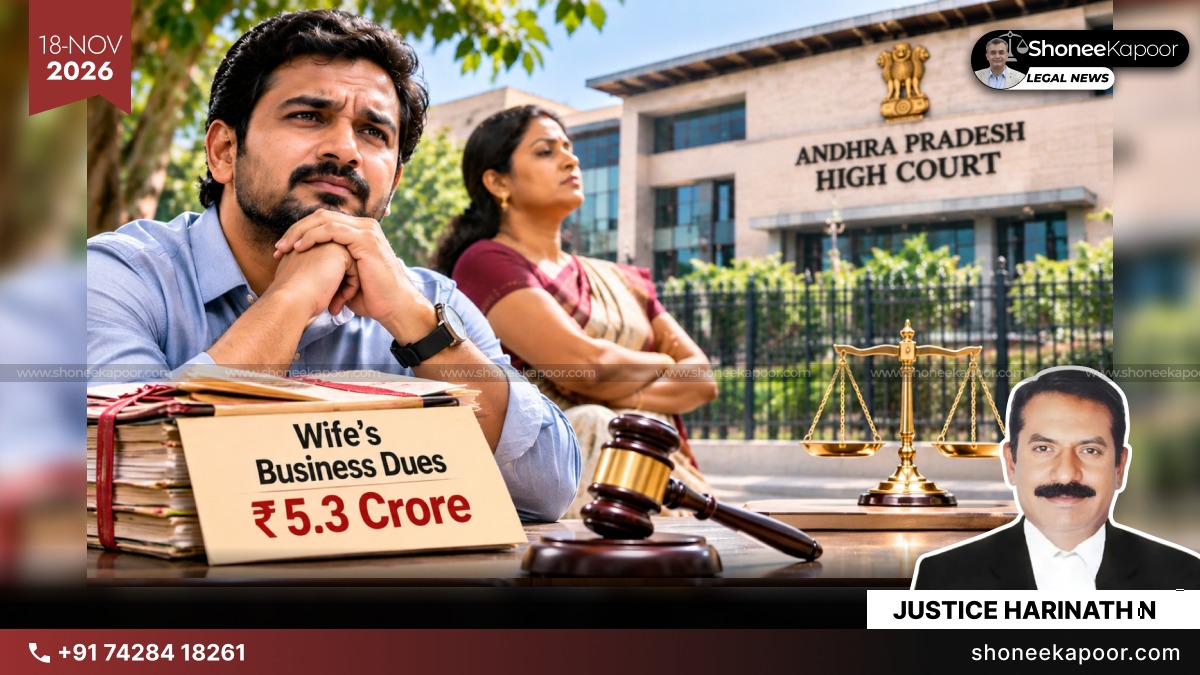
Marriage Does Not Make A Husband Liable To Pay His Wife’s ₹5.3 Crore Business Debt: Andhra Pradesh High Court

Curated by NEWS DESK
Editorial DeskANDHRA PRADESH: The Andhra Pradesh High Court has ruled that a husband cannot be held legally responsible for his wife’s business debts merely because of their marital relationship.
The Single Bench of Justice Harinath N. set aside the rejection of a husband's election nomination, holding that marriage does not automatically create contractual liability between spouses.
The case involved Veerapaneni Siva Rama Prasad, president of the Penamakuru Milk Producers Mutually Aided Cooperative Society.
His wife, Padmaja, independently owned a business named Ratnalamma Dairy.
In 2022, the husband's nomination for the cooperative union elections was rejected over his wife's alleged outstanding business dues of ₹4.26 lakh.
When he submitted his nomination again in 2023, the alleged outstanding dues had increased to over ₹5.3 crore.
The cooperative union argued that the husband had signed certain documents relating to his wife's business and could not escape responsibility for the outstanding dues.
However, the husband maintained that he neither owned nor managed his wife's business and was not personally liable for her debts.
The Cooperative Tribunal upheld the rejection of his 2022 nomination but subsequently set aside the rejection of his 2023 nomination and directed fresh elections.
The cooperative union, two elected directors, and the husband approached the High Court, challenging the Tribunal's decisions.
While examining the matter, the High Court clarified that living together, knowing about a spouse's business or enjoying its financial benefits does not automatically create contractual liability.
The Court further clarified that a sole proprietor's business debts cannot automatically be transferred to their spouse or children.
Explaining the independent legal identity of married individuals, the Court observed:
“The spouse is a separate legal person and is not automatically liable for the proprietor's business obligations.”
The High Court found that the arbitration proceedings were initiated against the wife's business alone.
It further held that Bye-law 24 could not be invoked to disqualify the husband over his wife's outstanding business dues.
Ultimately, the Andhra Pradesh High Court allowed the husband's writ petition, dismissed the petitions filed by the cooperative union and the elected directors, and upheld the direction for fresh elections in the 2023 election dispute.
EXPLANATORY TABLE OF LAWS AND SECTIONS
| Law / Section | What It Means | Application In This Case |
|---|---|---|
| Article 226, Constitution of India | Empowers High Courts to issue writs. | Used to challenge the Tribunal's orders. |
| Section 151 CPC, 1908 | Recognises the inherent powers of civil courts. | Invoked in applications seeking interim and procedural relief. |
| Section 50 CPC, 1908 | Governs execution of decrees against legal representatives of deceased judgment debtors. | Explained the limited liability of legal heirs. |
| Section 138, Negotiable Instruments Act, 1881 | Deals with cheque dishonour. | Discussed in a judicial precedent concerning spousal liability. |
| Andhra Pradesh Mutually Aided Cooperative Societies Act, 1995 | Governs registered mutually aided cooperative societies. | Applicable to the cooperative union. |
| Bye-law 24(1)(e) | Provides for disqualification relating to outstanding dues. | Could not be applied to the husband for his wife's debts. |
| Bye-law 24(1)(h) | Provides for disqualification relating to business dealings. | Could not justify rejecting the husband's nomination in this case. |
| Principle of Contractual Liability | A person must have a valid legal basis for being held liable under a contract. | Marriage alone did not establish the husband's liability. |
CASE DETAILS
| Particular | Details |
|---|---|
| Case Title | Sri Veerapaneni Siva Rama Prasad v. The Milk Commissioner Cum Managing Director & Ors. |
| Court | Andhra Pradesh High Court, Amaravati |
| Bench | Justice Harinath N. |
| Case Identification Number | APHC010427102026 |
| Case Numbers | W.P. Nos. 23150, 24861 and 25053 of 2026 |
| Jurisdiction | Special Original Jurisdiction |
| Husband's Counsel | Ganta Prasad, Sitaram Chaprala |
| Union's Senior Counsel | P. B. Vijay Kumar |
| Other Counsel on Record | Jyothi Eswar Gogineni, A. V. S. Laxmi, K. S. Murthy Associates, GP for Cooperation |
| Tribunal Case Numbers | E.O.P. No. 56 of 2022 and E.O.P. No. 16 of 2023 |
| Judgment Reserved | 12 October 2026 |
| Judgment Pronounced | 16 November 2026 |
| Decision | Husband's petition allowed; union's and elected directors' petitions dismissed. |
| Costs | No order as to costs |
KEY TAKEAWAYS
- Husband Not Liable For Wife's Debts: Marriage alone cannot create financial liability.
- ₹5.3 Crore Business Dues: Husband was denied his election nomination over his wife's alleged dues.
- Independent Legal Identity: Husband and wife remain separate legal persons.
- Marriage Is Not A Business Partnership: Contractual liability requires a valid legal basis.
- High Court Grants Relief To Husband: Wrongful rejection of his nomination set aside.
Share Your Thoughts
Comments are moderated before publication.