
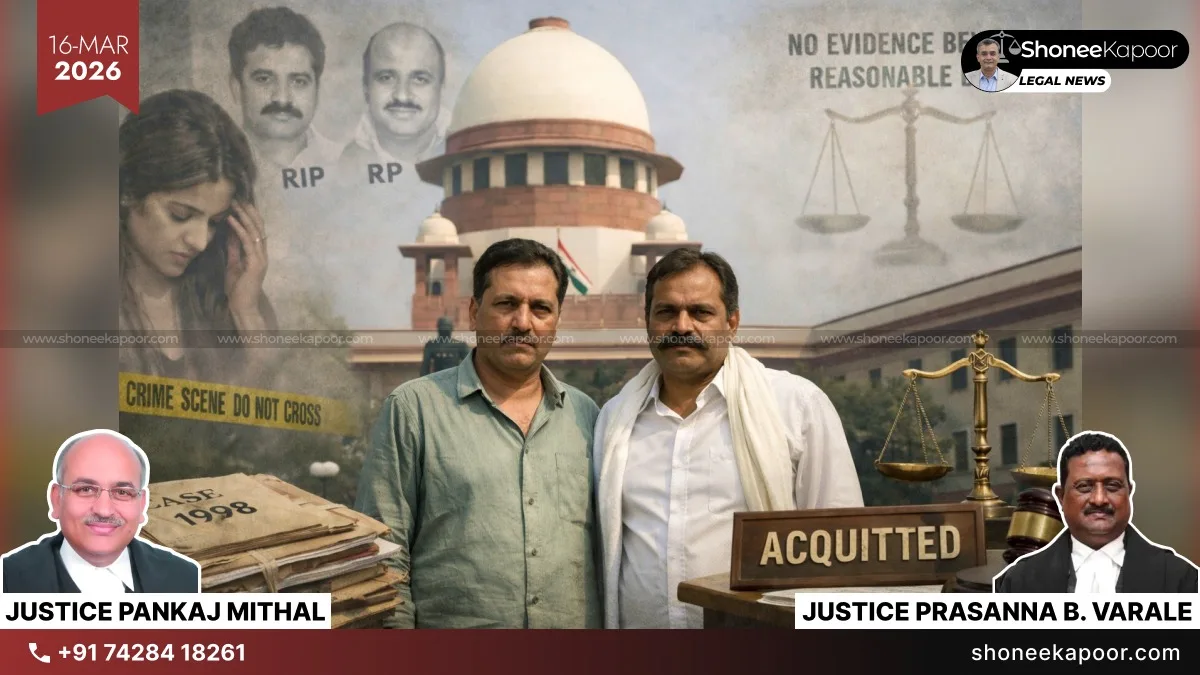
The Supreme Court set aside the conviction of 4 men in a 1998 gang rape case, ruling that the prosecution failed to prove the charges beyond reasonable doubt.
But when decades pass and the accused are finally acquitted, who restores the years of life lost to an unproven allegation?
NEW DELHI: A Supreme Court bench of Justice Pankaj Mithal and Justice Prasanna B. Varale has acquitted two men in a 1998 alleged gang rape case from Dehradun, Uttarakhand. The Court held that the prosecution failed to prove the allegations beyond reasonable doubt and therefore the conviction could not stand.
According to the complaint, the alleged incident happened on 7 April 1998 around 7:30 PM when the woman was returning home from the market in Sanjay Colony. She alleged that four men stopped her, covered her mouth with a black handkerchief and took her to a nearby place where they raped her one by one. She also claimed that the accused threatened her afterwards, which is why she did not immediately report the incident.
However, the complaint was filed only on 31 July 1998, more than three months after the alleged incident. Based on this complaint, the police registered an FIR under Sections 376, 427 and 506 of the Indian Penal Code and later filed a charge sheet.
Originally, there were four accused in the case: Rajendra, Pappu alias Hanuman, Sushil Kumar, and Kishan. The trial court convicted all four accused in 2000 and sentenced them to 10 years of rigorous imprisonment along with a fine. The Uttarakhand High Court later upheld this conviction in 2012.
During the long legal proceedings, two of the accused (Accused No. 3 and Accused No. 4) passed away. Because of this, the appeal before the Supreme Court continued only for the remaining two accused (Accused No. 1 and Accused No. 2).
Before the Supreme Court, the defence argued that there were major contradictions in the statements of the complainant and that the FIR was filed after a long delay without a proper explanation. They also pointed out that there were no independent witnesses and no medical evidence to support the allegations.
After examining the evidence, the Supreme Court noted that the entire case was based mainly on the statement of the complainant and that there were several inconsistencies in her version.
The Court observed:
“It is the trite in law that the conviction can rest on the solitary version of the prosecutrix, provided it inspires confidence of the Court. In the present case, the version of the prosecutrix utterly fails to inspire confidence of this Court.”
The judges also pointed out that there was no medical evidence or other supporting material to prove that the accused had committed the alleged crime. The Court concluded that the prosecution had not established the guilt of the accused.
Because of this, the Supreme Court allowed the appeal and set aside the conviction passed by the lower courts. As a result, the two surviving appellants were acquitted and ordered to be released immediately if they were not required in any other case.
Explanatory Table: Laws And Sections Involved
| Law / Section | Explanation | How Applied in This Case |
| Indian Penal Code – Section 376(2)(G) | This provision dealt with gang rape under the IPC as it existed at the time of the alleged incident. | Trial court convicted the accused under this section; Supreme Court later set aside the conviction. |
| Indian Penal Code – Section 506 | This section deals with criminal intimidation or threatening someone with harm. | Allegation that the accused threatened the complainant after the incident. |
| Indian Penal Code – Section 427 | This section punishes mischief causing damage to property. | Included in the FIR as part of the alleged acts during the incident. |
| Code of Criminal Procedure – Section 374 | Gives a convicted person the right to appeal against a conviction. | Used by the accused to challenge their conviction before the High Court. |
| Code of Criminal Procedure – Section 164 | Allows statements to be recorded before a magistrate during investigation. | The complainant’s statement under this section was examined for inconsistencies. |
Case Details
- Case Title: Rajendra & Ors. vs State of Uttarakhand
- Court: Supreme Court of India
- Criminal Appeal Number: Criminal Appeal No. 264 of 2015
- Bench: Justice Pankaj Mithal and Justice Prasanna B. Varale
- Neutral Citation: 2026 INSC 238
- Judgment Date: 13 March 2026
- Counsels:
- For the Appellants: Ms. Sonia Mathur, Senior Advocate (argued), Dr. Sandeep Singh, Advocate, Ms. Shubhi Bhardwaj, Advocate, Mr. Vikrant Rana, Advocate, Mr. Vinay Pal, Advocate, Mr. Prashant Malik, Advocate, Mr. Kushagra Sachdeva, Advocate, Mr. Arham Khan, Advocate, Ms. Seema Singh, Advocate, Mr. Ashutosh Rai Sharma, Advocate, Mr.,, Kisalaya Shukla, Advocate, Ms. Vanshika Mudgil, Advocate, Ms. Manasi Sridhar, Advocate, Ms. Safeena Khan, Advocate, Mr. Nikhil Chandra Jaiswal, Advocate, and Mr. Sanchit Garga, Advocate-on-Record
- For the Respondent (State of Uttarakhand): Ms. Saakshi Singh Rawat, Advocate (argued), Ms. Rachna Gandhi, Advocate, Mr. Sudarshan Singh Rawat, Advocate-on-Record
Key Takeaways
- A criminal conviction cannot be sustained merely on allegations if the prosecution fails to prove the case beyond a reasonable doubt.
- Even though a conviction can legally be based on the sole testimony of a prosecutrix, the Court clarified that such testimony must inspire confidence and be free from serious contradictions.
- A complaint filed after several months without a convincing explanation can weaken the prosecution case and affect the reliability of allegations.
- There was no medical evidence, independent witness, or supporting material, which significantly weakened the prosecution’s case.
- When doubts exist in evidence, the benefit must go to the accused to prevent miscarriage of justice
This Could Change Your Case-Get FREE Legal Advice-Click Here!
Disclaimer: The views and opinions expressed in this article are those of the Indian courts and do not necessarily reflect the official policy or position of “ShoneeKapoor.com” or its affiliates. This article is intended for informational and educational purposes only. The content provided is not legal advice, and viewers should not act upon this information without seeking professional counsel. Viewer discretion is advised.
