
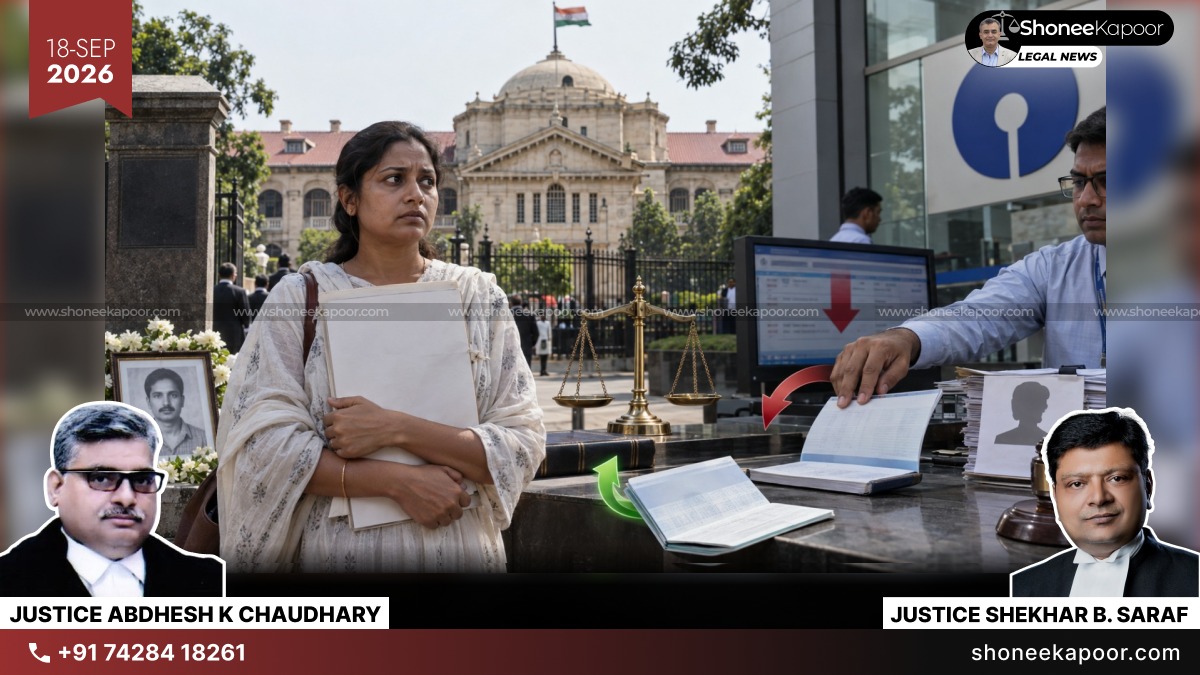
SBI Case | If Husband Dies Owing Loan, Can Bank Take Money From His Wife's FD? Allahabad High Court Answers

Curated by NEWS DESK
Editorial DeskCan a bank recover a deceased husband’s personal loan directly from his wife’s independent fixed deposit when she never signed the loan documents? The Allahabad High Court has ordered SBI to return ₹19.90 lakh with interest and pay ₹1 lakh compensation.
UTTAR PRADESH: The Allahabad High Court, Lucknow Bench, has strongly criticised the State Bank of India (SBI) for taking ₹19,90,693 from a widow’s fixed deposit to recover a personal loan taken by her deceased husband. The Court directed the bank to refund the entire amount with applicable FD interest and also pay ₹1 lakh as exemplary and punitive compensation.
The Division Bench of Justice Shekhar B. Saraf and Justice Abdhesh Kumar Chaudhary passed the order in a writ petition filed by Neha Mishra.
Mishra’s husband, an Assistant Professor at Medicine Hospital, Ring Road, Lucknow, took a ₹15 lakh Xpress Credit Loan from SBI on November 3, 2020. He died due to Covid-19 on May 6, 2021.
Importantly, the wife had not taken the loan. She was neither a co-applicant nor a co-borrower, guarantor, surety, indemnifier or nominee in the loan transaction. The High Court therefore found no privity of contract between her and SBI in relation to her husband’s loan.
The loan was also stated to have been covered by an insurance policy, for which the deceased husband had allegedly paid a premium of ₹8,803.
Years after the husband’s death, SBI issued a legal notice to the wife seeking payment of ₹13,87,382 plus interest. SBI also placed her salary account on hold, which it later released after she approached the RBI Ombudsman.
During subsequent negotiations, however, SBI encashed her fixed deposit and deducted ₹19,90,693. The FD, opened at SBI’s Ashiyana Branch in 2025, was transferred to the Jankipuram Branch, where her husband had taken the loan. After the amount was deducted towards the husband’s liability, the account was transferred back.
The Court noted that the bank had
“merely debited the bank account of the petitioner, as the petitioner had a fixed deposit in the respondent-Bank.”
The Bench called this
“a serious breach of trust reposed on the Banks”.
SBI relied upon an irrevocable standing instruction given by the deceased husband concerning amounts payable towards provident fund, gratuity, pension and similar benefits. The Court, however, found that the bank had not established that the money taken from the wife’s FD represented her husband’s gratuity or other retiral benefits.
The High Court also made an important distinction. It did not hold that SBI could never proceed against a legal heir for a deceased borrower’s legally recoverable liability. It observed that SBI “may very well have a legal right to proceed against the petitioner as the legal heir of the deceased”, but any such recovery must follow due process of law.
The bank could not recover the money in an “arbitrary, capricious and whimsical manner”.
The Bench was particularly critical of how the wife’s FD was moved between SBI branches before and after the deduction.
It observed:
“The entire process that has been adopted by the Bank of surreptitiously transferring the fixed deposit from one Branch to another to debit the same and upon debiting the same once again transferring the account back clearly indicates that the intention of the Bank was to achieve its purpose in a surreptitious manner.”
The Court ultimately concluded:
“The entire process is abominable and clearly an anathema to banking practice.”
Accordingly, the Allahabad High Court directed SBI to immediately refund ₹19,90,693 to Neha Mishra along with interest at the rate applicable to her fixed deposit. SBI must pay the amount within four weeks.
The Court further directed SBI to pay ₹1 lakh as exemplary and punitive compensation for the manner in which it made the recovery.
EXPLANATORY TABLE OF LAWS AND SECTIONS
| Law / Provision | What It Means | Application In this Case |
|---|---|---|
| Article 226, Constitution of India | Gives High Courts the power to issue writs against the State and public authorities for violations of legal and constitutional rights. | The petitioner approached the Allahabad High Court, challenging SBI’s deduction from her FD and seeking a refund and other reliefs. |
| Section 60, Code of Civil Procedure, 1908 | Deals with property that can be attached and sold in execution of a decree and also protects specified categories of money/property from attachment. | The dispute involved the legal protection available to certain retiral benefits and whether the bank could appropriate money without following lawful recovery proceedings. |
| Privity of Contract | Normally, contractual obligations bind only the parties to the contract. | The wife did not sign or join her husband’s personal loan transaction as a borrower, guarantor, surety, or indemnifier. |
| Legal Heir Liability / Due Process | A creditor may have remedies against a deceased borrower’s estate or legal heirs under law, but cannot automatically impose personal contractual liability on a legal heir. | The Court said SBI could pursue any lawful remedy available to it, but could not simply debit the wife’s independent FD arbitrarily. |
CASE DETAILS
| Particular | Details |
|---|---|
| Case Title | Ms Neha Mishra v. Reserve Bank of India Through Governor, Central Office Building, Mumbai & 5 Others |
| Case Number | Writ-C No. 6722 of 2026 |
| Neutral Citation | 2026:AHC-LKO:63471-DB |
| Court | High Court of Judicature at Allahabad, Lucknow Bench |
| Decision Date | September 10, 2026 |
| Bench | Justice Shekhar B. Saraf and Justice Abdhesh Kumar Chaudhary |
| Petitioner | Neha Mishra |
| Counsel for Petitioner | Syed Mohammad Haider Rizvi, Asheesh Kumar and Shakti Kumar Verma |
KEY TAKEAWAYS
- Wife Got Her Money Back: She was relieved from her deceased husband’s loan liability because she was neither borrower nor guarantor.
- Reverse the Genders: If a husband’s FD were taken for his deceased wife’s loan on identical facts, would he get his money back just as easily?
- Would Husband Be Freed From Wife’s Loan? The same principle says he should not be personally liable for a debt he never borrowed or guaranteed.
- His FD Should Be Protected Too: A husband’s independent money cannot automatically become a recovery fund for his wife’s personal loan.
- Same Facts, Same Relief: If the genders were reversed, the husband should get his money back and be relieved from the wife’s personal loan liability on the same legal principle.
Share Your Thoughts
Comments are moderated before publication.