
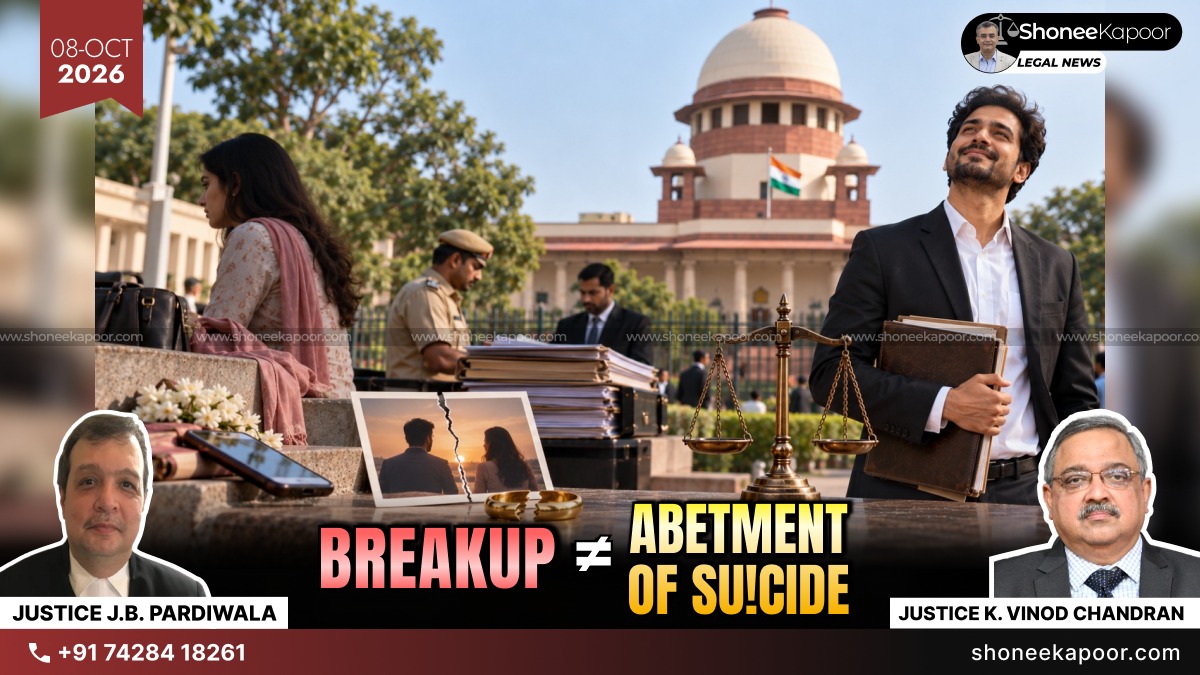
“Refusal To Marry Live-In Partner Is Not Abetment Of Suicide”: Supreme Court Quashes Section 306 IPC Case Against Man And Family

Curated by NEWS DESK
Editorial DeskNEW DELHI: The Supreme Court of India has quashed criminal proceedings against a man and five others accused of abetment of suicide after a woman allegedly ended her life following her live-in partner's refusal to marry her.
A Bench of Justice J.B. Pardiwala and Justice K. Vinod Chandran held that a breakup or refusal to marry cannot automatically be treated as abetment of suicide without evidence of instigation or the required criminal intent.
The case arose in Telangana, where the woman had been in a consensual relationship with the first accused. According to the complaint filed by her sister, the couple had lived together at the man's house for about three months. His family had also accepted their relationship.
However, the woman's sisters brought her back to their family home. Subsequently, the man allegedly refused to marry her. The woman reportedly informed her eldest sister about the refusal and her intention to end her life.
The woman later died by suicide at the man's house. Criminal proceedings were initiated against six people under Section 306 read with Section 34 of the Indian Penal Code (IPC).
Apart from the man, the accused included his parents, sister, friend and his sister's prospective husband. The allegations suggested that the friend had spoken negatively about the woman, while other family members had discouraged the marriage.
The Supreme Court examined these allegations and found no material establishing that the accused had intentionally instigated the woman to end her life.
The Court observed:
"People react differently to situations and if a breakup ends up with suicide, it cannot always be termed an abetment to suicide."
The Bench further clarified:
"The refusal to marry was not with an intention to drive the woman to death by suicide nor can knowledge be attributed to the accused that on such refusal, she would commit suicide."
The Court also questioned why the woman's sisters had taken her away from the man's house when the relationship was consensual and accepted by his family. It noted that the eldest sister had received a call indicating the woman's intention to end her life but had not taken steps to prevent it.
Rejecting the allegations against the accused, the Supreme Court stated:
"We are unable to sustain the prosecution initiated against the accused on such frivolous allegations and we quash the proceedings in Sessions Case No.101 of 2024 pending before the Learned IInd Additional Senior Civil Judge-cum-Additional Chief Judicial Magistrate, Medchal-Malkajgiri District at Kushaiguda, Telangana."
The Bench directed that any accused still in custody be released immediately, unless required in another case. It also cancelled the bail bonds of those already on bail.
The Supreme Court made it clear that refusing marriage, ending a consensual relationship or facing family opposition does not automatically establish criminal liability for abetment of suicide.
EXPLANATORY TABLE OF LAWS AND SECTIONS
| Law / Provision | What It Means | Application in This Case |
|---|---|---|
| Section 306 IPC | Punishes abetment of suicide with imprisonment of up to 10 years and a fine. | Six accused faced prosecution following the woman's suicide. The Supreme Court found no sufficient basis to establish instigation and quashed the proceedings. |
| Section 34 IPC | Establishes joint criminal liability when several persons act in furtherance of a common intention. | Invoked against the man and five others. The Court found no sufficient basis to continue the prosecution against them. |
| Section 108 BNS | Corresponding provision under the Bharatiya Nyaya Sanhita, 2023, dealing with abetment of suicide. | Included for current legal reference. The original case was registered under Section 306 IPC. |
| Section 3(5) BNS | Provides for joint criminal liability where several persons act with a common intention. | Corresponds to Section 34 IPC. It was not invoked in the original proceedings. |
CASE DETAILS
| Particular | Details |
|---|---|
| Case Title | XYZ & Ors. v. The State of Telangana & Anr. |
| Court | Supreme Court of India |
| Bench | Justice J.B. Pardiwala and Justice K. Vinod Chandran |
| Judgment Date | October 5, 2026 |
| Case Number | Criminal Appeal of 2026 arising out of SLP (Crl.) No. 7239/2026 |
| High Court Case | CRLRC No. 763/2025 |
| High Court Order Date | February 20, 2026 |
| Trial Court Case | Sessions Case No. 101/2024 |
| Trial Court | II Additional Senior Civil Judge-cum-Additional Chief Judicial Magistrate, Kushaiguda, Medchal-Malkajgiri District, Telangana |
| Counsel for Petitioners | Senior Advocate Aparna Bhat; Advocates Yash S. Vijay (AOR), Shikhar Aggarwal, Joshua Tom Thomas and Saransh Khandelwal |
| Counsel for Respondents | Advocates Devina Sehgal (AOR), Yatharth Kansal, Srikanth Varma Mudunuru, Syed Ahmed Saud, Mohd. Parvez Dabas, Mir Mukarram Ali, Daanish Ahmed Syed, Uzmi Jameel Husain, Mohd. Shahib and Shakil Ahmad Syed (AOR) |
KEY TAKEAWAYS
- Refusal to Marry Is Not Suicide Abetment: A man's decision not to marry cannot automatically make him criminally liable for his partner's suicide.
- Six People Dragged Into Criminal Proceedings: The man, his parents, sister and two others faced prosecution under Section 306 read with Section 34 IPC.
- Breakup Cannot Become Criminal Guilt: The Supreme Court held that a relationship ending in suicide does not automatically establish abetment.
- Family Opposition Is Not Instigation: Disapproving of a marriage cannot, by itself, establish criminal liability for abetment of suicide.
- Allegations Cannot Replace Evidence: The Supreme Court quashed the proceedings against all six accused. A man's refusal to marry is not proof of a crime, and his family cannot be prosecuted merely for opposing the relationship.
Share Your Thoughts
Comments are moderated before publication.