
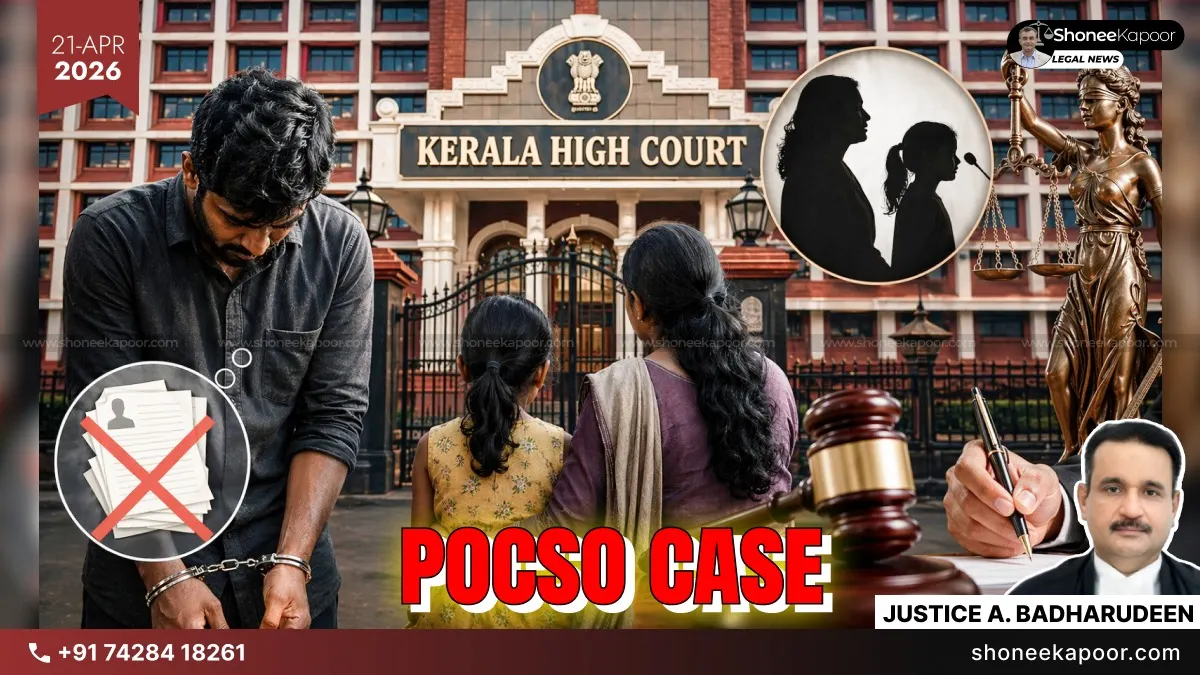
Is documentary proof always necessary to establish minority in POCSO cases? The Kerala High Court ruling indicates oral evidence is sufficient, if unrebutted during trial.
Kerala: In a recent judgment, the Kerala High Court, through Justice A. Badharudeen, upheld the conviction of an accused under the Protection of Children from Sexual Offences Act, 2012 and Indian Penal Code, despite serious objections regarding proof of the victim’s age.
The case revolved around allegations of sexual assault, where the prosecution claimed that the accused had committed offences under Section 7 read with Section 8 of the POCSO Act and Section 354 IPC. The trial court had already convicted the accused and imposed punishment.
The defence strongly argued that the prosecution failed to establish the most basic requirement under POCSO law — proof that the victim was below 18 years. It was pointed out that no valid documentary evidence like birth certificate, school record, or municipal record was produced.
Despite the absence of documentary proof, the court held that the prosecution had sufficiently established that the victim was a minor. The Court relied on the oral statements of the girl and her mother regarding her age, and treated that testimony as adequate evidence to satisfy the legal requirement for invoking the POCSO Act.
Justice A. Badharudeen recognized that age proof is a foundational requirement in such cases. The Court said:
“The very rudimentary plank for prosecuting an accused under the POCSO Act, is that the victim must be below 18 years of age, and in such cases, the prosecution is under a bounden duty to prove the age of the victim”.
However, despite noting this strict legal requirement, the Court relied on the statements of the victim and her mother that the child was 8 years old.
The Court further observed:
“It is not in dispute that a fact in issue can be proved either by oral evidence or by documentary evidence or by both including circumstances arising therefrom.”
The defence argued that the prosecution had failed to legally establish age through proper documentary evidence, but the Court rejected that argument.
It concluded:
“The contention raised by the learned counsel for the appellant/accused that the prosecution miserably failed to prove the age of the victim… is untenable.”
This raises a serious concern. If even the most basic requirement under POCSO can be accepted without strict documentary proof, then the burden practically shifts onto the accused. In criminal cases involving jail, stigma, and lifelong consequences, foundational facts must be proved rigorously by the prosecution, not relaxed through oral claims alone.
Explanatory Table: Laws And Sections Involved
| Law / Section | Purpose | How Applied in This Case |
| POCSO Act, 2012 | Special law to protect children from sexual offences | Main law used against accused |
| Section 2(d), POCSO | Defines child as person below 18 years | Age issue was central dispute |
| Section 7, POCSO | Sexual assault by touching private parts or sexual physical contact without penetration | Main allegation |
| Section 8, POCSO | Punishment for Section 7 offence | Basis of 3-year sentence |
| Section 29, POCSO | Presumption against accused in certain cases once prosecution proves basics | Mentioned in discussion |
| Section 42, POCSO | If same act falls under IPC and POCSO, higher punishment applies | Separate IPC sentence not imposed |
| Section 354 IPC | Assault or force to outrage modesty of woman | Also charged |
| Section 357(1) CrPC | Compensation from fine amount to victim | Fine ordered to victim |
| Section 134 Evidence Act | No fixed number of witnesses needed for proof | Used to discuss single witness rule |
| Section 94(2) JJ Act | Method to determine age through records / medical test | Referred in age proof discussion |
| Rule 12 JJ Rules | Earlier framework for age determination | Referred by Court |
Case Details
- Case Title: Joseph @ Sabu v. State of Kerala
- Court: Kerala High Court
- Case Number: Criminal Appeal No. 929 of 2015
- Bench: Justice A. Badharudeen
- Neutral Citation: 2026:KER:32710
- Date of Judgment: 10 April 2026
- Counsels:
- For Appellant: Sri. Manju Antony, Sri. R. Anas Muhammed Shamnad, Smt. P. Mamatha
- For State: Sr. Public Prosecutor Sri. Vipin Narayan A
Key Takeaways
- When basic legal requirements are relaxed, the burden silently shifts onto the accused to prove innocence.
- Oral statements alone, without strong documents, can still lead to serious criminal conviction.
- Foundational facts in criminal law must be proved strictly, not assumed or inferred loosely.
- Lowering evidentiary standards increases the risk of wrongful conviction in sensitive cases.
- Procedural safeguards are the backbone of fair trials; once weakened, restoring justice after conviction becomes far more difficult.
This Could Change Your Case-Get FREE Legal Advice-Click Here!
Disclaimer: The views and opinions expressed in this article are those of the Indian courts and do not necessarily reflect the official policy or position of “ShoneeKapoor.com” or its affiliates. This article is intended for informational and educational purposes only. The content provided is not legal advice, and viewers should not act upon this information without seeking professional counsel. Viewer discretion is advised.
