
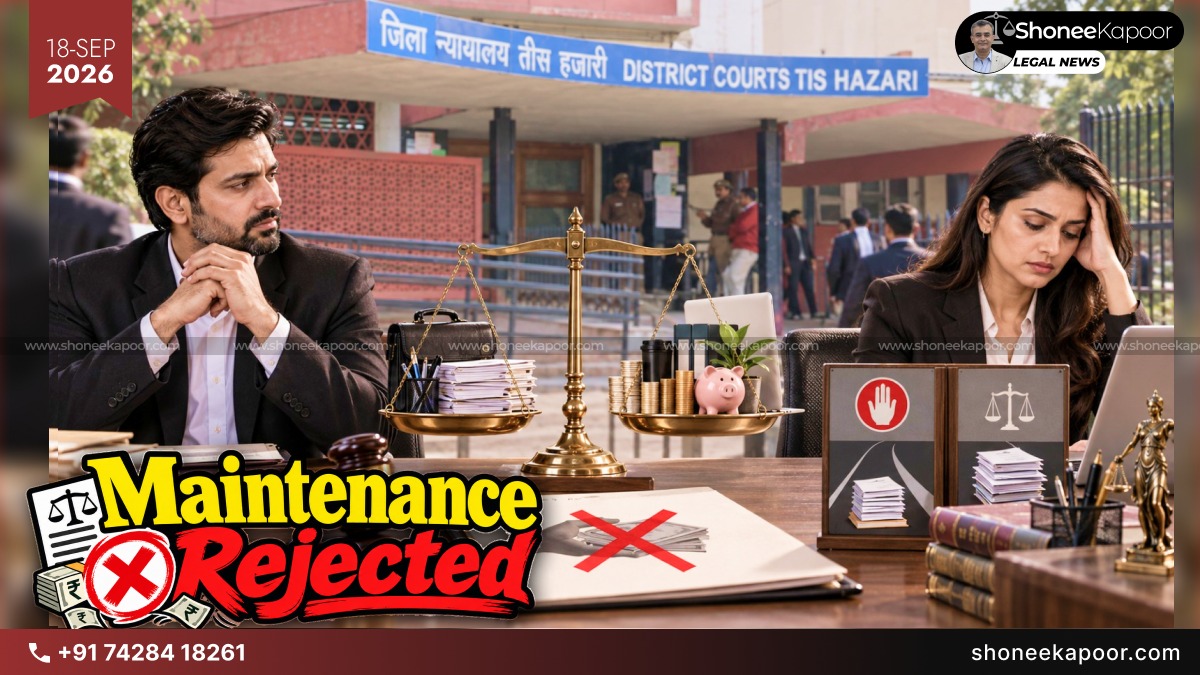
Misuse Of Maintenance Law Exposed | Husband Earns More, So He Must Pay? Delhi Court Rejects Working Wife’s ₹60,000 Maintenance Plea

Curated by NEWS DESK
Editorial DeskCan a working wife earning ₹63,863 per month claim interim maintenance merely because her husband earns substantially more? A Delhi court has rejected her Section 23 DV Act application, holding that maintenance law is not meant to equalise the incomes of spouses.
DELHI: A Delhi court has dismissed a woman's application for ₹60,000 per month in interim maintenance from her husband after finding that she earns ₹63,863 per month and can support herself from her own income.
Judicial Magistrate First Class, Mahila Court-01, Central, Tis Hazari Courts, passed the order on September 7, 2026. The complainant had moved an application under Section 23(2) of the Protection of Women from Domestic Violence Act, 2005, referred to in the order as the “DV ACT”, seeking interim maintenance of ₹60,000 per month for herself.
According to her case, she married respondent no. 1 on November 28, 2023, according to Hindu rites and ceremonies. No child was born from the marriage. She alleged that after marriage, her husband subjected her to mental and physical harassment and did not provide maintenance or household expenses. She stated that she had been living separately from him since August 6, 2024.
The husband admitted the marriage but denied the allegations of cruelty and harassment. He also submitted that the complainant was herself earning and therefore sought dismissal of her interim maintenance application.
At this interim stage, the court considered the Domestic Incident Report and the allegations in the complaint relating to emotional, mental and economic abuse. It observed that, prima facie, there appeared to be allegations of domestic violence. However, the court separately examined interim maintenance based on the parties' financial disclosures.
The wife's income affidavit showed that she was a graduate and worked as a Systems Engineer, earning ₹63,863 per month.
She stated that her husband was a Chartered Accountant working as a Senior Auditor and also alleged that he had residential property, a car, stocks and several fixed deposits. The court, however, recorded that she had not placed material on record to substantiate these claims regarding his alleged assets.
In his income affidavit, the husband stated that he worked as an Assistant Audit Manager and earned approximately ₹1.63 lakh per month.
He argued that the wife was not entitled to maintenance because she was educated, employed and earning ₹63,863 per month. He also alleged that she had mutual funds, PPF and fixed deposits worth lakhs, though the court noted that he too had not produced material to prove those assertions.
The court then examined the wife's own income affidavit. In part “A”, she disclosed general monthly expenses of around ₹60,000. In part “F”, she stated that she worked and earned ₹63,863 per month. She also disclosed an FD of ₹2 lakh, a PPF account and investments in mutual funds.
Based on these disclosures, the court concluded that the complainant could maintain herself from her own income and did not require interim maintenance from her husband.
Her counsel argued that even though she was earning, she should receive interim maintenance because she had enjoyed a “good lifestyle” with her husband.
The court compared this argument with her own pleadings. It noted that she had herself alleged that the husband was unemployed, that she was treated like a maid, that he financially manipulated her, asked her to withdraw savings for stock-market investments, denied her access to the family car, asked her to move to Bangalore without him for a better salary, demanded large sums of money, restricted her use of the bathroom and controlled her daily routine, and that she was served rotten food and not allowed to enjoy family meals.
The court found these pleadings inconsistent with the argument that she had enjoyed a “good lifestyle” with the husband. It therefore rejected this ground for seeking interim maintenance.
The wife's counsel further argued that she earned only ₹63,863 per month while the husband earned around ₹2 lakh per month and owned various movable and immovable properties. It was contended that this income difference itself entitled her to interim maintenance.
The court disagreed.
It held that merely because the husband and wife had different incomes, the wife did not automatically become entitled to interim maintenance.
In a significant observation, the court stated:
“The purpose of law of maintenance is not to equalise the income of the wife with that of the husband but is only to see that when divorce and other matrimonial proceedings are filed, either of the parties should not suffer because of paucity of source of income.”
On the facts before it, the court found that the complainant had failed to demonstrate any such paucity of income.
Accordingly, the court dismissed her application under Section 23 of the DV Act. The court expressly clarified that its observations would not be treated as an expression on the merits of the main domestic violence case. The matter was listed for the complainant's evidence on November 16, 2026.
EXPLANATORY TABLE OF LAWS AND SECTIONS
| Law / Provision | What It Means | Application In This Case |
|---|---|---|
| Protection of Women from Domestic Violence Act, 2005 | Provides civil remedies to an aggrieved woman in a domestic relationship, including monetary relief and interim orders. | The wife instituted proceedings under the DV Act and sought interim maintenance from her husband. |
| Section 23, DV Act | Empowers the Magistrate to grant interim and ex parte orders where the statutory requirements are satisfied. | The court considered and ultimately dismissed the wife's interim maintenance application. |
| Section 23(2), DV Act | Specifically permits an ex parte order on the basis of the prescribed affidavit where the Magistrate is satisfied that the application prima facie discloses domestic violence or likelihood of such violence. | The uploaded order identifies the application as one under Section 23(2), through which the complainant sought ₹60,000 per month. |
| Income Affidavit / Financial Disclosure | Financial disclosures enable the court to examine the parties' actual income, expenses, assets and liabilities while deciding maintenance. | The wife's own affidavit disclosed ₹63,863 monthly income, around ₹60,000 monthly expenses, an FD of ₹2 lakh, PPF and mutual-fund investments. The husband's affidavit disclosed approximately ₹1.63 lakh monthly income. |
CASE DETAILS
| Particular | Details |
|---|---|
| Case Title | Wife v. Husband |
| CNR Number | DLCT02-015898-2025 |
| Case Number | 15 Ct. Cases 588/2025 |
| Court | Mahila Court-01, Central, Tis Hazari Courts, Delhi |
| Decision Date | September 7, 2026 |
| Counsel for Respondent No. 1 | Tripaksha Litigation Through Vibhuti Zibbu |
| Relief Sought | ₹60,000 per month interim maintenance |
| Provision | Section 23(2), Protection of Women from Domestic Violence Act, 2005 |
| Result | Interim maintenance application dismissed |
| Next Date | November 16, 2026, for complainant's evidence |
KEY TAKEAWAYS
- Husband earning more does not automatically make the wife entitled to interim maintenance.
- The wife was earning ₹63,863 per month, and the Court found her capable of maintaining herself.
- Maintenance law is not meant to equalise the incomes of husband and wife.
- Her ₹60,000 per month interim maintenance plea was rejected despite the husband earning around ₹1.63 lakh per month.
- A husband’s higher salary cannot become an automatic financial liability when the wife has sufficient independent income
Share Your Thoughts
Comments are moderated before publication.