
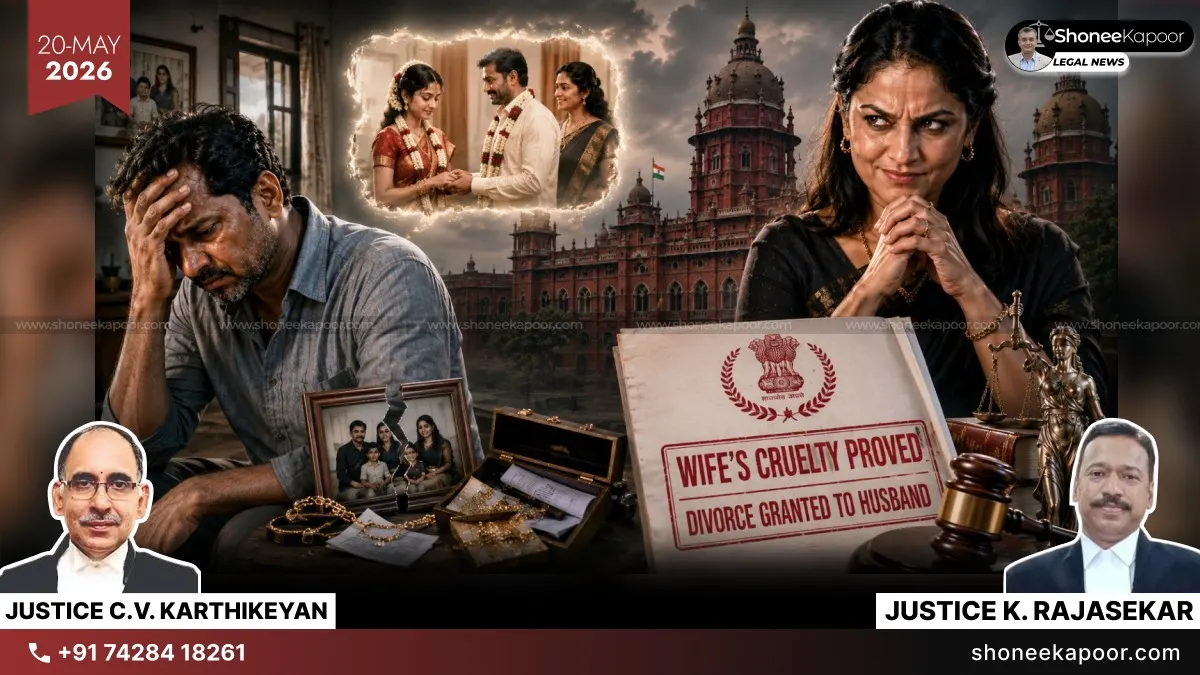
Can a father be treated like a stranger in his own daughter’s marriage?
The Madras High Court recognised the pain suffered by the father and granted divorce after finding that the husband was kept in the dark while the wife secretly arranged their daughter’s marriage.
CHENNAI: The Madras High Court has granted divorce to a husband after finding that his wife secretly arranged the marriage of their daughter to her own divorced brother without even informing the father and calusing mental cruelty to him.
The judgment was delivered by Justice C.V. Karthikeyan and Justice K. Rajasekar, who held that the husband had suffered deep mental agony and emotional trauma because of the wife’s conduct.
The couple had married in 1997 and were living in Chennai with their two children. According to the husband, problems in the marriage became serious in 2017 when his wife suddenly left the matrimonial home along with their daughter. About a week later, she returned and informed him that their daughter had already been married in Bangalore to the wife’s own brother, who was a divorcee.
The husband told the Court that he was never informed about the marriage, was not invited to attend it, and came to know about it only after everything had already taken place. He also stated that the man whom his daughter married had earlier been involved in another failed marriage within the family, and police complaints had previously been lodged against him.
The wife defended herself by claiming that the daughter had willingly chosen the relationship and that the marriage was performed in her interest. She also alleged that after returning from Bangalore, she was stopped from entering the matrimonial home, forcing her to approach the police.
However, the High Court found that the wife never denied her active role in arranging the marriage. The Court also noted that the daughter had just attained the age of 18 years, while the man she married was over 32 years old and already divorced. The judges observed that the father was completely excluded from one of the most important moments in his daughter’s life.
While examining the emotional impact on the husband, the Court observed:
“The pain of the appellant as a father could be visualised by us.”
The judges further said there was no reason for the wife to secretly conduct the marriage without informing the father, especially when she knew he may object because of the background of the groom. The Court found that the husband naturally suffered shock, humiliation and emotional pain after learning that his daughter had been married without his knowledge.
The High Court also considered several other incidents while deciding the case. It noted that police complaints had been filed against the husband, complaints were sent to his superior officers affecting his reputation, and allegations were made that the wife broke open the flat and removed documents and belongings while he was away.
According to the Court:
“This act of lodging complaint to the police, to the higher officials of the appellant would also have caused serious mental cruelty to the appellant herein.”
The judges referred to the Supreme Court judgment in Samar Ghosh v. Jaya Ghosh regarding mental cruelty in matrimonial disputes. The High Court reiterated that continuous conduct causing “mental pain, agony and suffering” can amount to cruelty if it becomes impossible for spouses to continue living together peacefully.
After considering the complete facts, the Court concluded that the wife’s actions had completely damaged the marital relationship and caused continuous emotional suffering to the husband.
The Madras High Court finally set aside the Family Court order and granted divorce to the husband, while also cancelling the order of restitution of conjugal rights passed in favour of the wife.
Explanatory Table: Laws And Provisions Involved
| Law / Section | Purpose | How Applied In This Case |
| Section 13(1)(i-a), Hindu Marriage Act | Divorce for cruelty | Husband sought divorce for mental cruelty |
| Mental Cruelty | Emotional pain caused by spouse | Court found wife’s conduct caused agony |
| Restitution of Conjugal Rights | Direction to resume marriage | Wife had sought reunion through court |
| Section 19(1), Family Courts Act | Right to appeal Family Court order | Husband challenged Family Court judgment |
| Samar Ghosh v. Jaya Ghosh (2007) 4 SCC 511 | Landmark cruelty judgment | Relied upon by High Court |
| Vishwanath Agrawal v. Sarla Vishwanath Agrawal (2012) 7 SCC 288 | Mental agony can be cruelty | Cited during arguments |
| Sapna v. B. Pradeep Kumar (2012-2-LW-623) | Long separation principle | Discussed during hearing |
Case Details
- Case Title: G. S. v. S. K.
- Court: Madras High Court
- Case Numbers: CMA Nos. 1155 & 1156 of 2024
- Date of Judgment: 24 April 2026
- Bench: Justice C.V. Karthikeyan | Justice K. Rajasekar
- Counsels:
- For Appellant: Mr. N. Mariappan
- For Respondent: Mr. D. Nellaiappan
Key Takeaways
- A father being secretly excluded from his own daughter’s marriage can cause irreversible emotional trauma and mental cruelty.
- Courts are increasingly recognising that mental cruelty against men is not limited to abuse inside the home, but also includes humiliation, manipulation and public targeting.
- Filing repeated police complaints and complaints to employers as pressure tactics can seriously damage a man’s dignity, career and mental peace.
- Marriage cannot survive where one spouse takes major family decisions behind the other spouse’s back and destroys trust completely.
- Men’s emotional suffering is real, and courts are slowly acknowledging that psychological pain inflicted on husbands also deserves legal protection.
This Could Change Your Case-Get FREE Legal Advice-Click Here!
Disclaimer: The views and opinions expressed in this article are those of the Indian courts and do not necessarily reflect the official policy or position of “ShoneeKapoor.com” or its affiliates. This article is intended for informational and educational purposes only. The content provided is not legal advice, and viewers should not act upon this information without seeking professional counsel. Viewer discretion is advised.
