
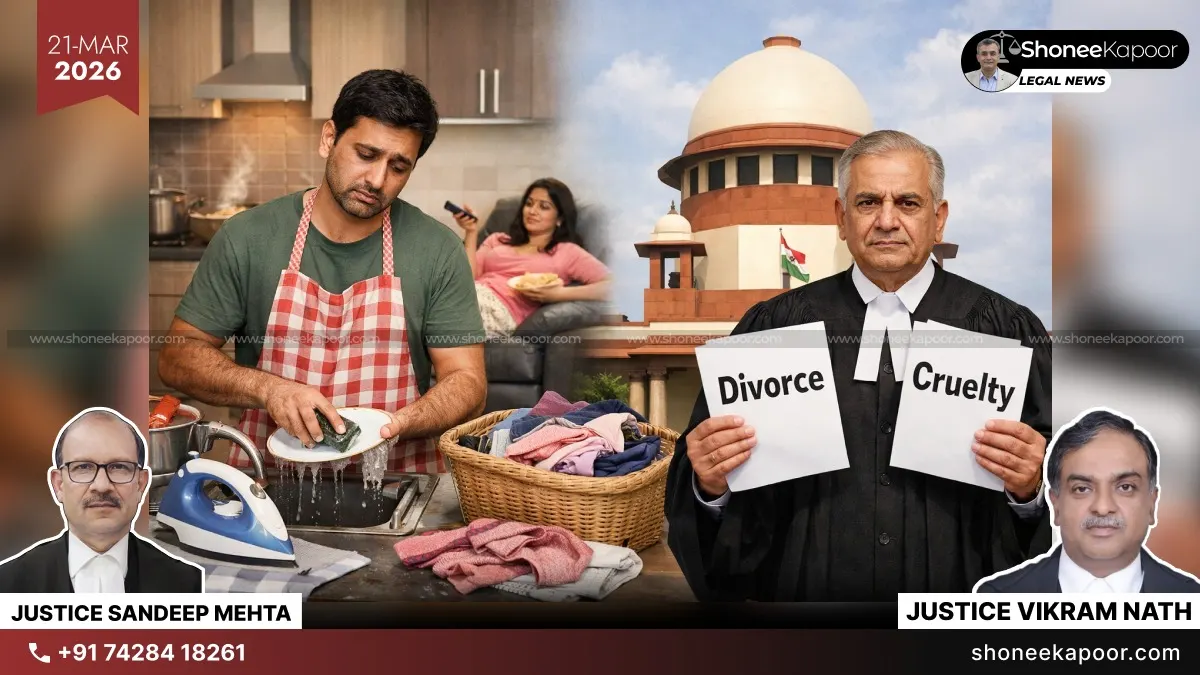
Is not cooking or doing housework enough to prove cruelty in marriage? Supreme Court raises a bigger question—are expectations from husbands quietly being redefined?
You Marrying A Maid? SC In Divorce Case: The Supreme Court of India made oral observations while hearing a husband’s plea seeking divorce on the ground of cruelty.
The Bench of Justice Sandeep Mehta and Justice Vikram Nath clearly indicated that complaints like a wife not properly doing household work, such as cooking or daily chores, cannot automatically be treated as cruelty under law. This observation in modern matrimonial disputes where expectations inside marriage are increasingly being reinterpreted.
During the hearing, the Bench highlighted the changing nature of marital responsibilities. Justice Mehta remarked:
“You’re not marrying a maid, you’re marrying a life partner”.
The Court stressed that marriage is a partnership and not a one-sided arrangement of duties.
Further reinforcing this view, Justice Nath stated:
“You have to contribute in this cooking, washing, etc. Today’s times are different”.
This observation reflects a shift where courts are expecting shared responsibilities within households rather than fixed traditional roles.
The case relates to a couple married in 2017, who have an 8-year-old son. The husband is a government school teacher, while the wife works as a lecturer. It was pointed out during the hearing that the wife is financially better placed and has not demanded any maintenance or alimony so far.
The husband had filed for divorce alleging that soon after marriage, the wife’s behaviour changed. He claimed that she used abusive language towards him and his parents, refused to cook for the family, and did not invite him to their child’s cradle ceremony.
On the other hand, the wife presented a different version. She stated that she went to her parental home for childbirth with the consent of the husband and his family. She further alleged that they did not attend the cradle ceremony and demanded cash and gold from her parents. Additionally, she claimed that she was forced to give up her salary.
Initially, the Family Court accepted the husband’s claims and granted divorce on grounds of cruelty. However, the High Court later reversed this decision. Challenging this reversal, the husband approached the Supreme Court.
The matter has now been listed for further hearing, and both parties have been directed to appear in person. Earlier attempts at mediation between the parties had failed.
Explanatory Table – Legal Position & Principles Applied
| Legal Issue | Relevant Law / Principle | Explanation | Practical Impact |
| Divorce on Ground of Cruelty | Section 13(1)(ia), Hindu Marriage Act, 1955 | Cruelty must be serious, continuous, and legally provable conduct causing mental or physical harm | Ordinary marital disagreements or domestic expectations may not qualify as cruelty |
| Household Work Disputes | Judicial Interpretation (Case Law) | Refusal or inability to perform household chores like cooking is not automatically cruelty | Raises threshold for husbands seeking divorce on such grounds |
| Marriage as Partnership | Constitutional & Social Interpretation | Courts increasingly interpret marriage as an equal partnership, not role-based | Expands expectation of shared responsibilities, especially on husbands |
| Mediation in Matrimonial Disputes | Section 89 CPC & Family Court Practice | Courts attempt reconciliation through mediation before final decision | Delay in resolution but promotes settlement attempts |
| Burden of Proof in Cruelty | Evidence Act Principles | Allegations like abuse, misconduct must be clearly proven with evidence | Personal grievances without strong proof often fail in higher courts |
| Appellate Review | High Court & Supreme Court Jurisdiction | Higher courts can overturn Family Court findings if legal standards not met | Even after winning at trial stage, outcomes can reverse against husband |
Key Takeaways
- Courts are raising the bar for “cruelty”, making it harder for husbands to legally exit broken marriages.
- Everyday marital conflicts are being dismissed as normal, even when consistently one-sided.
- Legal expectations from husbands are expanding, but enforceable accountability on the other side remains weak.
- Trial court relief can easily be reversed, leaving men stuck in prolonged litigation cycles.
- Personal suffering inside marriage is increasingly being treated as non-actionable unless backed by extreme evidence.
This Could Change Your Case-Get FREE Legal Advice-Click Here!
Disclaimer: The views and opinions expressed in this article are those of the Indian courts and do not necessarily reflect the official policy or position of “ShoneeKapoor.com” or its affiliates. This article is intended for informational and educational purposes only. The content provided is not legal advice, and viewers should not act upon this information without seeking professional counsel. Viewer discretion is advised.

Could we also get case no. or case title?
This was an oral observation by the Supreme Court and has not yet been uploaded on the official website. Once the order or record is published, the case details will be updated on the same weblink accordingly.