
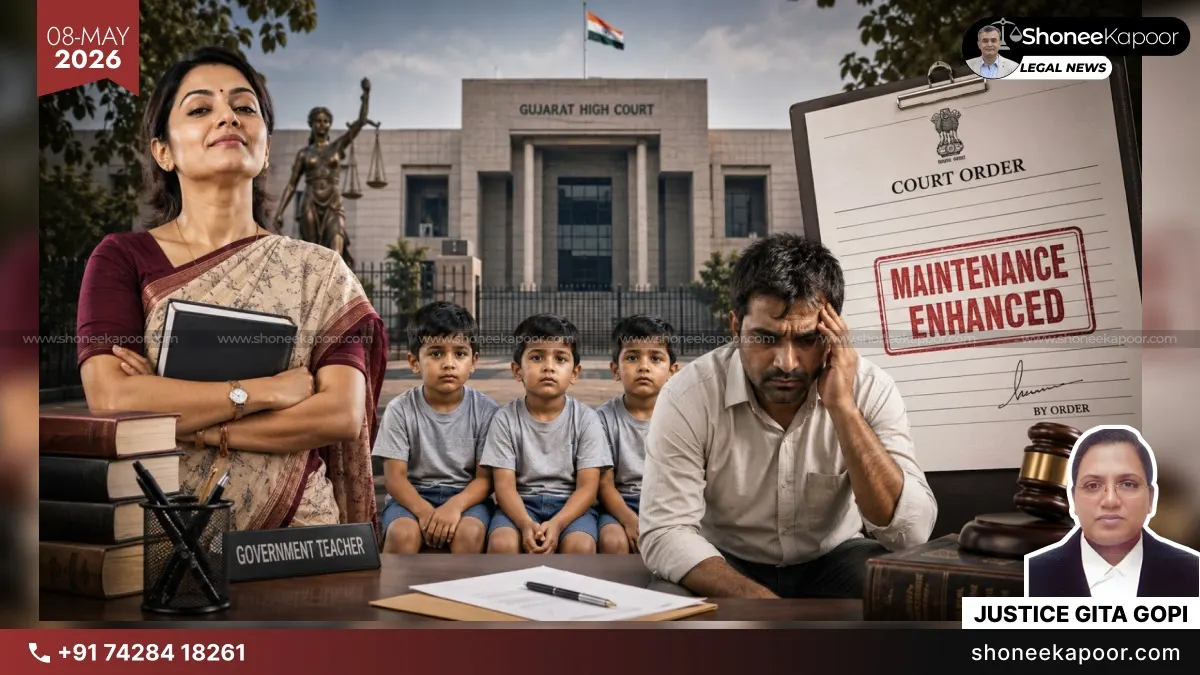
Does A Mother’s Government Job And Higher Salary Reduce The Father’s Maintenance Liability?
The Gujarat High Court rejected this argument and held that a father’s legal duty towards children cannot be avoided merely because the mother is financially stronger.
AHMEDABAD: The Gujarat High Court, through Justice Gita Gopi, held that a father cannot escape his legal duty to maintain his children merely because the mother is financially stronger.
The case involved three minor triplet children whose mother sought enhancement of maintenance under Section 127 CrPC after the Family Court had earlier rejected her plea by observing that she was earning more as a government teacher and that the children were receiving scholarship benefits.
Before the High Court, the father argued that since the mother was earning substantially more than him, no further financial burden should be imposed upon him. He also relied upon his low salary, loan EMIs, and expenses arising from his second marriage.
However, the High Court rejected these arguments after examining financial affidavits filed by both parties in light of the Supreme Court judgment in Rajnesh v. Neha.
The Court referred to important observations of the Supreme Court judgment Sunita Kachwaha v. Anil Kachwaha and quoted:
“The wife had a postgraduate degree, and was employed as a teacher in Jabalpur. The husband raised a contention that since the wife had sufficient income, she would not require financial assistance from the husband. The Supreme Court repelled this contention, and held that merely because the wife was earning some income, it could not be a ground to reject her claim for maintenance.”
The High Court further reproduced:
“An able-bodied husband must be presumed to be capable of earning sufficient money to maintain his wife and children, and cannot contend that he is not in a position to earn sufficiently to maintain his family…”
While discussing child expenses, the Court also quoted:
“The living expenses of the child would include expenses for food, clothing, residence, medical expenses, education of children.”
The Court additionally relied upon the Supreme Court judgment in Deepa Joshi v. Gaurav Joshi and reproduced the following observations:
“Deductions arising out of financial commitments such as loan repayments… cannot be placed on the same footing as necessary expenditure so as to substantially reduce the liability of maintenance.”
After examining the facts, the Gujarat High Court observed that the mother was independently handling educational, medical, tuition, and day-to-day expenses of the children. The Court held that liabilities arising from the father’s second marriage or loan repayments could not override his primary duty towards his children from the first marriage.
The Court finally enhanced the maintenance amount from ₹1,800 to ₹3,000 per month for each child with effect from July 16, 2019, and set aside the earlier Family Court order rejecting the enhancement of maintenance.
Explanatory Table: Laws & Provisions Involved
| Law / Provision | Purpose | Relevance In This Case | |
| Section 125 CrPC | Provides maintenance to wife, children, and parents who cannot maintain themselves | Original maintenance order of ₹1,800 per child was passed under this provision | |
| Section 127 CrPC | Allows modification or enhancement of maintenance upon change in circumstances | Mother filed enhancement application under this section | |
| Rajnesh v. Neha | Landmark Supreme Court judgment laying down guidelines for maintenance affidavits and financial disclosure | High Court relied heavily on this judgment | |
| Deepa Joshi v. Gaurav Joshi | Supreme Court ruling stating that loan repayments cannot reduce maintenance liability | Used to reject father’s EMI-related defence | |
| Shailja v. Khobbanna | Supreme Court held that wife’s earning capacity alone cannot deny maintenance | Relied upon while discussing maintenance principles | |
| Sunita Kachwaha v. Anil Kachwaha | Held that earning wife can still claim maintenance | Referred to by the High Court | |
| Chander Parkash v. Shila Rani | Held that an able-bodied husband is presumed capable of maintaining family | Important observation reproduced by Court | |
| Shamima Farooqui v. Shahid Khan | Supreme Court reaffirmed husband’s obligation to maintain wife | Relied upon in judgment | |
Case Details
- Case Title: Minor Triplet Children Through Mother vs Father
- Case No.: R/CR.MA/15576/2024
- Court: Gujarat High Court
- Bench: Justice Gita Gopi
- Date of Judgment: 05 May 2026
- Nature of Case: Child Maintenance / Enhancement of Maintenance
- Counsels:
- For Applicant / Husband: Mr. I.H. Syed, Senior Advocate with Ms. Vidhi J. Bhatt
- For Respondents: Mr. Hemant B. Raval
- For State: Mr. Niraj Sharma, APP
Key Takeaways
- Even when the mother was earning far more than the father, the Court still increased maintenance liability upon the father.
- The father’s second marriage, loan EMIs, and financial burdens were not treated as valid grounds to reduce maintenance.
- Courts continue treating child maintenance as a near-absolute obligation of the father irrespective of comparative parental income.
- Despite evidence that the mother had stable government income and scholarships for the children, the father remained financially liable for enhanced support.
- Matrimonial and maintenance litigation increasingly places long-term financial responsibility upon men even in financially unequal parenting situations.
This Could Change Your Case-Get FREE Legal Advice-Click Here!
Disclaimer: The views and opinions expressed in this article are those of the Indian courts and do not necessarily reflect the official policy or position of “ShoneeKapoor.com” or its affiliates. This article is intended for informational and educational purposes only. The content provided is not legal advice, and viewers should not act upon this information without seeking professional counsel. Viewer discretion is advised.
