
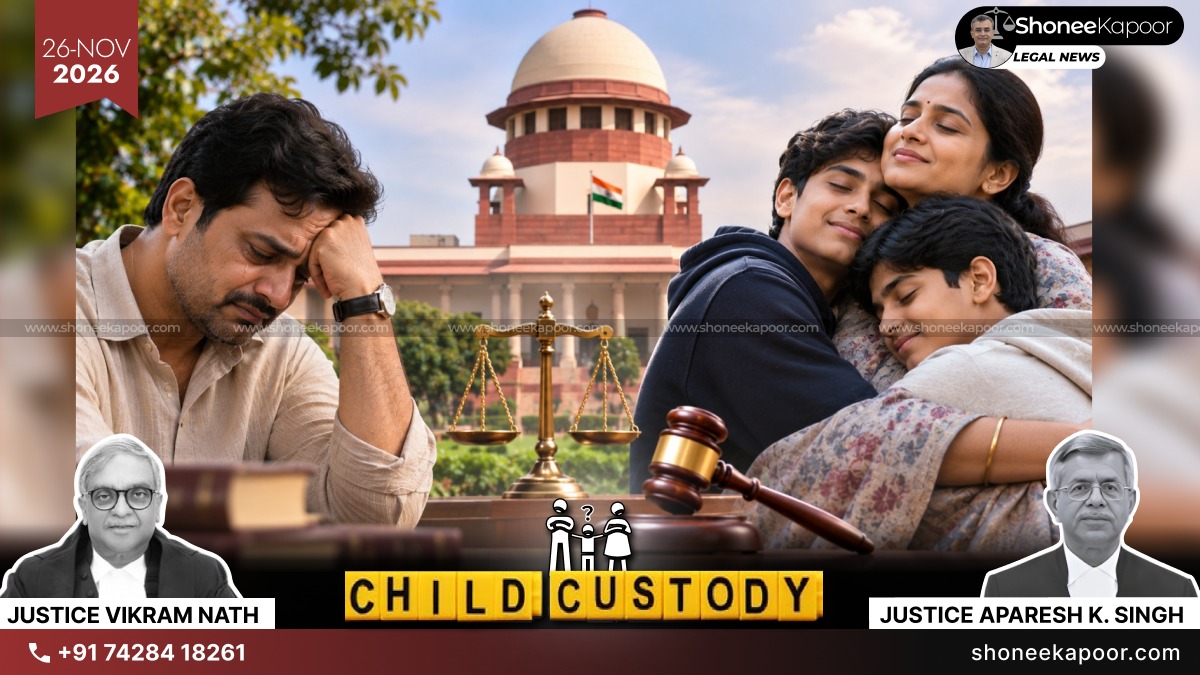
Child Custody Denied To Father Despite Winning In Two Courts: “Children Are Not Mere Chattels”, Says Supreme Court

Curated by NEWS DESK
Editorial DeskNEW DELHI: The Supreme Court of India set aside a Madras High Court judgment granting custody of two minor sons, aged 16 and 14 years, to their father, holding that the welfare of children takes priority over the legal rights of parents in child custody disputes.
Read Also:- Child Custody to Father: Latest Judgments in India (2026)
In a judgment dated 23 November 2026, a Bench comprising Justice Vikram Nath and Justice Aparesh Kumar Singh allowed the children to remain with their mother despite no disqualification being established against the father.
The couple married on 23 August 2009 and started living separately in May 2014. The husband subsequently obtained a decree of divorce on the grounds of cruelty on 19 November 2018. The wife did not challenge the divorce decree.
On the same date, the Family Court, Madurai, directed the father to pay ₹6,000 per month as maintenance for each child and separately granted him custody of both sons.
Meanwhile, the wife had also filed a criminal complaint against her husband and six members of his family under Sections 498A, 294(b) and 506 IPC.
The charges under Sections 294 and 506 IPC were dropped against six accused in December 2019. The proceedings against another accused abated following her death.
On 22 March 2022, the remaining six accused were acquitted of the charges under Section 498A IPC.
The wife challenged the custody order before the Madras High Court, which upheld the Family Court's decision after finding no material supporting her allegations regarding the husband's mental fitness.
The High Court also recorded that the mother had not allowed the father to meet his children despite the orders passed by both courts.
The mother subsequently approached the Supreme Court, which stayed the custody order on 24 January 2025.
The Supreme Court spoke separately with both children, who said they preferred to continue living with their mother and maternal grandparents.
The children revealed that they had met their father only four to five times during the prolonged separation.
The Court acknowledged the father's grievance regarding the denial of access to his sons despite securing favourable custody orders from two courts.
While examining the provisions of the Guardians and Wards Act, 1890, the Supreme Court reiterated that both parents are natural guardians, but the welfare and preferences of mature children must be considered while deciding custody.
The Court observed:
“Children are not mere chattels, nor are they toys for their parents”
The Supreme Court found that the children had developed a strong emotional bond with their mother over the years and that changing their living environment at this stage could adversely affect their education and well-being.
However, the Court also recognised the importance of paternal love and affection in children's balanced development.
The Court observed:
“The respondent-father also deserves the company of his children”
Recognising the children's right to receive love and affection from both parents, the Supreme Court issued the following visitation directions:
- The father can meet his sons on the second Saturday and Sunday of every month at Gandhi Museum, Madurai, between 10 AM and 2 PM.
- The mother must facilitate these meetings.
- The father can also meet his children during Pongal and half-yearly vacations after informing the mother through telephone or WhatsApp.
- The father should share their future educational expenses if requested by the mother.
Accordingly, the Supreme Court allowed the mother's appeal and set aside the High Court's custody judgment while protecting the father's visitation rights and recognising the importance of his presence in his children's lives.
EXPLANATORY TABLE OF LAWS AND SECTIONS
| Law / Section | What It Means | Application In This Case |
|---|---|---|
| Guardians and Wards Act, 1890 | Governs the appointment of guardians and custody of minor children. | Applied while deciding the custody dispute between both parents. |
| Section 17, Guardians and Wards Act | Makes the welfare of the minor the primary consideration while appointing a guardian. | The Supreme Court prioritised the children's welfare over the father's legal entitlement to custody. |
| Section 17(3), Guardians and Wards Act | Allows courts to consider the preference of a child mature enough to make an intelligent decision. | Both sons expressed their willingness to remain with their mother. |
| Section 19(b), Guardians and Wards Act | Recognises the legal position of both parents as natural guardians, subject to their fitness. | No disqualification was established against the father. |
| Section 498A IPC | Punishes a husband or his relatives for subjecting a married woman to legally defined cruelty. | Six accused were acquitted on 22 March 2022. |
| Section 294(b) IPC | Punishes obscene words, songs or acts covered by the provision, causing annoyance in or near public places. | The charges were dropped by the High Court. |
| Section 506 IPC | Prescribes punishment for criminal intimidation. | The charges were dropped by the High Court. |
CASE DETAILS
| Particular | Details |
|---|---|
| Case Title | J. Sakthi Devi @ Chriti v. Joseph Charles |
| Court | Supreme Court of India |
| Bench | Justice Vikram Nath and Justice Aparesh Kumar Singh |
| Neutral Citation | 2026 INSC 1260 |
| Case Number | Civil Appeal arising out of SLP (Civil) No. 30284 of 2024 |
| Counsel for Appellant (Wife) | T. Harish Kumar, AOR; Shubham Kothari, Adv.; Aiyushi Daga, Adv.; Shubham P. Chopra, Adv.; Atul Kundlia, Adv.; Gowthamkumar V, Adv. |
| Counsel for Respondent (Husband) | Ajit Sharma, Adv.; R. Ayyam Perumal, AOR; Kanchan Singh, Adv.; Aravind Raj, Adv.; Gaurika Sood, Adv.; A. Sai Kumar, Adv. |
| Divorce Case | I.D.O.P. No. 86/2014 |
| Maintenance Case | M.C. No. 100/2014 |
| Child Custody Case | G.W.O.P. No. 36/2015 |
| High Court Appeal | C.M.A. (MD) No. 17 of 2019 |
| Criminal Case | C.C. No. 22 of 2016 |
| Final Decision | Mother's appeal allowed; custody retained by mother; father's visitation rights protected. |
KEY TAKEAWAYS
- Two Court Victories, Yet No Custody: The father won twice but ultimately lost custody of his children.
- Fatherhood Denied For Years: A father met his own children only four to five times in 10–12 years.
- 498A Prosecution Ended In Acquittal: The husband and five others faced criminal proceedings before being acquitted.
- A Fit Father Still Lost Custody: No legal disqualification was established against him.
- Visitation Is No Substitute For Fatherhood: Children deserve meaningful relationships with both parents, not merely scheduled meetings.
Share Your Thoughts
Comments are moderated before publication.