
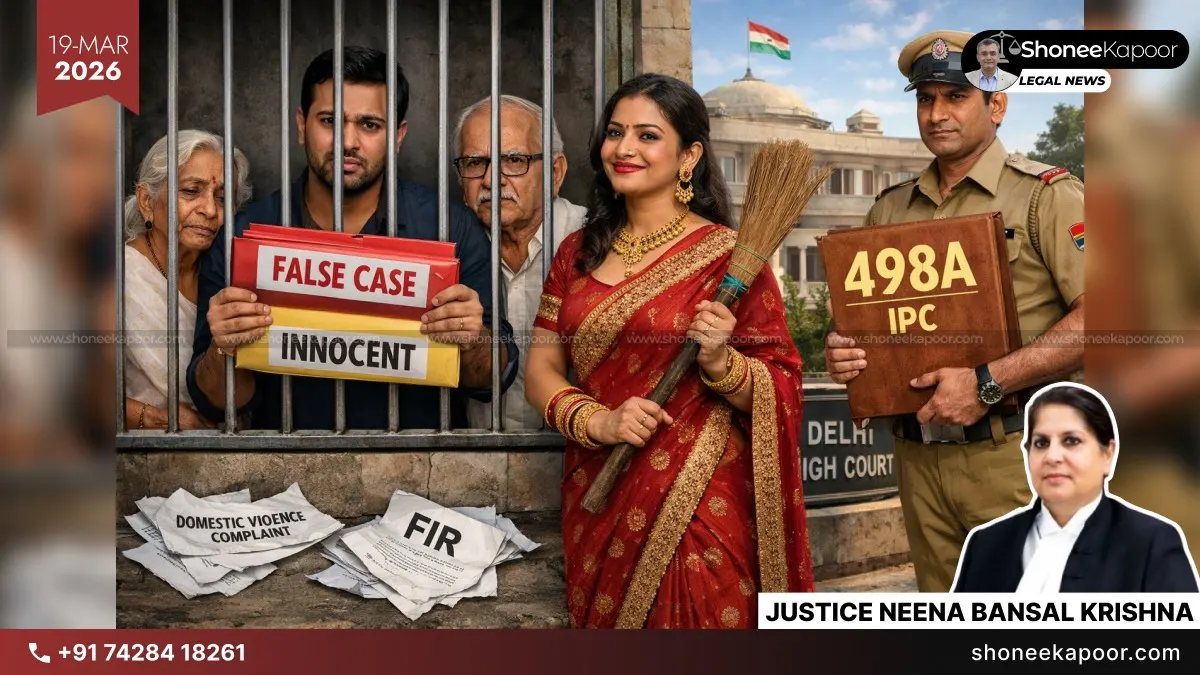
Is living with in-laws or helping family now a criminal offence under 498A IPC? Delhi High Court clarifies the line between real cruelty and routine marital disputes—read what it said.
NEW DELHI: The Delhi High Court has clarified that asking a wife to help in taking care of family members or to live with in-laws does not automatically amount to cruelty under Section 498A of the Indian Penal Code.
Justice Neena Bansal Krishna gave this ruling while cancelling an FIR filed under Sections 498A, 406, and 34 IPC, along with proceedings under the Domestic Violence Act, 2005, against a husband and his family.
The Court carefully examined the allegations and found them to be general, vague, and without specific details that are required to prove cruelty under criminal law.
Looking at the facts, the Court observed that the issues raised by the wife mainly showed normal marital disagreements and adjustment issues, not criminal behaviour.
The wife had claimed that her unmarried sister-in-law was living in the matrimonial home, handling her husband’s finances, and influencing property decisions. However, the Court found nothing unusual in this.
“Aside from bald assertions, that she had control over the finances of the husband, there is nothing to show how it was impacting her; there is no allegation that she was deprived in any way, by this alleged act of the Sister-in-law or any other family member,” it said.
The wife also alleged that she was taunted for not bringing enough gifts at the time of marriage and that she was asked to keep her mother-in-law at her mother’s house in Delhi during winter months.
The Court rejected these claims as well, stating they were too general and lacked clear evidence of harassment.
“Again, there can be no more vague, omnibus allegations that to sweepingly claim that she was taunted for not bringing sufficient dowry. Moreover, even if mother-in-law stayed with the Complainant in winter months, it leaves to ones imagination, how it tantamount to cruelty or harassment,” the Court said.
Another allegation was that the husband’s brother forced her to take responsibility for his 11-year-old son by keeping him at her mother’s house. The Court did not accept this argument.
“Merely asking the Complainant to assist in caring for a family member cannot, by itself, constitute cruelty within the meaning of Section 498A IPC.”
On the charge under Section 406 IPC, the Court found that there were no proper details about entrustment or misuse of stridhan, which is necessary to prove criminal breach of trust.
In the end, the Court ruled in favour of the husband and his family, cancelling both the FIR and the domestic violence complaint.
This judgment again highlights that criminal law cannot be used for every household disagreement, and vague allegations without proof cannot be allowed to put entire families through legal harassment.
Explanatory Table Of Laws & Sections
| Law / Section | Full Name | Purpose | Key Legal Requirement | Court’s Finding in This Case |
| Section 498A IPC | Cruelty by husband or relatives | Protects women from cruelty linked to dowry or severe harassment | Must show serious cruelty, harassment for unlawful demand, or conduct driving to suicide | No specific cruelty proved; allegations vague and general |
| Section 406 IPC | Criminal breach of trust | Deals with misuse of entrusted property (like stridhan) | Must prove entrustment + dishonest misappropriation | No details of jewellery, no entrustment proved |
| Section 34 IPC | Common intention | Fixes joint liability when multiple accused act together | Requires clear common intention and role of each accused | No specific role attributed to each accused |
| DV Act, 2005 (Section 12) | Domestic Violence Complaint | Provides civil remedies for domestic violence | Requires specific acts of domestic violence in a subsisting domestic relationship | Complaint vague; filed after divorce; not maintainable |
| DV Act Sections 18–22 | Protection, residence, monetary relief, custody, compensation | Remedies available under DV Act | Requires existence of domestic relationship + specific acts | No domestic relationship after divorce; proceedings quashed |
| Section 482 CrPC | Inherent powers of High Court | To prevent abuse of process of law | Used when FIR is malicious or lacks offence ingredients | FIR quashed as abuse of process |
| Article 227 Constitution | Supervisory jurisdiction | High Court oversight over lower courts | Ensures legality of proceedings | Invoked to correct misuse of process |
| Section 405 IPC | Definition of criminal breach of trust | Defines offence elements | Entrustment + dishonest misuse | Not satisfied |
| Section 13(1)(i-a) HMA | Divorce on cruelty | Allows divorce on cruelty grounds | Requires proof of cruelty | Divorce already granted earlier |
| Section 2(f) DV Act | Domestic relationship definition | Defines relationship for DV Act | Must exist at time of complaint | Relationship ended after divorce |
Case Details
- Case Title: ABC vs XYZ
- Case Numbers: CRL.M.C. 297/2021 & CRL.M.C. 485/2021
- Court: High Court of Delhi at New Delhi
- Bench: Hon’ble Ms. Justice Neena Bansal Krishna
- Date Reserved: 09 December 2025
- Date Pronounced: 10 March 2026
Counsels
- For Petitioners: Ms. Jyoti Dutt Sharma, Mr. Chinmaya K. Bhatt, Ms. Amrita Pandey
- For State: Mr. Ajay Vikram Singh, APP
- For Respondent: Respondent in person
Key Takeaways
- Normal family expectations like staying with in-laws or helping relatives are not cruelty—this kills one of the most misused 498A narratives.
- Courts will not accept vague, “all family members harassed me” type allegations without specific incidents—blanket accusations are being exposed.
- Filing criminal cases after divorce, without a real domestic relationship, is a clear indicator of legal harassment and revenge litigation.
- No proof of entrustment or misuse means 406 IPC cannot be casually slapped to pressure husbands and their families.
- This judgment reinforces that 498A is not a tool for emotional blackmail or financial extraction—misuse will be treated as abuse of legal process.
This Could Change Your Case-Get FREE Legal Advice-Click Here!
Disclaimer: The views and opinions expressed in this article are those of the Indian courts and do not necessarily reflect the official policy or position of “ShoneeKapoor.com” or its affiliates. This article is intended for informational and educational purposes only. The content provided is not legal advice, and viewers should not act upon this information without seeking professional counsel. Viewer discretion is advised.
