
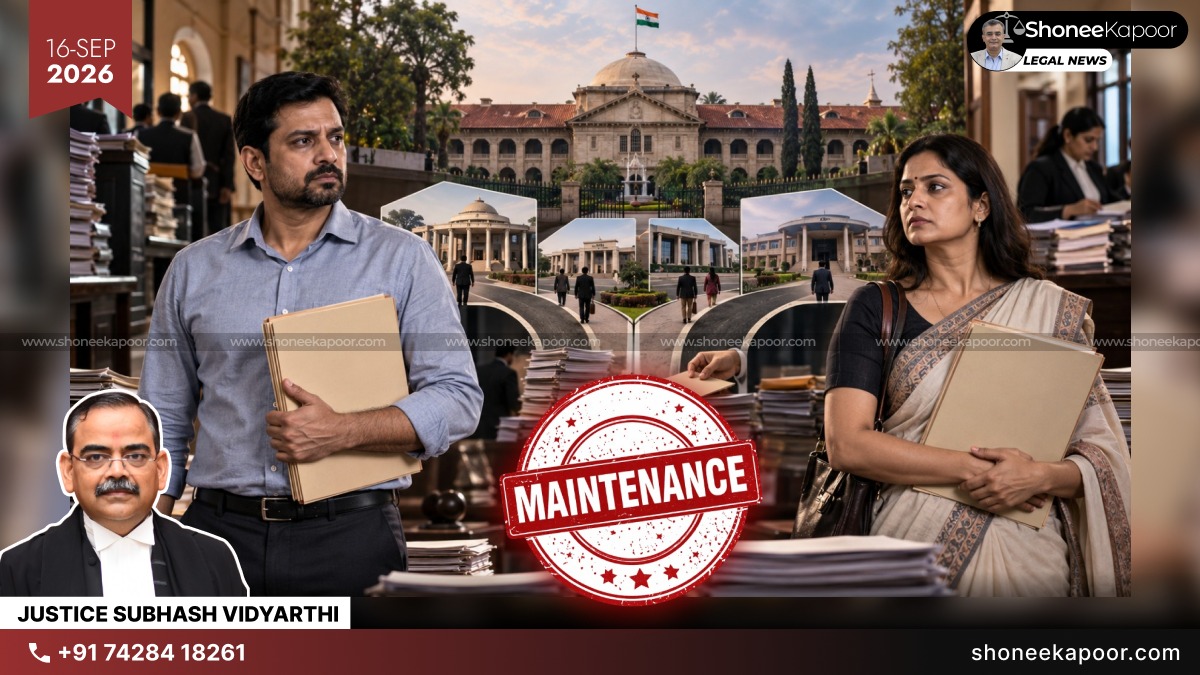
Wife Pursued Husband For Maintenance In Multiple Courts Without Seeking Divorce Or RCR? Allahabad HC Says She Was “Merely Fighting For Getting Maintenance"

Curated by NEWS DESK
Editorial DeskCan a wife seek priority in one maintenance case while pursuing maintenance against her husband before different courts? The Allahabad High Court refused to fast-track her execution case after examining the multiple proceedings and the burden they placed on Family Courts.
UTTAR PRADESH: The Allahabad High Court, Lucknow Bench, has dismissed a wife’s petition seeking speedy disposal of her maintenance execution case, after noting that she was pursuing maintenance from her husband through different proceedings before different courts. The Court said that multiplying optional litigation with the same objective places an unnecessary burden on already overworked Family Courts.
The case arose when Shashi Gupta approached the High Court under Article 227 of the Constitution of India. She sought a direction to the Additional Principal Judge-I, Family Court, Lucknow, to dispose of Execution Case No. 1675 of 2024, filed under Section 147 BNSS, at an early date.
The execution proceedings were filed on July 19, 2024, to enforce an order dated June 4, 2024, passed in proceedings under Section 125 Cr.P.C. The Family Court had directed her husband to pay Rs. 7,000 per month as maintenance.
However, the High Court also noted from the wife’s own affidavit of assets and liabilities that she had filed proceedings under Section 12 of the Protection of Women from Domestic Violence Act, where another order had been passed granting her Rs. 4,500 as maintenance.
The Court further recorded that the couple had earlier reached a settlement. Under it, the husband agreed to pay Rs. 1.51 lakh and return certain goods, while both sides were to dissolve their marriage by mutual consent. The husband had already paid Rs. 50,000 towards the settlement, but the proposed mutual-consent divorce did not materialise.
The Court then noted that the wife had filed neither a divorce petition nor proceedings for restitution of conjugal rights. It observed that “she is merely fighting for getting maintenance from her husband in different proceedings before different Courts.”
Significantly, the High Court did not hold that a woman is legally barred from pursuing maintenance under different statutes. Instead, it expressly recognised that such remedies can legally be invoked, while questioning the multiplication of non-compulsory proceedings in the facts before it.
The Court observed:
“Although she had a legal right to institute numerous proceedings claiming maintenance under various statutory provisions, when she claims to be unable to maintain herself and afford even the basic necessities for survival, it does not appear to be proper to multiply non-compulsory litigation.”
The Court further found that the absence of proceedings either to restore the matrimonial relationship or to end the marriage indicated that the petitioner was “interested only in claiming maintenance from her husband before various fora and not in settling her disputes either way by restitution of her matrimonial status or by dissolution of her marriage.”
This was significant for the husband as well. He was already facing maintenance-related litigation under more than one statutory route, had paid Rs. 50,000 under the failed settlement, and was still required to defend proceedings across different fora. The Court’s concern was not with denying a lawful maintenance remedy, but with repeated optional litigation pursuing substantially similar financial relief and its effect on judicial resources.
Justice Subhash Vidyarthi observed:
“Multiplication of optional and non-compulsive litigation is creating an unwarranted burden on the Family Courts which is causing delay in disposal of matters.”
The Court further noted that
“The Family Courts especially have been artificially overburdened with workload by multiplying litigation with similar object by numerous litigants, including the petitioner”
and therefore found no good ground to direct priority disposal of her execution proceedings.
Accordingly, the Allahabad High Court dismissed the petition on August 11, 2026. The ruling does not cancel the existing maintenance orders or hold that parallel statutory remedies are inherently illegal. It specifically refuses the wife’s request to have her pending execution case expedited in the circumstances recorded by the Court.
EXPLANATORY TABLE OF LAWS AND SECTIONS
| Law / Section | Simple Meaning | How It Applied Here |
|---|---|---|
| Article 227, Constitution of India | Gives High Courts supervisory jurisdiction over subordinate courts and tribunals. | The wife approached the High Court seeking a direction to the Family Court to dispose of her execution case speedily. |
| Section 125 Cr.P.C. | Provides a summary remedy for maintenance to eligible wives, children and parents who are unable to maintain themselves, subject to statutory conditions. | The Family Court had directed the husband to pay Rs. 7,000 per month to the wife. |
| Section 12, Protection of Women from Domestic Violence Act, 2005 | Allows an aggrieved woman to approach the Magistrate for reliefs available under the DV Act, including monetary relief. | The wife had separately initiated DV Act proceedings where Rs. 4,500 maintenance had been ordered. |
| Section 147 BNSS | Provides for enforcement of orders of maintenance or interim maintenance and expenses of proceedings under the BNSS framework. | The pending Execution Case No. 1675 of 2024 was stated in the judgment to be under Section 147 BNSS. |
CASE DETAILS
| Particular | Details |
|---|---|
| Case Title | Shashi Gupta v. State of U.P. Thru. Prin. Secy. Home Civil Sectt. Lko. And Another |
| Case Number | Matters Under Article 227 No. 4292 of 2026 |
| Neutral Citation | 2026:AHC-LKO:55690 |
| Court | High Court of Judicature at Allahabad, Lucknow Bench |
| Order Date | August 11, 2026 |
| Bench | Justice Subhash Vidyarthi |
| Petitioner | Shashi Gupta |
| Respondents | State of U.P. through Principal Secretary, Home Civil Secretariat, Lucknow and Another |
| Counsel for Petitioner | Mohammad Aziz Mansuri, Shalu Yadav |
| Counsel for State | Shri Ravi Srivastava, A.G.A. |
| Underlying Execution Case | Execution Case No. 1675 of 2024 |
| Underlying Maintenance Case | Criminal Case No. 1506 of 2022 under Section 125 Cr.P.C. |
KEY TAKEAWAYS
- Husband Dragged Into Multiple Maintenance Cases: Wife pursued maintenance under Section 125 Cr.P.C. and the DV Act.
- Husband Paid, Settlement Still Failed: He had already paid Rs. 50,000 towards the matrimonial settlement.
- Maintenance Cases Continued: Court noted the wife filed neither divorce nor restitution proceedings, while pursuing maintenance before different fora.
- High Court Called It Out: Wife was “merely fighting for getting maintenance from her husband” in different proceedings.
- No Fast-Track Relief: Calling multiple optional cases an “unwarranted burden” on Family Courts, the High Court dismissed her petition.
Share Your Thoughts
Comments are moderated before publication.