
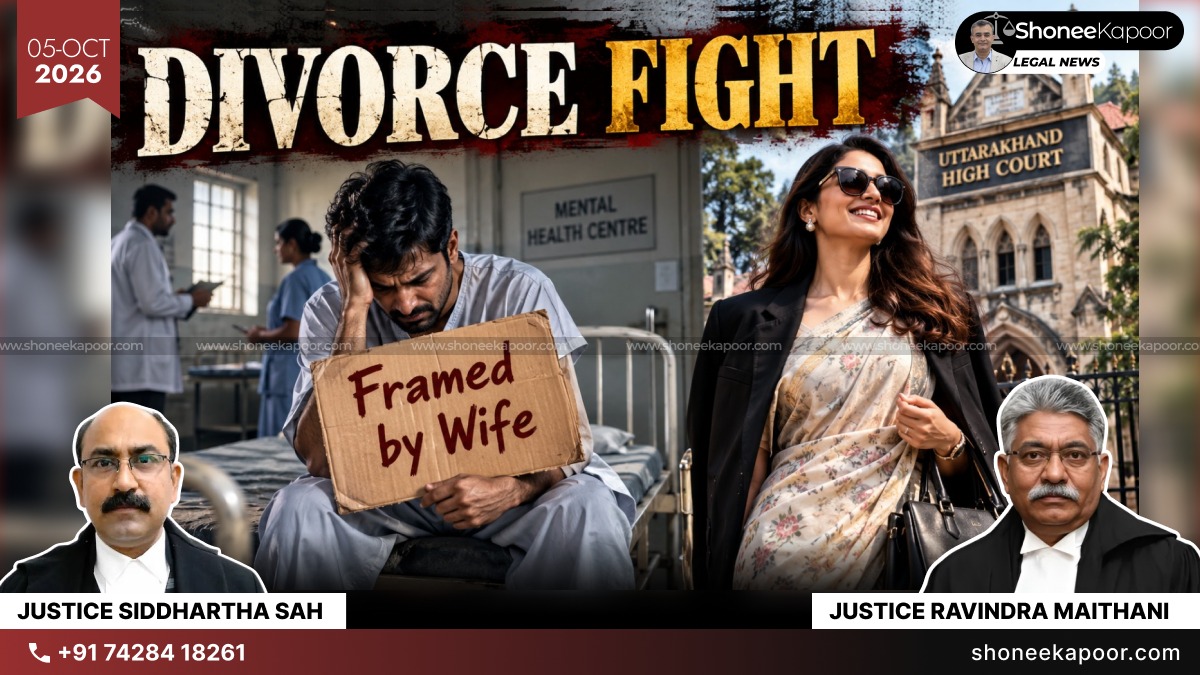
Wife Sent Husband To Mental Health Centre After A Divorce Fight: Uttarakhand High Court Orders His Release

Written and analysed by Vaibhav Ojha
Head Of Legal CommunicationsNAINITAL: A man who was admitted to a mental health and wellness facility in Dehradun by his wife during their ongoing divorce dispute has been released following an order of the Uttarakhand High Court.
The man had spent 42 days at Ashirwad Wellness Samiti before approaching the High Court through a habeas corpus petition. He claimed that he was being kept at the facility against his wishes and wanted to return home.
The matter came before a Division Bench of Justice Ravindra Maithani and Justice Siddhartha Sah.
According to the case, the man and his wife were involved in an ongoing matrimonial dispute and divorce proceedings. His wife had got him admitted to the facility.
His counsel argued that the admission was without his consent and that the mandatory legal procedure for keeping a person in a mental health establishment against his wishes had not been followed.
The facility, however, told the High Court that the man was free to leave whenever he wanted. Its counsel also maintained that the facility was acting under the Mental Healthcare Act, 2017.
To justify the admission, the facility relied upon a medical examination and a blood test conducted on the day the man was admitted. According to the facility, these formed the basis for concluding that he required admission.
The High Court then examined Section 89 of the Mental Healthcare Act, 2017, which deals with supported admission of a person with mental illness for up to 30 days.
The provision requires specific safeguards before such an admission can be made. The person must be independently examined by a psychiatrist and separately by another mental health professional or medical practitioner. The required professionals must independently reach the conclusions prescribed under the Act, including circumstances involving risk of harm to the person or others, or inability to care for oneself.
When the High Court asked whether the required certification existed in this case, counsel for the facility admitted that it did not.
The man's admission had instead been based on the examination of one doctor and a blood test.
A medical report also referred to his history of alcohol and ganja use. However, the High Court made an important distinction: addiction by itself cannot automatically be treated as mental illness under the Mental Healthcare Act.
The Court had also directed the Dehradun District Magistrate to examine the functioning of the facility and submit a report.
During the hearing, the District Magistrate appeared through video conferencing and informed the Court that he had not been able to examine the report prepared by his own office.
The proceedings also revealed serious questions about the facility itself. Its registration had expired in August 2025 and had not been renewed. The facility had also shifted to another location and was continuing its operations, with 28 other persons staying there.
Most importantly, the judges interacted directly with the husband during the hearing.
He clearly told the Court that he wanted to leave the facility and return home. He also confirmed that his matrimonial dispute with his wife remained unresolved.
His counsel maintained that there was no valid legal order or statutory certification authorising his continued stay at the facility.
The High Court found that the mandatory certification contemplated under Section 89 was absent. In those circumstances, there was no proper legal basis before the Court to justify keeping him at the facility against his wishes.
The case raises a serious issue beyond one matrimonial dispute. A spouse cannot lose his personal liberty merely because a marriage has broken down or because allegations are made about his mental condition. When the law prescribes safeguards before a person can be kept in a mental health establishment, those safeguards cannot become optional simply because the person caught in the dispute is a husband.
With the husband himself asking to leave and the necessary statutory requirements not having been established, the Uttarakhand High Court ordered his immediate release.
The habeas corpus petition was disposed of, and the man was permitted to go wherever he wished.
LAWS & SECTIONS EXPLAINED
| LAW / SECTION | WHAT IT PROVIDES | FINDING IN THIS CASE |
|---|---|---|
| Mental Healthcare Act, 2017 | Governs mental healthcare, establishments and admission/treatment safeguards. | Court found statutory requirements had not been complied with before Ankush's admission. |
| Section 89 | Permits supported admission of persons with mental illness and high support needs, subject to strict statutory conditions. | Facility relied on this provision but failed to satisfy its requirements. |
| Section 89(1)(a) | Requires independent examination by one psychiatrist plus another mental health professional/medical practitioner, with both independently reaching the required conclusion. | No such certification existed. |
| Section 89(1)(b) | Requires certification that admission is the least restrictive care option in the circumstances. | Part of the statutory safeguards governing supported admission. |
| Section 89(1)(c) | Requires inability to make mental healthcare/treatment decisions independently and need for very high support. | Part of the threshold for supported admission. |
| Section 89(2) | Supported admission under Section 89 is limited to 30 days. | Petitioner told the Court he had already been there for 42 days. |
| Section 2(s) | Defines “mental illness.” | Court said it could not conclude that Ankush was suffering from mental illness under this definition. |
CASE DETAILS
| PARTICULAR | DETAILS |
|---|---|
| Case Title | Ankush Chauhan v. State of Uttarakhand and Others |
| Court | High Court of Uttarakhand at Nainital |
| Case No. | Habeas Corpus Petition No. 44 of 2026 |
| Neutral Citation | 2026:UHC:8601-DB |
| CNR/Case ID | UKHC010157032026 |
| Decision Date | 23 September 2026 |
| Petitioner | Ankush Chauhan |
| Respondent No. 7 | Ashirwad Wellness Samiti, Dehradun |
| Bench | Justice Ravindra Maithani and Justice Siddhartha Sah |
| Judgment | Oral judgment by Justice Ravindra Maithani |
| Result | Habeas corpus petition disposed of; petitioner set free |
COUNSELS
| PARTY | COUNSEL |
|---|---|
| Petitioner | Mr. Gaurav Singh, Advocate |
| Petitioner In Person | Mr. Ankush Chauhan |
| State | Mr. V.S. Rawat, A.G.A. |
| Respondent No. 7 | Mr. Aditya Singh, Advocate |
| District Magistrate, Dehradun | Mr. Ashish Chauhan appeared through video conferencing |
KEY TAKEAWAYS
- Wife Got Husband Admitted: He remained at the Dehradun facility for 42 days amid their ongoing divorce dispute.
- Mandatory Certification Missing: The facility could not produce the certification required under Section 89.
- Addiction Is Not Automatically Mental Illness: Alcohol or ganja use alone cannot establish mental illness under the Act.
- Husband Wanted His Freedom: He personally told the High Court that he wanted to leave and return home.
- Marriage Dispute Cannot Cancel A Man’s Liberty: A husband cannot be deprived of personal freedom merely because his marriage is in conflict.
Share Your Thoughts
Comments are moderated before publication.