
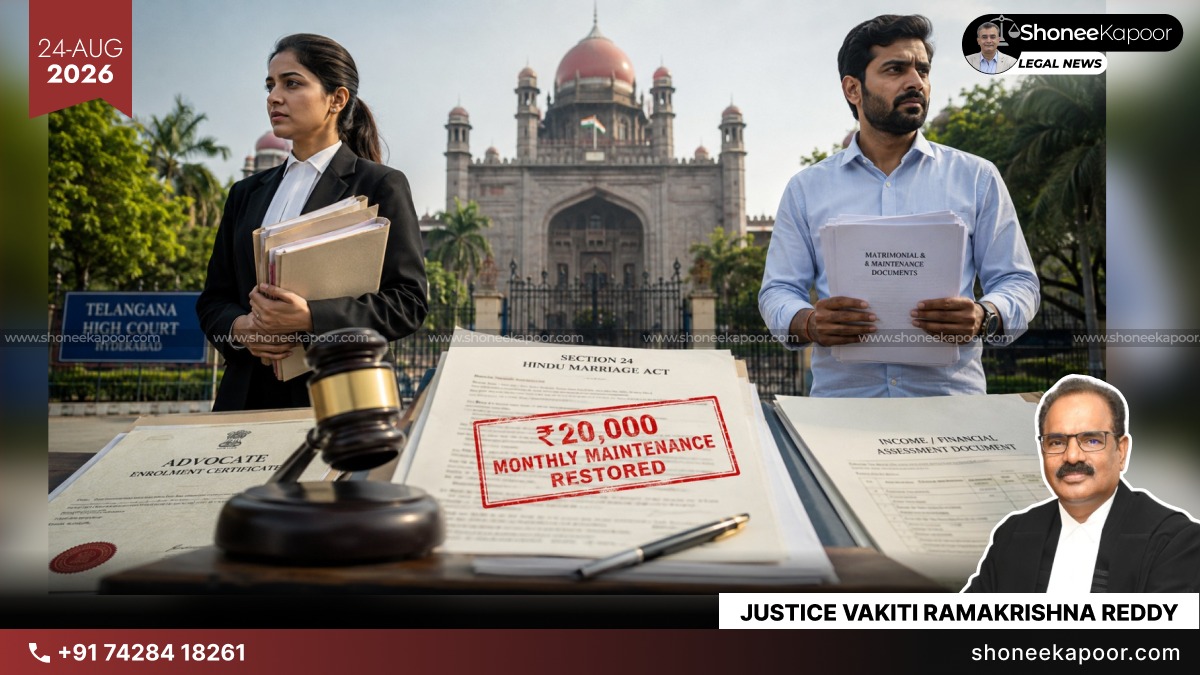
Husband Cannot Deny Maintenance Even If Wife Is Enrolled As An Advocate: Telangana High Court

Curated by NEWS DESK
Editorial DeskHYDERABAD: The Telangana High Court has held that merely being enrolled as an advocate or practising independently does not prove that a wife has sufficient independent income to deny her maintenance under Section 24 of the Hindu Marriage Act, 1955.
Justice Vakiti Ramakrishna Reddy allowed the wife’s review application and recalled the High Court’s earlier order dated 15 October 2024, which had removed the ₹20,000 per month interim maintenance granted to her by the Family Court.
The matrimonial dispute has been pending before the Additional Family Court, Hyderabad, since 2010.
On 27 June 2013, the Family Court had directed the husband to pay ₹20,000 per month to the wife and ₹15,000 per month each to their two daughters until disposal of the matrimonial case.
The husband challenged this order. In October 2024, the High Court removed the wife’s maintenance while continuing maintenance for the daughters till they attained majority. The wife then filed a review application.
The main question before the Court was whether the wife’s status as a practising advocate itself proved that she was financially capable of maintaining herself.
The High Court said that Section 24 HMA requires an examination of the income actually available to a spouse, not merely educational qualification, professional status, or earning capacity.
The Court observed that income from independent legal practice may not be fixed or regular like a salaried job.
It said:
“Enrolment at the Bar establishes a qualification and a right to appear. It establishes nothing about income.”
The Court further held that the relevant test is “the sufficiency of the income actually available, and not the capacity to earn.”
Importantly, the High Court did not hold that the wife actually had insufficient income. It found that the earlier order had not examined how much she actually earned, whether that income was sufficient for her support, or the husband’s income and means.
According to the Court, describing the wife as “earning” merely because she was an advocate could not replace the factual enquiry required under Section 24.
The Court referred to Supreme Court decisions including Chaturbhuj v. Sita Bai, Shailja v. Khobbanna, Manish Jain v. Akanksha Jain, Amarjit Kaur v. Harbhajan Singh, Jasbir Kaur Sehgal v. District Judge, Dehradun and Rajnesh v. Neha.
These decisions distinguish between a spouse's ability to earn and having sufficient independent income.
The High Court also examined whether its earlier order could be reviewed for failing to consider binding law.
Referring to Yashwant Sinha v. Central Bureau of Investigation, the Court noted:
“If the relevant law is ignored… it would provide a ground for review.”
It also referred to Board of Control for Cricket in India v. Netaji Cricket Club, where the Supreme Court recognised that a mistake or other sufficient reason may justify review.
The husband opposed the review and argued that the wife, being a practising advocate, had sufficient means to maintain herself.
His counsel also alleged that she had previously initiated several proceedings against the husband, his family members, counsel and judicial officers. The judgment records that criminal proceedings arising from an earlier matter had been quashed as an abuse of process, and subsequent challenges before the Supreme Court were also dismissed.
However, the High Court held that these issues did not establish the wife’s actual income for deciding the present maintenance claim.
The Court also found an error in restricting the daughters’ maintenance only until they attained majority. The Family Court’s original order had granted maintenance until disposal of the matrimonial proceedings, and the later restriction had been introduced without adequate reasons.
The Court left open any separate claim of the daughters under the Hindu Adoptions and Maintenance Act, 1956.
Another issue was the scope of the High Court’s revisional jurisdiction. The Court held that the earlier order had effectively re-appreciated the Family Court’s findings even though a revisional court cannot act like a first appellate court merely because another view of the material is possible.
Accordingly, the High Court allowed the review and set aside its order dated 15 October 2024.
The husband’s Civil Revision Petition No.4263 of 2013 was dismissed and the Family Court’s 2013 interim maintenance order was restored.
The husband has also been directed to file a statement showing the maintenance payable, payments already made and the balance admitted to be due, along with an Affidavit of Disclosure of Assets and Liabilities in the format prescribed in Rajnesh v. Neha.
The Court directed that the husband be given credit for ₹32.10 lakh already paid. The remaining arrears, after calculation, must be paid within eight weeks, while monthly maintenance will continue until disposal of the matrimonial proceedings.
At the same time, the High Court clearly stated that it has not finally decided whether the wife actually has sufficient independent income. That factual question remains open and can be examined on proper evidence. The Family Court has been requested to dispose of the long-pending matrimonial case as expeditiously as possible.
EXPLANATORY TABLE OF LAWS AND SECTIONS
| Law / Provision | What It Means | Application In This Case |
|---|---|---|
| Section 24, Hindu Marriage Act, 1955 | Allows interim maintenance and litigation expenses where a spouse does not have sufficient independent income for support and proceedings. | The Court held that actual sufficiency of income, not mere qualification or earning capacity, is the relevant test. |
| Order XLVII Rule 1, CPC | Permits review on grounds including discovery of important evidence, error apparent on the record or other sufficient reason. | Wife relied on it to seek review of the October 2024 High Court order. |
| Section 114, CPC | Provides statutory power of review in specified circumstances. | Invoked along with Order XLVII Rule 1 in the wife's review application. |
| Section 151, CPC | Preserves the inherent powers of civil courts to make orders necessary for justice or prevent abuse of process. | Read with the provisions governing review. |
| Sections 10, 11 & 12, Contempt of Courts Act, 1971 | Deal with High Court's contempt jurisdiction, territorial reach and punishment for contempt. | Wife's contempt case alleged disobedience of the earlier maintenance-related directions. The contempt case was ultimately closed without a finding of wilful disobedience. |
| Sections 3(b), 20 & 21, Hindu Adoptions and Maintenance Act, 1956 | Concern statutory concepts and maintenance rights, including maintenance of children/dependants. | Wife relied upon these provisions concerning the daughters. The High Court left their independent entitlement under the Act open. |
| Article 141, Constitution of India | Law declared by the Supreme Court is binding on all courts in India. | The Court noted that Rajnesh v. Neha and other Supreme Court rulings were binding when the earlier order was passed. |
CASE DETAILS
| Particular | Details |
|---|---|
| Case Title | X v. Y |
| Court | High Court for the State of Telangana at Hyderabad |
| Bench | Justice Vakiti Ramakrishna Reddy |
| Case Numbers | Contempt Case No.2792 of 2025 & I.A. No.2 of 2024 in Civil Revision Petition No.4263 of 2013 |
| Date of Order | 24 July 2026 |
| Petitioner / Wife | Party-in-Person |
| Counsel for Respondent / Husband | Sri K. Durga Prasad |
KEY TAKEAWAYS
- Practising advocate wife can still get maintenance unless sufficient actual income is proved.
- Husband had got her ₹20,000 maintenance removed, but that relief was reversed.
- The case has dragged on since 2010, with the husband still facing continuing liability.
- He has already paid ₹32.10 lakh, yet further dues may still remain.
- The Court did not find the wife financially dependent—only that being an advocate does not itself prove sufficient income.
Share Your Thoughts
Comments are moderated before publication.