
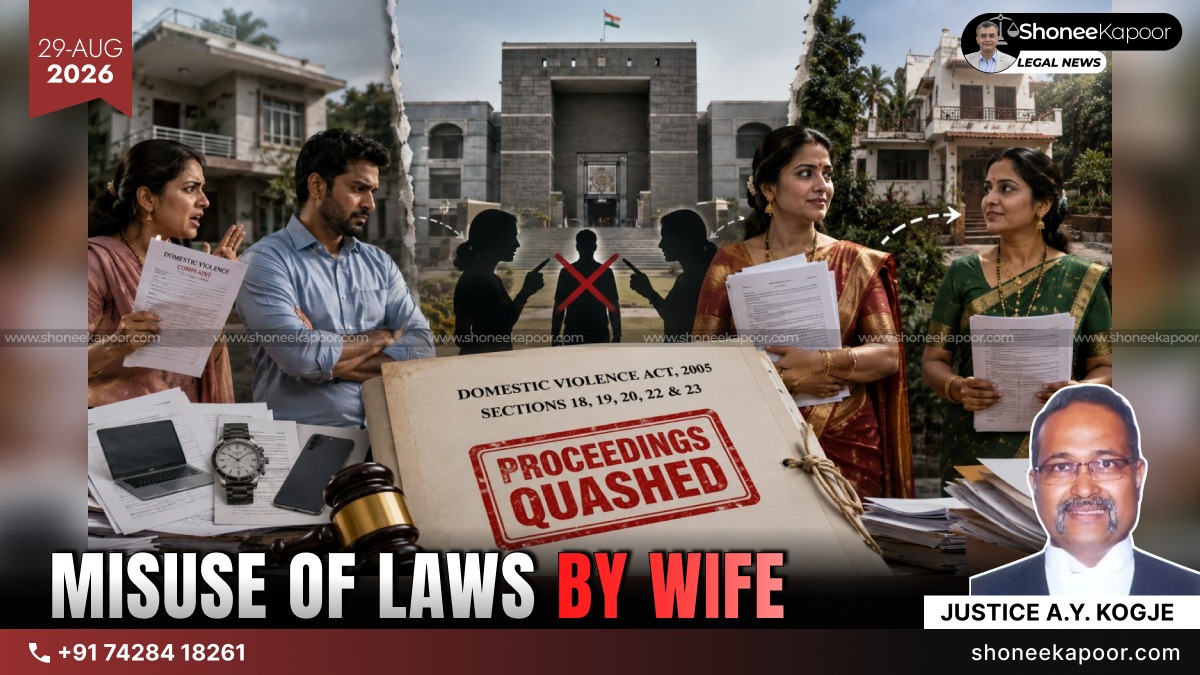
False DV Case | "Husband’s Sisters Lived Separately, So Question Of Torture Does Not Arise": Gujarat High Court Quashes Case

Curated by NEWS DESK
Editorial DeskCan a husband’s married sisters be dragged into a Domestic Violence case merely because the wife alleges that they instigated him to demand dowry? The Gujarat High Court found the allegations against two separately residing sisters-in-law to be general and quashed the proceedings against them.
AHMEDABAD: The Gujarat High Court has quashed Domestic Violence Act proceedings against two sisters of a husband, noting that both women were married much before the complainant’s marriage and were living separately.
Justice A.Y. Kogje observed that the allegations in the complaint were mainly against the husband and that the only allegation against his two sisters was that they allegedly instigated him to demand dowry.
The marriage between the complainant and the son of petitioner Nos. 1 and 2 was solemnised on 1 November 2013 according to Muslim customs. Two children were born from the marriage.
According to the petitioners, the wife left the matrimonial home along with the children on 21 July 2022 and later filed Criminal Misc. Application No. 316 of 2022 under Sections 18, 19, 20, 22 and 23 of the Domestic Violence Act against members of her husband’s family.
The husband’s parents and his two sisters originally filed the petition. However, the case was not pressed on behalf of the father-in-law and mother-in-law. Therefore, the High Court considered the quashing plea only for the two sisters.
The sisters argued that they had never lived with the complainant and had been married long before their brother's marriage. They claimed that they were unnecessarily included in the case through vague and general allegations.
The wife, however, alleged that she suffered mental and physical harassment and that her husband demanded articles such as a laptop, watch and mobile phone. She further alleged that his family members instigated him.
After examining the complaint, the High Court found that the allegations were mainly against the husband. The Court also noted that the husband was a dentist and that the complainant herself stated that she had lived separately with him in Pune while he was pursuing further studies.
The Court observed:
“The Court is of the opinion that looking to the complaint as a whole, the allegations are general in nature.”
It further noted that the only allegation against petitioner Nos. 3 and 4 was that they allegedly instigated their brother to demand dowry.
The Court said:
“Apart from this, there is no other allegation against petitioner Nos.3 and 4.”
Since both sisters were married much before the complainant and were residing separately, the Court concluded:
“So, question of mental and physical torture by them does not arise.”
The High Court also took note of earlier matrimonial proceedings filed by the complainant, including a maintenance case, Section 498A IPC proceedings and a Domestic Violence Act case against members of the husband’s family. According to the judgment, those earlier proceedings were later withdrawn after settlement through elders and community leaders.
The Court relied on the Supreme Court judgment in Arnesh Kumar v. State of Bihar, which discussed misuse of Section 498A IPC and the tendency to involve husbands' relatives.
The High Court reproduced the Supreme Court’s warning that Section 498A had, in some cases, been:
“used as weapons rather than shield by disgruntled wives.”
The Supreme Court had also observed:
“The simplest way to harass is to get the husband and his relatives arrested under this provision.”
The Court further relied on Preeti Gupta v. State of Jharkhand, where the Supreme Court had specifically discussed the problem of involving married sisters and other relatives in matrimonial cases.
The Supreme Court had observed:
“The tendency of implicating husband and all his immediate relations is also not uncommon.”
It further stressed that allegations against relatives living in different cities required careful scrutiny.
Another significant observation relied upon by the High Court was:
“The tendency of over-implication is also reflected in a very large number of cases.”
On the facts before it, the Gujarat High Court found that no ingredients were made out against petitioner Nos. 3 and 4 under Sections 18, 19, 20, 22 and 23 of the Domestic Violence Act.
Accordingly, Criminal Misc. Application No. 316 of 2022 and all proceedings arising from it were quashed against the husband’s two sisters.
EXPLANATORY TABLE OF LAWS AND SECTIONS
| Law / Section | What It Provides | Relevance In This Case |
|---|---|---|
| Section 18, Protection of Women from Domestic Violence Act, 2005 | Allows a Magistrate to pass protection orders where domestic violence is established. | The High Court found that the necessary ingredients were not made out against the two sisters-in-law. |
| Section 19, Domestic Violence Act | Deals with residence orders concerning the shared household and related protection. | The Court quashed the proceedings under this provision against petitioner Nos. 3 and 4. |
| Section 20, Domestic Violence Act | Allows monetary relief for expenses and losses caused by domestic violence. | The Court found no sufficient factual basis to continue this relief against the separately residing sisters. |
| Section 22, Domestic Violence Act | Allows compensation and damages for injuries, including mental torture and emotional distress caused by domestic violence. | The Court observed that both sisters were married earlier and living separately, and held that the question of mental and physical torture by them did not arise on the allegations made. |
| Section 23, Domestic Violence Act | Gives the Magistrate power to grant interim and ex parte orders where the statutory conditions are satisfied. | This was one of the provisions invoked in the DV proceedings which were quashed against the two sisters. |
| Section 498A, Indian Penal Code | Deals with cruelty by a husband or his relatives against a married woman. | The judgment referred to earlier Section 498A proceedings and relied on Supreme Court rulings discussing vague allegations and over-implication of the husband’s relatives. |
| Section 125, Code of Criminal Procedure | Provides a remedy for maintenance to eligible wives, children and parents subject to statutory conditions. | The judgment records that the complainant had also filed a maintenance application against her husband. |
| Arnesh Kumar v. State of Bihar, (2014) 8 SCC 273 | Supreme Court judgment dealing with arrest safeguards and misuse concerns in matrimonial cases involving Section 498A IPC. | The Gujarat High Court relied on the judgment while discussing the tendency to unnecessarily involve the husband and his relatives. |
| Preeti Gupta v. State of Jharkhand, (2010) 7 SCC 667 | Supreme Court judgment cautioning courts about exaggerated allegations and over-implication of relatives in matrimonial disputes. | Particularly relevant because the present petition concerned married sisters-in-law who were living separately. |
CASE DETAILS
| Particulars | Details |
|---|---|
| Case Title | Salimbhai Abubakarbhai Lakhani & Ors. v. Aksanabanu Samirbhai Lakhani D/o Abdul Rasidbhai Dholiya & Ors. |
| Court | High Court of Gujarat at Ahmedabad |
| Case Number | R/Special Criminal Application (Quashing) No. 12673 of 2023 |
| Bench | Hon’ble Mr. Justice A.Y. Kogje |
| Judgment Date | 21 August 2026 |
| Counsel for Petitioners | Mr Kuldeep D. Vaidya |
| Counsel for Respondent Nos. 1 to 3 | Mr Aditya J. Pandya |
| Counsel for State / Respondent No. 4 | Mr Rohan Shah, APP |
| Original DV Proceeding | Criminal Misc. Application No. 316 of 2022 |
| Petitioners Who Got Relief | Petitioner Nos. 3 and 4, the husband’s married sisters |
| Relief Granted | DV proceedings and all consequential proceedings quashed against petitioner Nos. 3 and 4 |
KEY TAKEAWAYS
- Husband’s family cannot become automatic collateral damage: The two married sisters were pulled into the DV case even though they were living separately and had no specific act attributed to them.
- A vague claim of “instigation” should not become a licence to prosecute relatives: The High Court found no concrete allegation showing what the sisters actually did.
- Men’s families often pay the price of matrimonial litigation: The complaint did not stop with the husband; his sisters too had to approach the High Court to get themselves out of the case.
- Repeated proceedings can become punishment by process: The judgment noted earlier 498A, maintenance and DV proceedings involving the husband’s family before the present complaint was filed.
- Courts must separate real allegations from over-implication: The High Court quashed the DV proceedings against the sisters after finding that the legal ingredients were not made out against them.
Share Your Thoughts
Comments are moderated before publication.