
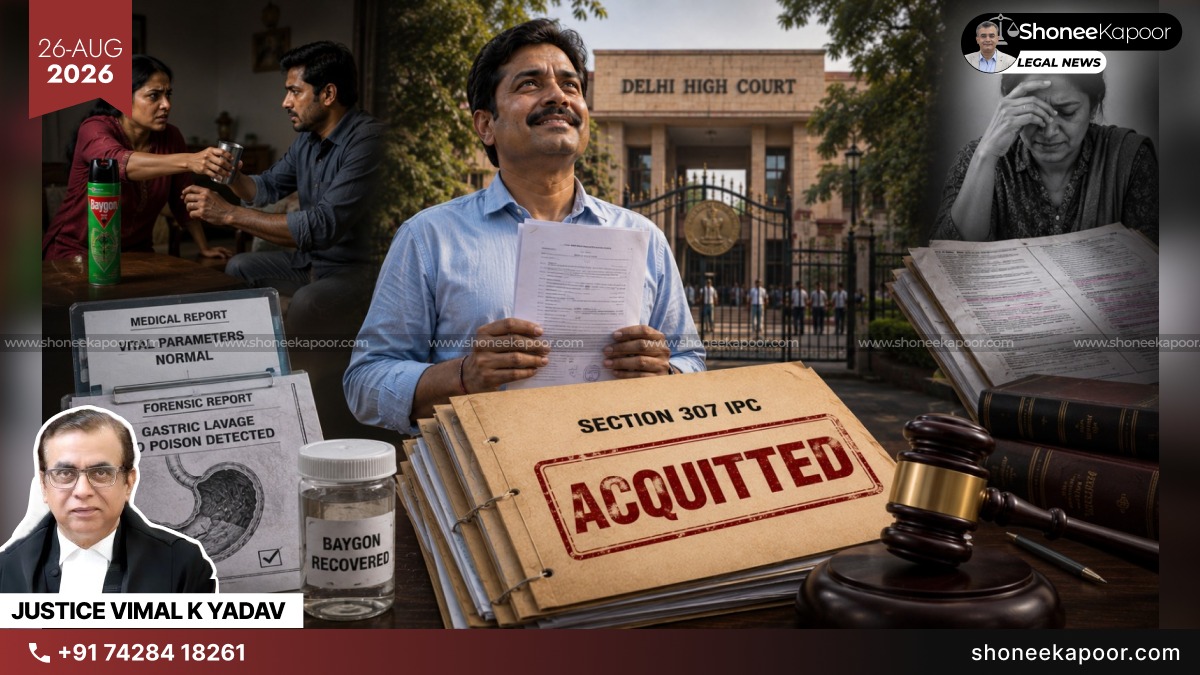
False Attempt-To-Murder Case | Husband Forced Wife To Consume Baygon Insecticide? Delhi HC Acquits Husband After 22 Years

Curated by NEWS DESK
Editorial DeskA husband was sentenced to 3 years under Section 307 IPC after his wife alleged he forced Baygon down her throat. What made the Delhi High Court overturn the conviction 22 years later?
NEW DELHI: The Delhi High Court has acquitted a husband who had been convicted in 2004 for allegedly attempting to murder his wife by forcibly administering Baygon insecticide, holding that the prosecution failed to prove the charge under Section 307 IPC beyond reasonable doubt.
Justice Vimal Kumar Yadav, while allowing Nafe Singh’s criminal appeal, began the judgment with observations on how matrimonial relationships can turn into serious conflicts if disputes are not addressed in time.
The Court observed:
“The better-half becomes the bitter-half if issues are not taken care of and resolved as soon as possible. One of the most beautiful relationships of humans, that is of a husband and wife becomes one of the most terrible when things go wrong in a matrimonial alliance. Time, albeit, is a big healer and tones down a lot of pains in life, however in relationships time taken can also be counterproductive.”
It further noted:
“There are recent examples where the spouses have resorted to extreme levels of violence against each other which were incomprehensible some decades ago.”
Nafe Singh and the complainant had married on March 5, 2000. Their matrimonial relationship deteriorated within about a year. According to the prosecution, during an incident on April 20, 2001, Singh first attempted to make his wife consume Baygon through a tumbler and later allegedly poured the insecticide directly into her mouth. An FIR under Sections 498A and 307 IPC was registered at Police Station Ashok Vihar. Police subsequently arrested Singh and his mother.
The trial court eventually acquitted both accused of the Section 498A IPC charge, but convicted Nafe Singh under Section 307 IPC and sentenced him to three years’ rigorous imprisonment with a ₹5,000 fine. Singh challenged that conviction before the Delhi High Court.
The High Court found serious weaknesses in the prosecution evidence. The woman’s medical parameters were normal when she reached the hospital, and the gastric lavage sent for forensic examination did not reveal any poisonous substance. The Court said that although a negative forensic result alone could not automatically clear the accused, it raised an important question when considered with the remaining evidence.
There was another unexplained inconsistency. The investigating officer described the recovered Baygon container as empty, whereas the FSL report recorded approximately 4 ml of Baygon in the container. The prosecution did not explain this discrepancy.
The Court also considered Singh’s conduct immediately after the incident. The record showed that medical treatment was promptly arranged, and the High Court noted evidence supporting Singh’s claim that he had deposited ₹10,000 towards a total hospital bill of ₹10,870.
More importantly, the High Court found material inconsistencies in the wife’s testimony. She had initially attributed an earlier abortion to beatings allegedly given by Singh, but during cross-examination admitted that the abortion had occurred naturally and was not caused by him. She also admitted that no dowry was demanded at the time of marriage, while her examination-in-chief contained an allegation concerning demand for a scooter.
The Court ultimately recorded:
“And then the testimony of the victim herself is not credible.”
On the essential ingredients of attempt to murder, the High Court relied upon Hari Singh v. Sukhbir Singh and Others, (1988) 4 SCC 551, where the Supreme Court had explained:
“Under Section 307 IPC what the court has to see is, whether the act irrespective of its result, was done with the intention or knowledge and under circumstances mentioned in that section. The intention or knowledge of the accused must be such as is necessary to constitute murder. Without this ingredient being established, there can be no offence of ‘attempt to murder’.”
After examining the medical evidence, forensic findings, inconsistencies in testimony, the discrepancy regarding the Baygon container, and Singh’s post-incident conduct, the High Court held that the prosecution failed to establish the required intention or knowledge under Section 307 IPC beyond reasonable doubt.
The Court concluded:
“It is highly unsafe to act upon the kind of shaky evidence brought on record. Appellant is certainly entitled to the benefit of doubt.”
Accordingly, the Delhi High Court allowed Nafe Singh’s appeal, acquitted him of the Section 307 IPC charge and discharged his bail bonds. The judgment was delivered on August 24, 2026, more than 22 years after the trial court conviction.
EXPLANATORY TABLE OF LAWS AND SECTIONS
| Law / Section | What It Means | Application In This Case |
|---|---|---|
| Section 307 IPC | Attempt to murder. Requires an act accompanied by the intention or knowledge necessary for murder if death had resulted. | The trial court convicted Nafe Singh under this provision. The High Court found the required intention/knowledge was not proved beyond reasonable doubt and acquitted him. |
| Section 498A IPC | Cruelty by husband or his relatives against a married woman. | Singh and his mother were prosecuted under this provision but both were acquitted by the trial court. The prosecution did not appeal that acquittal. |
| Section 34 IPC | Deals with acts done by several persons in furtherance of a common intention. | The chargesheet was filed under Sections 498A/307/34 IPC against the accused. |
| Section 313 CrPC | Gives an accused an opportunity to personally explain incriminating circumstances appearing in prosecution evidence. | Statements of the accused were recorded under Section 313 CrPC; they maintained that they had been falsely implicated. |
| Section 294 CrPC | Provides for admission or denial of genuineness of documents, allowing admitted documents to be read in evidence without formal proof in appropriate circumstances. | The High Court held that the FSL report, though not formally proved, could be considered as admissible under Section 294 CrPC. |
CASE DETAILS
| Particular | Details |
|---|---|
| Case Title | Nafe Singh v. State |
| Court | High Court of Delhi at New Delhi |
| Case Number | CRL.A. 296/2004 |
| Neutral Citation | 2026:DHC:7091 |
| Bench | Hon’ble Mr Justice Vimal Kumar Yadav |
| Date Reserved | 28 April 2026 |
| Date of Decision | 24 August 2026 |
| Appellant | Nafe Singh |
| Respondent | State |
| Counsel for Nafe Singh | Sanjay Suri, Vinny Shangloo and Rishabh Ratan, Advocates |
| Counsel for State | Satinder Singh Bawa, APP for State, with SI Ravi Shankar, PS Ashok Vihar |
KEY TAKEAWAYS
- A husband carried an attempt-to-murder conviction for over 22 years before the Delhi High Court acquitted him on the benefit of the doubt.
- The gastric lavage showed no poison, and the medical record did not establish expected symptoms of forcible Baygon ingestion.
- The wife’s testimony had material contradictions and improvements, and the High Court ultimately found it “not credible.”
- She initially blamed alleged beatings for an abortion, but later admitted it occurred naturally and was not caused by the husband.
- An acquittal may come years later, but lost time, reputation and mental burden cannot be restored. Matrimonial allegations must face the same strict evidentiary scrutiny as any other criminal case.
Share Your Thoughts
Comments are moderated before publication.