
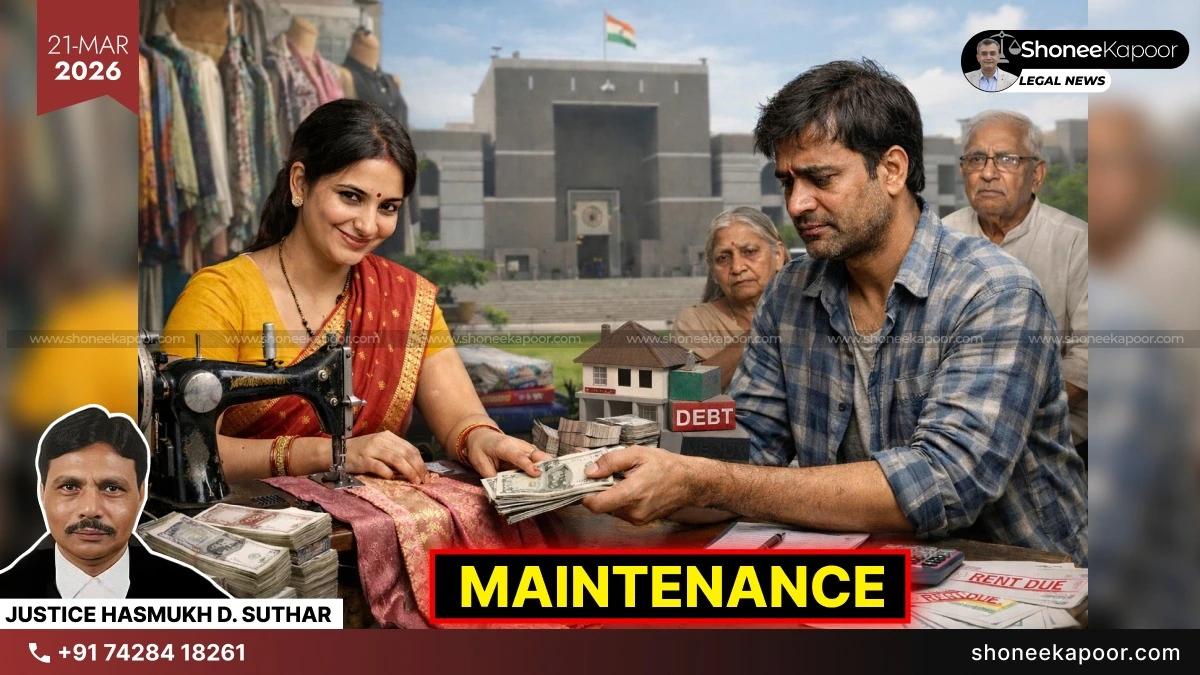
Even when the wife earns, the law says it’s not enough to deny maintenance—raising serious questions about financial parity. If income isn’t the benchmark, then what actually protects a husband from unlimited liability?
AHMEDABAD: In a recent decision, Honourable Mr. Justice Hasmukh D. Suthar of the Gujarat High Court dealt with a case where a husband challenged the increase in maintenance granted to his wife, reflecting a wider trend where husbands struggle to get relief despite showing financial burden.
The wife had approached the Family Court seeking enhancement of maintenance from ₹5,000 to ₹30,000 per month, alleging cruelty and that she was forced out of the matrimonial home. The Family Court increased the amount to ₹15,000 per month after evaluating the evidence.
The husband challenged this before the High Court, arguing that his income was limited and he had multiple responsibilities like supporting parents, rent, and loans. He also claimed that his wife was earning around ₹15,000 per month through tailoring but had hidden this fact. He further alleged “false and exaggerated allegations against the applicant just a view to get the handsome amount from the applicant and living her luxury life”.
However, the wife maintained that she could not sustain herself independently, and the Court accepted her position based on settled legal principles.
The Court reiterated:
“Inability to maintain herself is the pre-condition for grant of maintenance to the wife. The wife must positively aver and prove that she is unable to maintain herself, in addition to the fact that her husband has sufficient means to maintain her and that he has neglected to maintain her.”
The Court clarified that even if the wife is earning, it may still not be sufficient grounds to deny maintenance, as the expectation is to maintain a standard of living similar to that during the marriage. At the same time, this position places a continuing and strict financial burden on the husband, as the judgment reiterates that he “cannot escape from his liability to maintain his wife or children because it is the legal and ethical duty of the husband to maintain them.”
The reasoning was further supported on the ground of protecting “marginalized sections of society” and ensuring “social justice”, but in practical terms, it results in limited consideration of the husband’s financial pressures and obligations.
Despite the husband highlighting his expenses and liabilities, the Court gave more weight to the increase in his income and upheld the enhancement of maintenance from ₹5,000 to ₹15,000 under Section 127 CrPC, treating the change in income as sufficient ground.
Ultimately, the revision application was dismissed, reinforcing that even where the husband raises financial constraints and disputes the wife’s earning capacity, the scope for relief remains narrow under the existing legal framework.
Explanatory Table: Laws & Provisions Involved
| Law / Provision | Purpose | How Applied In This Case |
| Section 125 CrPC | Provides basic maintenance to wife/children if neglected | Earlier order granted ₹5,000/month maintenance |
| Section 127 CrPC | Allows enhancement of maintenance on change in circumstances | Used to increase maintenance to ₹15,000 due to rise in husband’s income |
| Domestic Violence Act (Sec 18 – Monetary Relief) | Provides independent monetary relief to aggrieved woman | Court noted DV Act relief is wider and separate from CrPC |
| Sunita Kachwaha v. Anil Kachwaha (2014) | Wife earning is not a ground to deny maintenance | Relied upon to reject husband’s argument on wife’s income |
| Bhuwan Mohan Singh v. Meena (2015) | Maintenance is a legal and moral duty of husband | Used to reinforce obligation of husband |
| Bhagwan Dutt v. Kamla Devi (1975) | Maintenance can be modified with change in circumstances | Basis for enhancement under Section 127 CrPC |
| Lalita Toppo v. State of Jharkhand (2019) | DV Act relief broader than Section 125 CrPC | Highlighted expanded scope of maintenance |
| Amit Kapoor v. Ramesh Chander (2012) | Scope of revisional jurisdiction is limited | Used to dismiss husband’s revision plea |
Case Details
- Case Title: Lalitkumar Jivrajbhai Vaghela vs State of Gujarat & Anr.
- Court: High Court of Gujarat at Ahmedabad
- Case No.: Criminal Revision Application No. 283 of 2021
- Bench: Honourable Mr. Justice Hasmukh D. Suthar
- Neutral Citation: 2026:GUJHC:20342
- Date of Judgment: 17/03/2026
- Counsels:
- For Applicant (Husband): Mr. Tapaswi P. Raval, and Mr. Bhargav K. Mehta
- For Respondent (Wife): Mr. Harshad D. Barot
- For State: Mr. Rohan Raval, APP
Key Takeaways
- Wife’s earning does not reduce the husband’s liability—financial responsibility remains largely one-sided.
- Courts prioritise “standard of living” over actual financial strain of the husband.
- Even alleged or proven income of wife carries limited weight unless strongly evidenced.
- Increase in husband’s income almost automatically triggers higher maintenance under Section 127 CrPC.
- Legal threshold to challenge or reduce maintenance remains extremely high, leaving husbands with limited practical defence.
This Could Change Your Case-Get FREE Legal Advice-Click Here!
Disclaimer: The views and opinions expressed in this article are those of the Indian courts and do not necessarily reflect the official policy or position of “ShoneeKapoor.com” or its affiliates. This article is intended for informational and educational purposes only. The content provided is not legal advice, and viewers should not act upon this information without seeking professional counsel. Viewer discretion is advised.
