
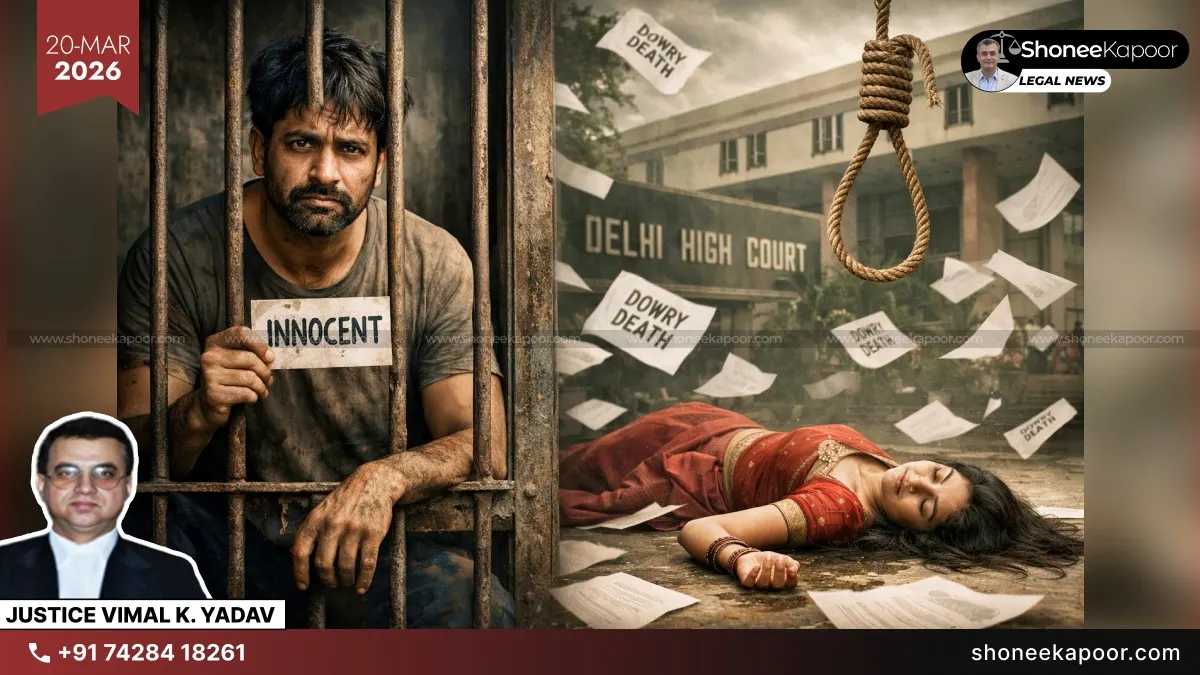
Did the evidence really prove dowry death, or was it a case built on assumptions? Why did the Delhi High Court reduce the charge but still hold the husband guilty?
NEW DELHI: The Delhi High Court has observed that suicide is increasingly becoming a serious issue in modern society, often linked to stress, social pressure, and weakening family support systems, while deciding a case where a husband was accused in his wife’s death.
Justice Vimal Kumar Yadav partly allowed the husband’s appeal. The Court changed the conviction from dowry death under Section 304B IPC to abetment of suicide under Section 306 IPC, but continued the conviction for cruelty under Section 498A IPC.
The Court explained the nature of suicide in detail, stating that survival instinct is natural, and suicide usually happens only when a person is under extreme pressure.
It observed:
“Suicide seems to be civilized world’s problem as in the Tribal societies it was kind of unheard. However, it has entered in the Tribal societies with the entry of civilized world. Strength of the Tribal or so called uncivilised societies i.e. strong, social and familial ties is being taken over by the stress, strains, tensions, etc. giving foothold to suicides there too. If someone commits suicide then there are bound to be very compelling circumstances, where the suicidal tendencies overtake the survival instinct and the result is death,”.
The case relates to July 1999, where the wife of the appellant died within seven years of marriage after consuming a substance suspected to be poison. The prosecution claimed that she was harassed for dowry of ₹50,000, out of which ₹30,000 was already paid, and harassment continued for the remaining amount.
Based mainly on statements given by the woman’s parents and brother, the trial court had convicted the husband under Sections 498A and 304B IPC and sentenced him to seven years of rigorous imprisonment.
However, on appeal, the High Court found that while allegations of harassment existed, there was no clear proof directly linking the husband to causing her death. The Court also questioned the reliability of the alleged dying declaration made to the brother, pointing out inconsistencies and medical evidence showing that the woman was not in a condition to give a statement.
The Court clearly stated:
“…As regards soon before her death she was subjected to harassment and cruelty, as referred above, no definite date and time etc. is available.”
At the same time, the Court observed that the circumstances suggested the possibility of suicide rather than direct involvement of the husband in administering poison.
It noted:
“There is a possibility that the deceased herself, fed up with her life, administered or mixed something poisonous in her tea and committed suicide. The only other possibility is that the Appellant or somebody else from the family of the Appellant mixed something in the tea of the deceased. Normally, kitchens are taken care of by the female folk of the family and therefore, in these circumstances it is highly unlikely that somebody else had the access to the kitchen or the tea being prepared or served by the deceased to herself and the Appellant.”
Despite the lack of direct evidence for dowry death, the Court held that continuous harassment created a situation that could have pushed the deceased to take such an extreme step, and therefore upheld conviction under Section 306 IPC.
Considering that the husband had already spent more than three years and eight months in jail, and also keeping in mind the long passage of time since the incident, the Court reduced the sentence to the period already undergone.
Explanatory Table – Laws & Sections Involved
| Section / Law | Title | Key Legal Meaning | Application in This Case | Court’s Finding |
| Section 498A IPC | Cruelty by Husband or Relatives | Covers physical or mental harassment, especially for unlawful demands like dowry | Allegations of continuous harassment for ₹50,000 | Conviction upheld |
| Section 304B IPC | Dowry Death | Applies when a woman dies unnaturally within 7 years of marriage and was harassed “soon before death” for dowry | Trial court convicted based on presumption and family testimony | Conviction set aside due to lack of direct evidence of causation |
| Section 306 IPC | Abetment of Suicide | Requires proof that accused instigated or created circumstances leading to suicide | Court inferred harassment may have pushed deceased to suicide | Conviction imposed |
| Section 113B Evidence Act | Presumption of Dowry Death | Presumes guilt if dowry harassment is shown before death | Initially applied due to timeline and allegations | Rebutted due to lack of conclusive link to death |
| Section 114 Evidence Act (Illustration) | Presumptions based on conduct | Helps interpret “soon before death” | Used to assess proximity of harassment | Applied cautiously |
| Section 498A – Judicial Interpretation | Defined in precedents | Requires harassment linked to unlawful demand | Relied on case laws for interpretation | Clarified scope of cruelty |
| Supreme Court Precedents | Various | Define cruelty, harassment, and abetment standards | Used to evaluate evidence and intent | Guided final conviction shift |
Case Details
- Case Title: Veer Pal v. State (NCT of Delhi)
- Case Number: CRL.A. 73/2003
- Court: High Court of Delhi at New Delhi
- Bench: Hon’ble Mr. Justice Vimal Kumar Yadav
- Date of Reserving Judgment: 8th January 2026
- Date of Decision: 16th March 2026
Counsels
- For Appellant: Ms. Aashaa Tiwari, Advocate & Mr. Puneet Narula, Advocate
- For State: Ms. Kiran Bairwa, APP & SI Preeti, PS SP Badli
Key Takeaways
- Court itself admits no proof of who caused the death, yet conviction still survives under a different section.
- Dowry death charge collapses due to lack of evidence, exposing how easily such serious allegations get framed.
- Entire case rests mainly on statements of interested family witnesses with contradictions and no medical support.
- Dying declaration theory fails, yet the burden silently shifts onto the man through “circumstantial harassment.”
- Even when causation is doubtful, law still ensures punishment—this is exactly where men lose despite weak evidence.
This Could Change Your Case-Get FREE Legal Advice-Click Here!
Disclaimer: The views and opinions expressed in this article are those of the Indian courts and do not necessarily reflect the official policy or position of “ShoneeKapoor.com” or its affiliates. This article is intended for informational and educational purposes only. The content provided is not legal advice, and viewers should not act upon this information without seeking professional counsel. Viewer discretion is advised.
