
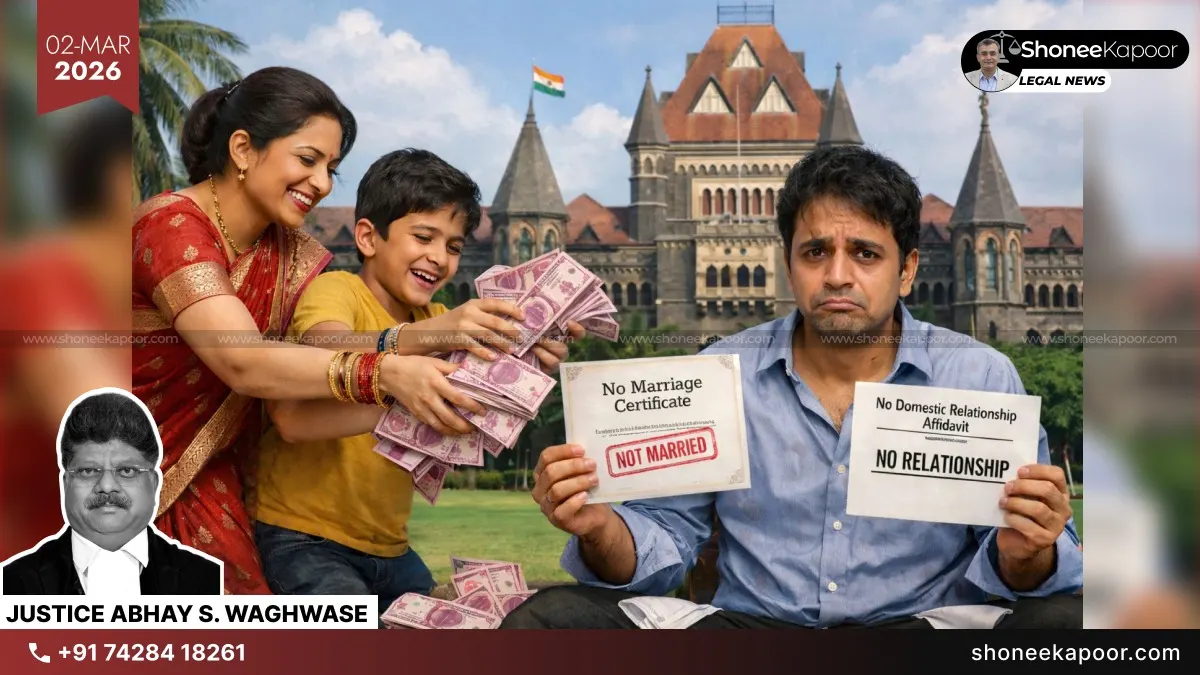
Does “Domestic Relationship” Under Section 2(f) Ensure an Efficacious Maintenance Remedy Without Formal Marriage?
Bombay High Court held that maintenance can be granted even without formal proof of marriage, as cohabitation alone may create financial liability for husbands.
AURANGABAD: In a judgment delivered on 16 February 2026, Justice Abhay S. Waghwase of the Bombay High Court, Aurangabad Bench, dismissed two criminal revision applications arising from a maintenance dispute under the Protection of Women from Domestic Violence Act, 2005.
The case revolved around a husband challenging the grant and enhancement of maintenance ordered in favour of a woman who claimed to be in a marital relationship with him.
The dispute began when the woman filed proceedings under Section 12 of the DV Act, alleging that she had performed a temple marriage with the man in 2007 and later faced cruelty and neglect. She sought monetary relief for herself and her son. The Judicial Magistrate First Class partly allowed her claim and granted ₹3,000 per month each to the woman and the child. On appeal, the Sessions Court enhanced the amount to ₹6,000 per month each.
The husband challenged this enhancement before the High Court, arguing that there was no legally valid marriage and questioning the existence of a domestic relationship. However, the High Court examined the scope of its revisional powers under Section 397 of the Criminal Procedure Code.
Justice Waghwase clearly explained the limited role of a revisional court, stating:
“Section 397 of the Code vests the court with the power to call for and examine the records of an inferior court for the purposes of satisfying itself as to the legality and regularity of any proceedings or order made in a case.”
He further clarified: “The object of this provision is to set right a patent defect or an error of jurisdiction or law.”
Emphasising restraint, the Court added:
“If one looks into the various judgments of this Court, it emerges that the revisional jurisdiction can be invoked where the decisions under challenge are grossly erroneous, there is no compliance with the provisions of law, the finding recorded is based on no evidence, material evidence is ignored or judicial discretion is exercised arbitrarily or perversely.”
After reviewing the record, the Court found no glaring error or illegality in the appellate court’s decision to enhance maintenance. Since no miscarriage of justice was demonstrated, both revision applications were dismissed. The High Court, however, granted the husband six weeks’ continuation of interim relief to allow him to approach the Supreme Court.
This ruling reinforces a critical legal principle: revision is not a second appeal. For men facing maintenance disputes, it underlines the importance of presenting strong evidence at the trial stage itself, as higher courts will not routinely reopen factual findings unless there is a clear legal violation.
Explanatory Table: Laws And Sections Involved
| Law / Section | Purpose | How Applied in This Case |
| Protection of Women from Domestic Violence Act, 2005 – Section 12 | Allows an aggrieved woman to approach the Magistrate seeking relief like protection, residence, and maintenance | Wife filed an application claiming a domestic relationship and sought maintenance and other reliefs |
| Protection of Women from Domestic Violence Act, 2005 – Section 2(a) | Defines who is an “aggrieved person” under the Act | The central issue was whether parties had lived together in a relationship in the nature of marriage |
| Protection of Women from Domestic Violence Act, 2005 – Section 2(f) | Defines “domestic relationship” as persons who live or have lived together in a shared household | Husband challenged the applicability of this definition to himself |
| Protection of Women from Domestic Violence Act, 2005 – Section 2(q) | Defines “respondent” as a male adult person in a domestic relationship | Wife filed application claiming a domestic relationship and sought maintenance and other reliefs |
| Criminal Procedure Code, 1973 – Section 397 | Husband invoked this provision to challenge the enhancement of maintenance | Mentioned in comparison to show broader relief available under the DV Act |
| Criminal Procedure Code, 1973 – Section 125 (referred in case law context) | Provides maintenance remedy to wife, children, and parents | Governs the admissibility of electronic evidence |
| Indian Evidence Act, 1872 – Section 65B | Wife produced electronic evidence but lacked proper certification under this section. | Wife produced electronic evidence but lacked proper certification under this section |
Case Details
- Case Title: Applicant Vs Respondents
- Case No.: Criminal Revision Application No. 101 of 2021, With Criminal Revision Application No. 103 of 2021
- Court: High Court of Judicature at Bombay, Bench at Aurangabad
- Bench: Hon’ble Justice Abhay S. Waghwase
- Neutral Citation: 2026:BHC-AUG:6648
- Dates:
- Judgment Reserved on: 09 February 2026
- Judgment Pronounced on: 16 February 2026
- Counsels:
- For Applicant (Husband): Mr. Bhushan S. Dhawale
- For Respondent No.1 (Wife) and Respondent No.2 (Son): Mr. S.R. Bodade.
Key Takeaways
- Revisional jurisdiction under Section 397 CrPC is extremely limited; the High Court will not re-examine facts unless there is clear illegality, perversity, or jurisdictional error.
- In DV Act cases, strict proof of a legally valid marriage is not always necessary; courts may rely on evidence suggesting a “relationship in the nature of marriage.”
- Once trial and appellate courts appreciate evidence and record findings, it becomes very difficult for husbands to overturn maintenance orders in revision.
- Electronic and documentary records, even if disputed, can significantly influence findings if not effectively challenged at the trial stage.
- Men must contest facts, evidence, and relationship claims aggressively at the earliest stage, as higher courts rarely interfere later.
This Could Change Your Case-Get FREE Legal Advice-Click Here!
Disclaimer: The views and opinions expressed in this article are those of the Indian courts and do not necessarily reflect the official policy or position of “ShoneeKapoor.com” or its affiliates. This article is intended for informational and educational purposes only. The content provided is not legal advice, and viewers should not act upon this information without seeking professional counsel. Viewer discretion is advised.
