
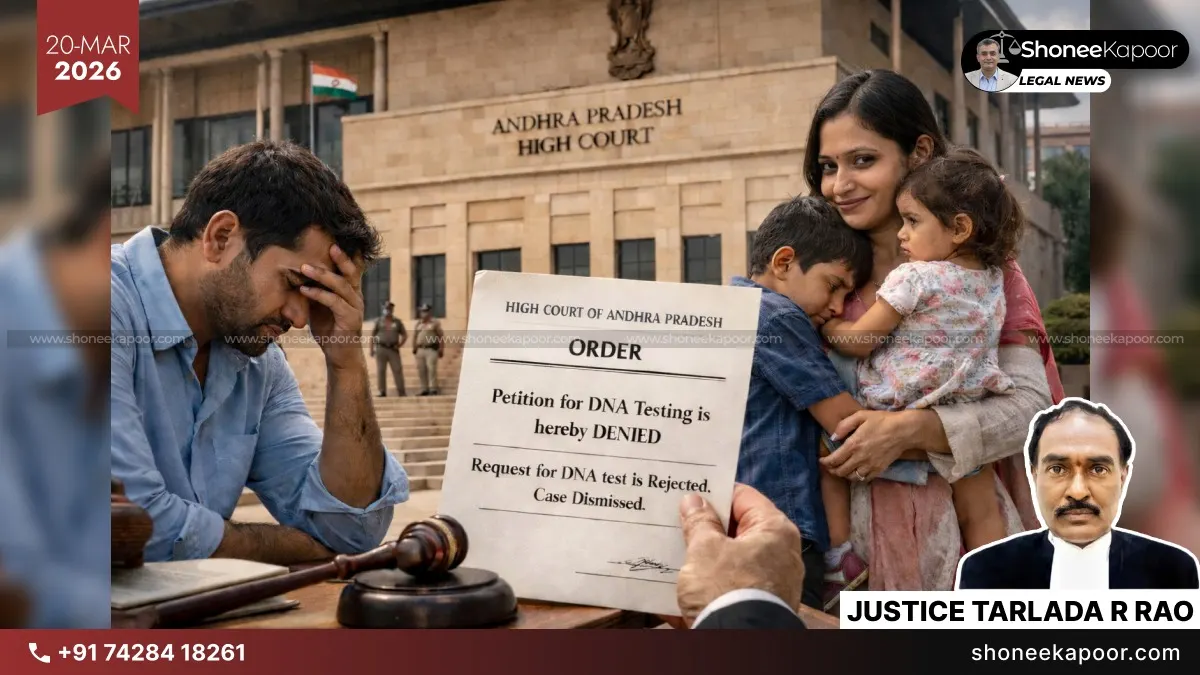
The Andhra Pradesh High Court held that the children cannot be sent for DNA testing merely to support allegations against the wife in a matrimonial dispute, as the child’s dignity and welfare come first.
If the law closes the door on the most direct method of verification, how is a husband expected to prove doubt without being left legally helpless?
Divorce Case: In a recent judgment, Justice Tarlada Rajasekhar Rao of the Andhra Pradesh High Court dismissed a husband’s plea seeking DNA testing of his children in a matrimonial dispute, highlighting how men often struggle to prove their claims while being legally restricted in the kind of evidence they can present.
The husband had approached the Court challenging a lower court order which denied his request to conduct DNA tests on his children. He wanted to establish that the children were not born out of his marriage and to support his allegations against his wife. However, the trial court had already refused this request, noting the serious social and emotional consequences such tests can have on children.
Before the High Court, the husband argued that DNA testing is a scientific method to uncover the truth and that denying it would deprive him of crucial evidence. He also claimed that the right to privacy should be balanced with the need for justice, especially when paternity itself is under question.
However, the Court relied on settled legal principles and previous Supreme Court judgments to reject this argument. It emphasized that ordering DNA tests is not a routine matter and should be handled with extreme caution. Referring to precedent, the Court reiterated that children should not be dragged into disputes between parents.
The judgment clearly stated:
“The use of DNA test is an extremely delicate and sensitive aspect and the Court must be reluctant in the use of such scientific advances and tools which result in invasion of right to privacy of an individual and may not only be prejudicial to the rights of the parties, but may have devastating effect on the child and sometimes the result of such scientific test may bastardise an innocent child even though his mother and her spouse were living together during the time of conception.”
The Court also reinforced the long-standing legal position protecting children born during marriage, stating that such children are presumed legitimate and this presumption cannot be easily challenged without strong reasons.
Addressing the husband’s argument about fair trial, the Court acknowledged that while every party has a right to present the best evidence, this right is not absolute. It cannot override the rights of a third party, especially a child who is not even directly involved in the dispute.
The Court quoted:
“Argument is attractive as it may seem at first blush, the said argument does not carry any legal weight. The lis in these cases is between the parties to a marriage. The lis is not between one of the parties to the marriage and the child whose paternity is questioned. To enable one of the parties to the marriage to have the benefit of fair trial, the Court cannot sacrifice the rights and best interests of a third party to the lis, namely, the child.”
The Court noted that even if allegations of adultery exist, the husband cannot use DNA testing of children as a shortcut to prove it. Instead, he must bring other forms of evidence.
This case once again brings forward the vulnerability of husbands in matrimonial litigation, where serious allegations can be made, but proving them becomes legally restricted. While the law aims to protect children, it also raises concerns about how men can effectively defend themselves when access to key scientific evidence is denied.
Finally, the High Court dismissed the petition and imposed a cost of Rs. 3,000 on the husband, making it clear that such requests cannot be entertained without strong and exceptional grounds.
Explanatory Table: Laws And Sections Involved
| Law / Section | Explanation (Simple Terms) | Role in This Case |
| Article 227 of the Constitution of India | Gives High Courts power to supervise lower courts | Husband used this to challenge lower court’s refusal |
| Section 45, Indian Evidence Act, 1872 | Allows expert opinion (like DNA tests) to be used as evidence | Husband filed application seeking DNA test under this |
| Section 112, Indian Evidence Act, 1872 | Presumes that a child born during marriage is legitimate | Court relied on this to protect children’s legitimacy |
| Hindu Marriage Act, 1955 (Divorce Petition Context) | Governs matrimonial disputes like divorce | Original case was a divorce dispute between husband and wife |
| Supreme Court Precedent: Goutam Kundu v. State of West Bengal | Says DNA/blood tests should not be ordered routinely | Used to deny DNA test request |
| Supreme Court Precedent: Aparna Ajinkya Firodia v. Ajinkya Arun Firodia (2024) | Protects child’s identity and rights over parental disputes | Strongly relied upon by Court |
| Supreme Court Precedent: R. Rajendran v. Kamar Nisha (2025) | DNA testing is sensitive and impacts privacy | Reinforced caution in ordering DNA tests |
| Sahara India Real Estate Corp. v. SEBI (2012) | Discusses balance between privacy and fair trial | Court rejected husband’s argument using this case |
Case Details
- Case Title: X Vs. Y
- Case No.: Civil Revision Petition No. 3393 of 2025
- Court: High Court of Andhra Pradesh at Amaravati
- Bench: Hon’ble Sri Justice Tarlada Rajasekhar Rao
- Date of Judgment: 12 March 2026
- Counsels:
- For Petitioner: M.M.M. Krishna Sanapala
- For Respondent: Arrabolu Sai Naveen
Key Takeaways
- A man can raise serious doubts about paternity, yet still be denied access to the most direct form of proof.
- The legal system prioritizes the child’s identity and social standing, even if it limits a father’s ability to establish the truth.
- Allegations against a wife must be proven through indirect evidence, making the burden on men significantly higher.
- Scientific and forensic tools exist, but their use is heavily restricted when it comes to protecting family structures.
- In matrimonial disputes, a husband’s right to defend himself often comes secondary to broader social and legal considerations.
This Could Change Your Case-Get FREE Legal Advice-Click Here!
Disclaimer: The views and opinions expressed in this article are those of the Indian courts and do not necessarily reflect the official policy or position of “ShoneeKapoor.com” or its affiliates. This article is intended for informational and educational purposes only. The content provided is not legal advice, and viewers should not act upon this information without seeking professional counsel. Viewer discretion is advised.
