
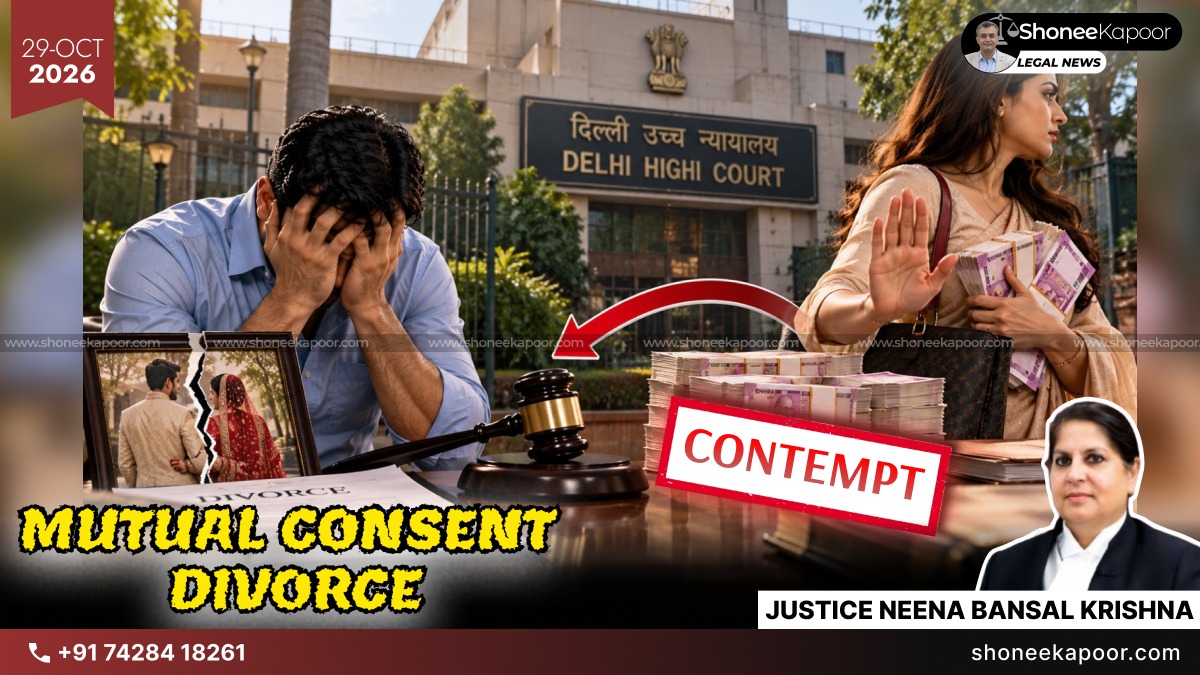
Wife Refuses Mutual Consent Divorce After Taking ₹20 Lakh Settlement? Delhi High Court Holds Her Guilty Of Contempt, Orders Refund To Husband

Curated by NEWS DESK
Editorial DeskNEW DELHI: The Delhi High Court has held a wife guilty of civil contempt for wilfully violating a court-recorded mutual divorce settlement despite receiving ₹20 lakh from her husband. The Court directed her to refund the entire amount within six weeks.
In its order dated 14 October 2026, Justice Neena Bansal Krishna held that the wife had failed to honour her undertaking without providing any satisfactory explanation. The contempt petition was filed by her husband.
The dispute began when the couple signed a mutual divorce settlement on 1 September 2020. Under the agreement, the husband agreed to pay ₹40 lakh, including ₹20 lakh during the first motion and the remaining ₹20 lakh during the second motion.
The Dwarka Family Court allowed the first motion on 22 September 2020, following which the wife received ₹20 lakh.
The couple filed their second motion divorce petition on 29 October 2020. However, disputes arose, and the divorce proceedings could not be completed.
Read Also:- Can Wife Claim Maintenance After Mutual Divorce? Supreme Court Law Explained
The husband subsequently filed an application under Section 26 of the Hindu Marriage Act, 1955, seeking modification of the child's custody arrangements.
According to the husband's petition, the wife had agreed not to claim future maintenance or initiate complaints against him and his family members. Despite this settlement, she filed a maintenance petition, a domestic violence case, and a criminal complaint resulting in an FIR under Sections 406, 498A and 34 IPC.
Consequently, the husband and his family members faced further matrimonial and criminal proceedings.
During counselling, the couple reached another settlement on 10 May 2022. The revised agreement allowed the child to remain with the mother while granting the father visitation rights, holiday stays and telephone contact.
The husband also agreed to contribute towards the child's education and financial needs. The remaining ₹20 lakh was to be paid in connection with the second motion and the quashing of the FIR.
However, the wife failed to complete the second motion divorce proceedings and withdraw her domestic violence complaint as agreed.
The husband approached the Delhi High Court under Sections 10 and 12 of the Contempt of Courts Act, 1971, seeking contempt action and a refund of ₹20 lakh with 2% monthly interest.
Opposing the petition, the wife argued that mutual divorce requires continuing consent until the final decree and that she could not be forced to proceed merely because she had signed a settlement.
She further alleged that the husband had breached the agreement by filing a custody application and claimed that the ₹20 lakh stood forfeited.
The High Court examined whether the wife's refusal was a lawful withdrawal of consent or a wilful breach of a court undertaking.
Referring to Section 2(b) of the Contempt of Courts Act, the Court explained that civil contempt includes:
"Wilful disobedience to any judgment, decree, direction, order, writ or other process of a court or wilful breach of an undertaking given to a court."
The Court noted that the husband had filed his custody application only after the second motion petition was presented. It further recorded that he had honoured the revised settlement by paying ₹3,000 monthly towards the child and bearing the child's entire schooling expenses.
Meanwhile, the wife's maintenance proceedings had resulted in an award of ₹15,000 per month for the child and ₹10,000 per month for herself, effective from 2021, despite her earlier receipt of ₹20 lakh under the divorce settlement.
Referring to Sureshta Devi v. Om Prakash, the High Court reiterated that neither spouse can be compelled to consent to a mutual divorce and that consent must continue until the final decree.
However, the Court distinguished the legal right to withdraw consent from the consequences of deliberately violating a court-recorded settlement after receiving financial benefits.
The High Court also relied on its earlier judgment in Avneesh Sood v. Tithi Sood, which observed:
"The respondent cannot make mockery of the law and mock at the Courts"
In the present case, the High Court found no evidence that the husband had refused to perform his settlement obligations. It also held that his custody application did not amount to wilful disobedience of the settlement terms.
The Court noted that even after the revised settlement, the wife refused to complete the second motion without providing a satisfactory explanation.
During the hearing, she was specifically asked whether she wanted to live with her husband or obtain a divorce. She answered both questions in the negative.
Examining her conduct, the Court observed:
"In view of this conduct, it is evident that the Respondent has resiled wilfully from the Settlement, for which there is no explanation."
The High Court consequently held that the wife's deliberate failure to honour her undertaking amounted to civil contempt. Justice Neena Bansal Krishna directed the wife to refund ₹20 lakh to her husband within six weeks to purge the contempt. However, the Court declined the husband's request for interest.
EXPLANATORY TABLE OF LAWS AND SECTIONS
| Law / Section | What It Means | Relevance In This Case |
|---|---|---|
| Section 2(b), Contempt of Courts Act, 1971 | Defines civil contempt as wilful disobedience of a court order or breach of an undertaking given to a court. | The Court held the wife guilty of wilfully violating her settlement undertaking. |
| Section 10, Contempt of Courts Act, 1971 | Empowers High Courts to punish contempt of subordinate courts. | The husband invoked it for breach of the Family Court settlement. |
| Section 12, Contempt of Courts Act, 1971 | Prescribes punishment for contempt of court. | The husband sought contempt action against the wife. |
| Section 13B(2), Hindu Marriage Act, 1955 | Governs the second motion for divorce by mutual consent. | The wife refused to complete the second motion despite the settlement. |
| Section 26, Hindu Marriage Act, 1955 | Deals with custody, maintenance and education of minor children. | The husband filed an application seeking to modify the child custody arrangements. |
| Section 12, Domestic Violence Act, 2005 | Allows an aggrieved person to seek relief under the Domestic Violence Act. | The wife filed a domestic violence complaint against the husband and his family members. |
| Section 406 IPC | Prescribes punishment for criminal breach of trust. | Included in the FIR arising from the wife's complaint. |
| Section 498A IPC | Deals with cruelty towards a married woman by her husband or his relatives. | Invoked in the criminal case against the husband and his family members. |
| Section 34 IPC | Deals with acts committed by several persons in furtherance of common intention. | Invoked alongside Sections 406 and 498A IPC. |
CASE DETAILS
| Particular | Details |
|---|---|
| Case Title | Manpreet Singh v. Harleen Kaur Khurana |
| Court | Delhi High Court |
| Bench | Justice Neena Bansal Krishna |
| Case Number | CONT.CAS(C) 752/2022 |
| CNR Number | DLHC010274632022 |
| Date of Order | 14 October 2026 |
| Petitioner | Husband |
| Respondent | Wife |
| Counsel for Husband | Mr. Anil Kumar Pruthi and Ms. Rachna, Advocates |
| Counsel for Wife | Mr. Ayush Jain, Mr. Tushar Thakur, Mr. Yahsovardhan Upadhyay, Mr. Vishwas Verma and Mr. Saksham Tungar, Advocates |
| First Motion Case | HMA No. 1248/2020 |
| Second Motion Case | HMA No. 1824/2020 |
| Child Custody Case | HMA No. 63/2021 |
| Maintenance Case | Petition No. 374/2021 |
| Domestic Violence Case | Complaint Case No. 719/2021 |
| Criminal FIR | FIR No. 464/2021, Police Station Hari Nagar |
| Main Legal Issue | Whether wilful breach of a court-recorded mutual divorce settlement after receiving ₹20 lakh amounts to civil contempt. |
| Final Decision | Wife held guilty of civil contempt and directed to refund ₹20 lakh within six weeks. No interest awarded. |
KEY TAKEAWAYS
- Wife Takes ₹20 Lakh, Faces Contempt: Delhi High Court held her guilty of violating the divorce settlement and ordered a full refund.
- Divorce Consent Is Not A Licence To Break Promises: A wife can withdraw consent, but cannot escape the consequences of wilfully breaching a court undertaking.
- ₹20 Lakh Paid, Yet Husband Faced Multiple Cases: Despite receiving settlement money, the wife pursued maintenance, domestic violence and criminal proceedings against him and his family.
- Fighting For Child Custody Is Not Contempt: The Court rejected the wife's claim that the husband's custody application amounted to wilful breach of the settlement.
- Husbands Have Rights, Court Undertakings Have Consequences: A wife cannot wilfully dishonour a court-recorded settlement and expect to retain its financial benefits without legal consequences.
Share Your Thoughts
Comments are moderated before publication.