
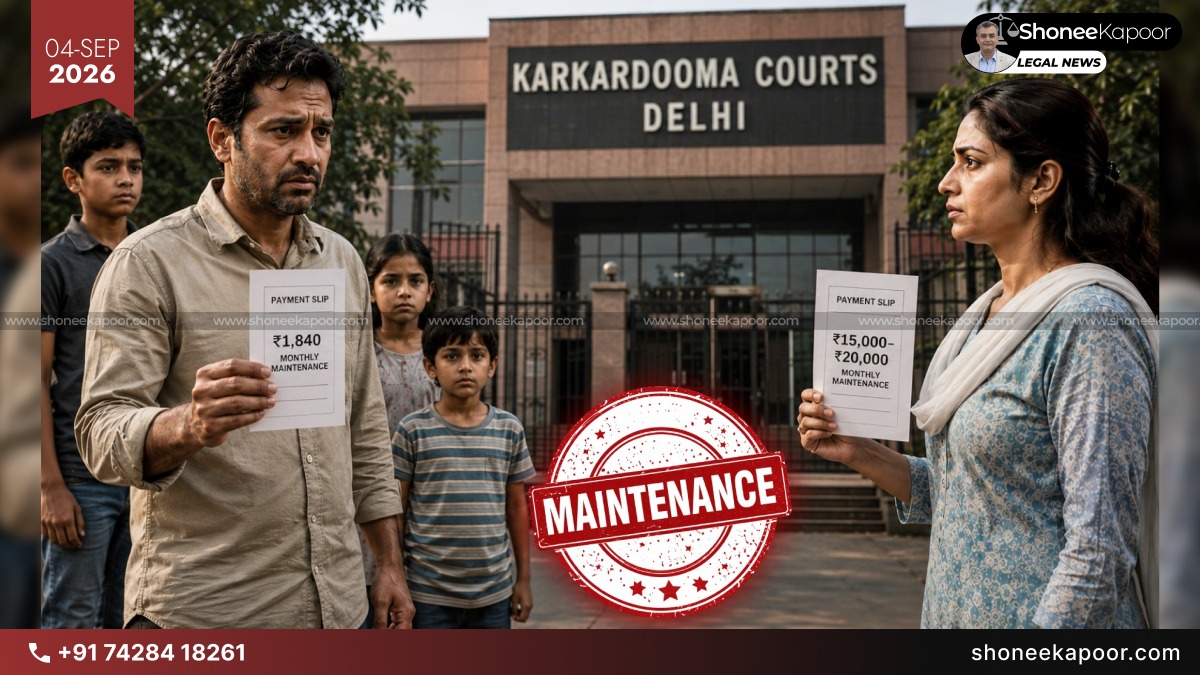
Delhi Court Refuses To Increase Wife’s Maintenance says, “Husband Cannot Be Ordered To Pay Beyond His Means”

Curated by NEWS DESK
Editorial DeskCan a husband earning barely enough for himself and three children be forced to pay ₹15,000–₹20,000 maintenance because ₹1,840 is too little for his wife? A Delhi Sessions Court refused to increase interim maintenance after finding no proof that the husband had the higher income the wife alleged
NEW DELHI: A Delhi Court has dismissed a woman’s appeal seeking higher interim maintenance from her estranged husband and held that a person cannot be ordered to pay maintenance beyond his financial capacity merely because the amount awarded is insufficient for the wife’s needs.
Additional Sessions Judge Parveen Singh was hearing the woman’s challenge against an order granting her ₹1,840 per month as interim maintenance under the Domestic Violence Act.
The woman argued that ₹1,840 was too small an amount for her to survive in Delhi. The Sessions Court accepted that the amount was low, but made it clear that maintenance could not be fixed without considering what the husband actually earned or could reasonably be presumed to earn.
The Court said:
“The court has to keep in mind that the appellant could only be awarded maintenance of income which the respondent no 2 (husband) was having or could be presumed to have.”
The wife claimed that her husband owned a medical store and also earned rent from agricultural and commercial properties. However, no documents were produced to prove these claims or establish his alleged higher monthly income.
Because there was no reliable proof of his actual earnings, the Magistrate Court assessed the husband’s income on the basis of the minimum wages applicable in Uttar Pradesh, where he was residing. The minimum wage for an unskilled worker at the relevant time was around ₹11,021 per month.
The Trial Court then followed the principles laid down by the Delhi High Court in Annurita Vohra v. Sandeep Vohra and divided the availauble income among the family members while calculating maintenance.
The woman claimed that she was illiterate, had no independent source of income and that her family had spent more than ₹10 lakh on the marriage besides giving household articles and jewellery. She argued that her husband could pay ₹15,000 to ₹20,000 per month.
The husband, on the other hand, stated that he worked as a helper/salesman at a medical store and earned only ₹8,000 per month. He also had to support himself and the couple’s three children.
The Sessions Court considered his financial position and existing family responsibilities. It described him as belonging to the “poor strata of society” and observed that he could not be directed to pay money beyond his means.
The Court said:
“The respondent no 2 (husband) belongs to poor strata of society. That being the case, he cannot be ordered to pay beyond his means even though the amount awarded is insufficient. Thus, I do not find any fault in the maintenance awarded to the appellant.”
The Court therefore upheld the ₹1,840 monthly interim maintenance and dismissed the woman’s appeal.
EXPLANATORY TABLE OF LAWS AND SECTIONS
| Law / Provision | What It Means | Relevance In This Case |
|---|---|---|
| Protection of Women from Domestic Violence Act, 2005 | The Act allows an aggrieved woman to seek various reliefs, including monetary relief in appropriate cases. | The wife was receiving ₹1,840 per month as interim maintenance under the DV Act and sought an increase in that amount. |
| Section 20, Protection of Women from Domestic Violence Act, 2005 | Provides for monetary relief to meet expenses and losses suffered because of domestic violence, including maintenance for the aggrieved person and children. | This is the substantive DV Act provision ordinarily governing monetary relief/maintenance. The news report, however, only identifies the DV Act generally and does not expressly state the section invoked in the order. |
| Annurita Vohra v. Sandeep Vohra | Delhi High Court precedent on assessing and apportioning family income for maintenance. | The Trial Court followed its principles while dividing the husband’s assessed income among family members for determining maintenance. |
| Minimum-Wage-Based Income Assessment | Where reliable evidence of actual income is unavailable, courts may have to assess earning capacity from available material, including applicable minimum wages depending on the facts. | With no proof of the higher income alleged against the husband, the court assessed his income using the applicable Uttar Pradesh minimum wage of about ₹11,021 per month. |
CASE DETAILS
| Particular | Details |
|---|---|
| Case Title | Wife v. Husband |
| Court | Delhi Sessions Court |
| Date of Order | September 1, 2026 |
| Bench/Judge | Additional Sessions Judge Parveen Singh |
| Proceeding | Appeal against interim maintenance awarded under the Domestic Violence Act |
| Interim Maintenance | ₹1,840 per month |
| Income Claimed By Husband | ₹8,000 per month |
| Result | Wife’s appeal dismissed; ₹1,840 interim maintenance upheld |
KEY TAKEAWAYS
- A husband cannot be forced to pay maintenance from income he does not have.
- The wife alleged higher earnings, business and property income, but could not produce documents to prove it.
- Even though ₹1,840 maintenance was low, the Court refused to create an unrealistic financial burden on a man earning at the lower end of the income scale.
- The husband was also maintaining himself and three children, a responsibility the Court could not simply ignore.
- Maintenance is meant to provide support, not to punish a husband by fixing an amount beyond his proved financial capacity.
Share Your Thoughts
Comments are moderated before publication.