
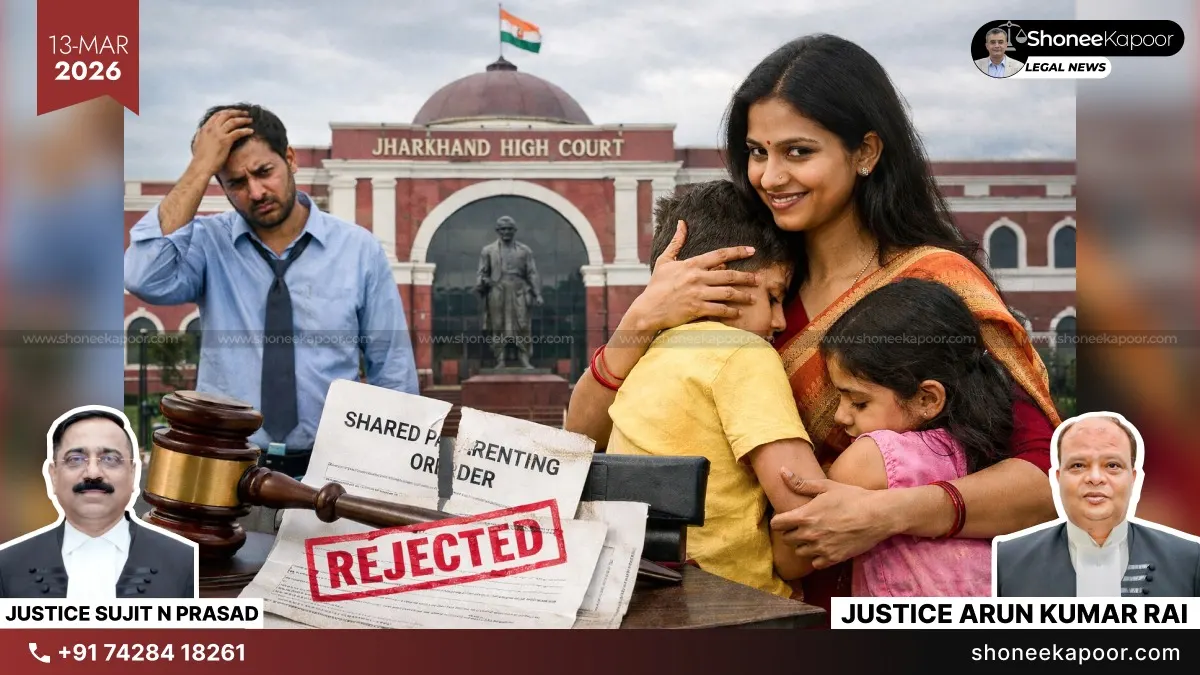
The Jharkhand High Court set aside the Family Court’s shared parenting arrangement and granted the father only visitation rights, leaving him sidelined from his children’s lives during the dispute.
Child Custody: The Jharkhand High Court, in a judgment delivered by a Division Bench of Justice Sujit Narayan Prasad and Justice Arun Kumar Rai, examined a matrimonial dispute involving divorce and child custody where a husband had approached the Family Court seeking dissolution of marriage under Section 13(1)(i-a) of the Hindu Marriage Act alleging cruelty by his wife. The marriage had taken place on 26 June 2011 according to Hindu rites, and two children were born from the marriage in 2012 and 2017.
The husband alleged that the matrimonial relationship had become deeply strained due to frequent quarrels, abuse, and hostile behaviour from the wife, which made it impossible for him to continue the marriage peacefully. However, the Family Court dismissed the divorce petition, and the High Court also upheld that decision after observing that the husband had failed to establish cruelty in the manner required under matrimonial law.
The primary dispute before the High Court then centred on the custody of the two minor children. The Family Court had earlier ordered a “shared parenting” arrangement, allowing both parents to share custody responsibilities. The wife challenged this arrangement before the High Court.
While examining the issue, the High Court observed that shared parenting can sometimes be beneficial for maintaining the relationship of children with both parents, but such arrangements are not suitable in every case, particularly where the relationship between the parents is highly strained, and multiple disputes are pending between them.
The Court noted:
“It requires to refer herein that high conflict between parents can negatively impact a child in shared parenting, and courts consider this risk, prioritizing a child’s welfare above all else. The shared parenting may be beneficial but it is not suitable for every family, especially in cases of extreme conflict which is the case herein. Further It is not healthy for a child to move between two homes and a stable, anchored home is the best option in relation to his/her study and other future prospects.”
The Bench emphasized that in child custody matters the rights of the parents cannot override the well-being of the child. It reiterated the settled principle that the welfare of the child is the most important factor for the Court while deciding custody disputes.
The Court clearly stated:
“It is not the welfare of the father, nor the welfare of the mother, that is the paramount consideration for the Court, rather it is the welfare of the minor and of the minor alone which is the paramount consideration.”
Taking these circumstances into account, the High Court concluded that the shared parenting arrangement ordered by the Family Court was not appropriate in a situation where the relationship between the parents had already become highly contentious. The Court therefore set aside the shared parenting arrangement and instead granted visitation rights to the father so that he could maintain contact with his children while ensuring stability in their upbringing.
Despite the ongoing marital conflict and prolonged litigation, the father remained largely separated from the daily lives of his children and struggled to maintain meaningful contact with them. The grant of visitation rights by the Court therefore becomes significant, as it restores at least a limited opportunity for the father to reconnect with his children after being effectively sidelined from their upbringing during the dispute.
Explanatory Table: Laws And Sections Involved
| Law / Section | Purpose | How Applied In This Case |
| Section 13(1)(i-a) Hindu Marriage Act, 1955 | Provides divorce on the ground of cruelty by a spouse | The husband filed a divorce petition alleging cruelty by the wife, but the Court held that the evidence was insufficient to legally establish cruelty |
| Section 9 Hindu Marriage Act, 1955 | Allows a spouse to seek restitution of conjugal rights when the other spouse withdraws from marital life without reasonable cause | Earlier matrimonial litigation between the parties included proceedings under this provision before the divorce dispute arose |
| Section 6 Hindu Minority and Guardianship Act, 1956 | Defines natural guardianship of minor children and regulates custody rights | The husband relied on this provision while seeking custody of the children before the Family Court |
| Section 19(1) Family Courts Act, 1984 | Provides the right to file an appeal against orders passed by a Family Court | Both the husband and wife approached the High Court through appeals challenging the Family Court’s decisions |
| Parens Patriae Jurisdiction | Principle allowing courts to act as guardians for minors and protect their interests | The High Court invoked this principle to emphasize that the welfare of the child is the paramount consideration while deciding custody |
Case Details
- Case Title: ABC v. XYZ
- Court: High Court of Jharkhand at Ranchi
- Neutral Citation: 2025:JHHC:34929-DB
- Case Numbers: F.A. No. 50 of 2023 and F.A. No. 06 of 2023
- Bench: Justice Sujit Narayan Prasad and Justice Arun Kumar Rai
- Dates:
- Judgment Reserved: 30 October 2025
- Judgment Pronounced: 21 November 2025
- Counsels:
- For Appellant: Advocate Rajesh Lala and Advocate Kumar Nishant
- For Respondent: Advocate Niharika Mazumdar
Key Takeaways
- Fathers often struggle to prove cruelty in matrimonial litigation even when they allege continuous hostility and conflict in the marriage.
- In many custody disputes, fathers remain sidelined from their children’s daily lives during prolonged legal battles.
- Courts repeatedly emphasize that the welfare of the child is paramount, yet fathers frequently have to fight extensively just to maintain basic contact with their children.
- Shared parenting may sound ideal in theory, but in high-conflict cases it can collapse, leaving fathers dependent only on limited visitation rights.
- The larger concern remains that fathers must often go through years of litigation simply to preserve a meaningful relationship with their own children.
This Could Change Your Case-Get FREE Legal Advice-Click Here!
Disclaimer: The views and opinions expressed in this article are those of the Indian courts and do not necessarily reflect the official policy or position of “ShoneeKapoor.com” or its affiliates. This article is intended for informational and educational purposes only. The content provided is not legal advice, and viewers should not act upon this information without seeking professional counsel. Viewer discretion is advised.
